Lifelong Learning and Leadership in Healthcare Administration: A Conversation with William Tuttle
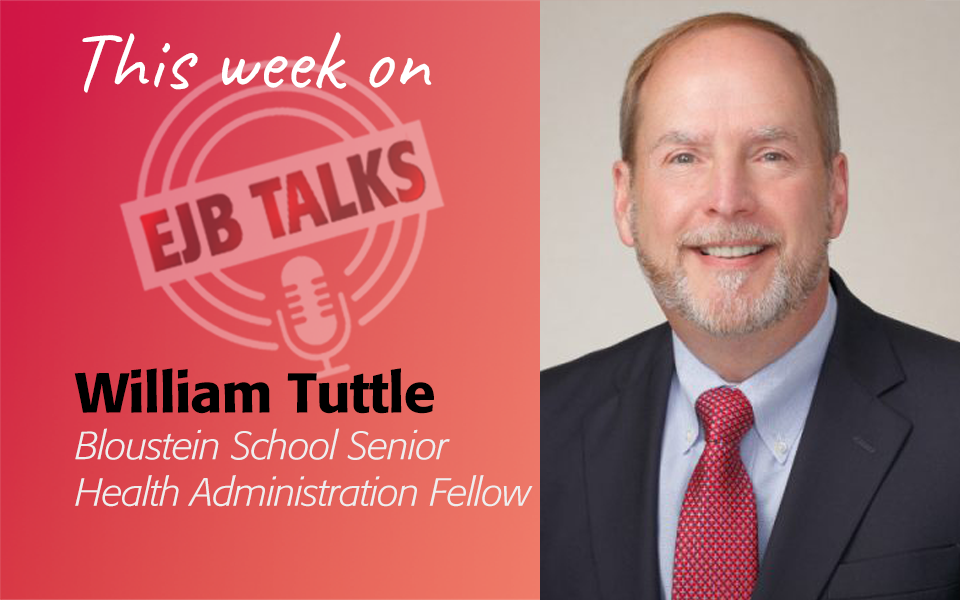
Dean Stuart Shapiro welcomes William Tuttle, a Senior Fellow in the Bloustein School’s Health Administration program, to EJB Talks this week. With nearly four decades of healthcare administrative experience, Bill explains how his journey began with his decision to transition from medicine to hospital management. He discusses his 38 years at Baptist Memorial Hospital in Memphis, where he advanced through multiple roles, from managing service departments to leading a rural hospital and later overseeing physician recruitment and large-scale construction projects. Bill also emphasizes the importance of communication and long-term planning as essential leadership skills, as well as the growing value of the Doctorate in Health Administration (DHA). Highlighting the Bloustein School DHA’s focus on applied research, data analysis, and critical thinking as tools to improve healthcare systems, he describes it as a way for experienced professionals to deepen their academic knowledge, strengthen research and analytical abilities, and open doors to executive or academic roles.
Transcript
Stuart Shapiro
Welcome to EJB Talks. I’m Stuart Shapiro, the Dean of the Bloustein School. And the purpose of this podcast is to highlight the work of my colleagues and our alumni in the fields of policy, planning, and health are doing to make the world a better place. Today we have as our guest, one of our senior fellows in our fast-rising Health Administration program, Doctor William Tuttle. Welcome to the podcast, Bill.
William Tuttle
Thank you, Dean Shapiro. I’m honored to be with you!
Stuart Shapiro
Well, as longtime listeners know, we almost always start with an origin story. So, tell us how you got into healthcare.
William Tuttle
Yeah, it’s interesting, I guess. My dad was a physician. He was a pediatric hematologist here in Memphis and taught hematology at the University of Tennessee School of Medicine. Unfortunately, he died at a young age and I was a teenager, a young teenager at the time. But you know, I thought I wanted to be a physician like my dad. And so, I started off undergraduate as a biology major. And took a course in organic chemistry.
Stuart Shapiro
((laughing))
William Tuttle
And that put an end to my desires to go to med school. And so, I started looking around to what else is out there.
And ended up talking with the individual who taught my dad anatomy in med school. He had then started off, he was a Dean of the School of Medicine, and so I’ve visited with him. He befriended me after my father’s passing. And we heard about and talked about healthcare administration. And he put me in touch with the then-CEO of Baptist Memorial Hospital in Memphis, Dr. Frank Groner. And after I talked to Doctor Groner, I said that’s it. I want to be in healthcare administration.
Stuart Shapiro
That’s great. I took organic chemistry when I was a college sophomore, so I know what you’re talking about. There are many, many a medical career…I was did not want to be a doctor, but I know many, many a medical career ran aground on organic chemistry.
William Tuttle
We did not like each other one bit!
Stuart Shapiro
((laughing)) So tell us a little bit about your career down there at the hospital in Tennessee. And sort of the highlights and the lessons you’ve learned from that experience.
William Tuttle
Well, I was blessed to be with that organization for about 38 years. And the hospital, a little unique maybe for this part of the country, it was over 2000 beds. It was one of the largest private hospitals in the country. And so, when I tell people or tell students, I share with students, I was with one organization for 38 years. That, in today’s world, is sort of unheard of, in any career.
Stuart Shapiro
Absolutely.
William Tuttle
But I was very fortunate in that I had, like, multiple careers with one organization. For instance, I started off, after doing my administrative residency, working with service departments—dietary, environmental services, plant operations, security, and others. And it was really through working with those departments that I had a great appreciation that all jobs in healthcare are important. You hear a lot about the clinical jobs and they’re very important. But developing the ability to communicate and work with the service departments…
Stuart Shapiro
Mmm hmm.
William Tuttle
…really, really helped me develop some great communication skills, and to have an appreciation for the broad spectrum of jobs in healthcare. So, I did that for about 10-12 years, and I was asked to go and serve as CEO of a small rural hospital in Mississippi. I’d never lived in a rural community, Memphis had always been my home. I was married at the time, two small children. But I had that position for three years, and one in particular event hit home with me on why a rural hospital is so important.
Stuart Shapiro
Mmm hmm.
William Tuttle
One Sunday night I get a call that seven teenagers who piled into a car–two in the front, three in the back seat, two in the trunk.
Stuart Shapiro
Oh my God.
William Tuttle
Were leaving church in a in a small community close to where I was, and they had an accident. And they were all brought to our little emergency room. And I can assure you some of those young people would never have survived without that emergency room. So, I’d grown really interested and appreciate the care and the necessity of a rural hospital. And you read about, here in the literature, on average, one or two hospitals in this nation closing, you know, every month.
Stuart Shapiro
Right.
William Tuttle
Many of them in rural communities.
Stuart Shapiro
Yep.
William Tuttle
And I did that for about 3 1/2 years, and then the Baptist people called me and wanted me to come up and join their corporate administrative staff. And I was able to help establish the, what was called the Baptist Medical Group. I recruited physicians to that and sort of put the foundation in place. And also oversaw many large hospital construction projects. And so, the two sort of skills or things that I sort of took away from that is, you know, communication skills with physicians in particular. You have to have those skills. You know, I again, been with an organization 38 years.
Stuart Shapiro
Mmm hmm.
William Tuttle
There’s one thing I never did and would never have done, and that’s admit a patient. And you have to be able to work with physicians. The other thing on construction projects. Learn the importance of long-term planning.
Stuart Shapiro
Mmm hmm.
William Tuttle
You don’t go out and spend $300, $280 million on a new hospital without thinking it through and making sure there’s a need. So within my 38 years with Baptist, I had some, at least three, maybe 4 different careers.
Stuart Shapiro
And communications and long-term planning are the two skills you say are absolutely essential there.
William Tuttle
Absolutely. I was visiting with a very prominent successful healthcare executive a week or so ago. And I was asking him about what is he seeing with young graduates coming out? And he said, you know, gave some nice compliments. But he said the number one issue that he sees is an issue with good communication skills.
Stuart Shapiro
That’s great to hear. So, I might want to come back that, but I also want to sort of, touch on the fact that Bloustein now has a brand spanking new Doctorate in Health Administration program. And we have been stunned by the interest in it. The first class just came in. There’s 24 students there, which was far more than we imagined.
And you have a doctorate in health leadership. And so, which is, I suspect, similar. And so, if you could sort of explain to our listeners, what does one get out of a DHA? is it those skills you just talked about? Is it something more. What do we want to see? If a student is looking at a DHA, what should they be looking at?
William Tuttle
Okay well, basically, I think most healthcare executives are committed to life-long learning. And there are opportunities to do that say, mainly College of Healthcare Executives, the Medical Group Management Association and others. But the idea now of a DHA, a terminal degree, is really relatively new. And Rutgers is on the cutting edge with that program. And so, it provides an opportunity for “practitioners,” quote unquote, to strengthen their academic background and credentials by way of a formal degree. You know, it will build upon skills that you have, but it’s going to dive deeper into various subjects like healthcare policy or finance. And one of the biggest takeaways that I think that the students will appreciate is the ability to conduct and participate in research.
Stuart Shapiro
Mmm hmm.
William Tuttle
They’re going to develop strong research skills and they have a project to research and develop for graduation. And so, I think it’s really a combination of building upon which you’ve been exposed to, but also developing new competencies, in particular, in research.
Stuart Shapiro
Can you give me an example, and you can talk about your own work when you got your doctorate, but can you give me some examples of things that a DHA student might research?
William Tuttle
Sure, sure. For instance, it can be…well, let me back up. Let me… because I was new to this whole idea of research and I had it explained to me, and I looked into it. Within the academic world, there’s theoretical research, and then applied research. And the theoretical research is, you know, why does the apple fall from the tree? Or something like that. But the applied research is taking issues that are in everyday life, researching them, and then looking at ways to improvement.
So students will have the opportunity to look at an area, whether it’s at where they’re employed, or it could doesn’t have to be where they’re employed, but it’s going to be a real research issue and applied issue. You know turnover, position, turnover or whatever it could be and then delve into it and apply strong research processes and analytical thinking to then present it back to the faculty.
Stuart Shapiro
So learning how to do that research. And that includes research methodology, presumably includes things like, understanding how to run a regression maybe. And understanding statistics. Maybe understanding how to do qualitative work like, interviewing and focus group. Are those all pieces of things that a DHA student gets?
William Tuttle
Absolutely. And you know, using using tools like SPSS, you know statistical packages that help you run that data analysis. You know, I had a professor in graduate school, and I’m talking back in 1982, who taught us statistics. And I don’t think he originated this comment, but it stuck with me. He said in healthcare we are choking on data, but starving for information.
Stuart Shapiro
Mmm hmm.
William Tuttle
And in in today’s world, I think that’s even more applicable.
Stuart Shapiro
Yep.
William Tuttle
How do we turn data into information that we can then improve healthcare?
Stuart Shapiro
And you’re absolutely right. There is… and I don’t know the healthcare sector in particular all that well, but in most sectors there is just so much more data now, right? It’s all you… cannot escape the prevalence of data.
William Tuttle
Mmm hmm.
Stuart Shapiro
But understanding it and knowing what to do with it is something else entirely.
William Tuttle
Absolutely.
Stuart Shapiro
So what types of positions do DHA students generally look at coming out of a program that they couldn’t have gotten with just an undergraduate degree, or even with just a master’s degree, which we also offer?
William Tuttle
Sure. Well, the students are successful already within their own calling. What they are doing now. This will allow them to potentially go into even a higher-level senior role. Such as a CEO role. May allow them to go into policy at the government level.
Stuart Shapiro
Mmm hmm.
William Tuttle
The other thing that was really important to me, it was getting involved in higher academia.
Stuart Shapiro
Mmm hmm.
William Tuttle
Wanting to teach.
Stuart Shapiro
Right.
William Tuttle
And my interest in teaching is really driven by a desire to give back to the profession. And so, the DHA is a terminal degree recognized in the world of academia. And that will help them as they pursue their academic opportunities, whether it be teaching or into, even, academic administration.
Stuart Shapiro
Right. That’s interesting. And of course, our DHA students have, and I’m biased of course, but have the benefit of being in a school where there is public policy. So if they’re interested in health policy, there are opportunities to expand their knowledge there, beyond what a traditional DHA might offer. And we also have a lot of professors who are public health experts, and I would imagine there is probably some overlap there that they could take advantage of.
William Tuttle
Well, and they’ll pick up skills that you know, that…when I was going through my degree program, I thought if I survive—and if I never look at a statistical issue ever again I’m happy…
Stuart Shapiro
((laughing)))
William Tuttle
But here I am doing research right now on an issue that is very important to me and back at, looking at, you know T tests…
Stuart Shapiro
Uh huh!
William Tuttle
…and all the other skills that you pick up by going through a DHA program.
Stuart Shapiro
Yeah. And I’ve always said that even if you don’t use the specific statistics, the T tests as you mentioned, taking statistics tells you how to yhink about the eorld. And that’s a lesson that is invaluable.
William Tuttle
Well, I’m glad you say that because you know, people ask me. The big take away about getting a DHA or your doctorate? And I tell folks, I read things differently.
Stuart Shapiro
Right.
William Tuttle
I go to conferences and I listen and I’m much more critical in reading an article or listening to a presentation and questioning the data and questioning the logic. And those skill sets you’ll pick up through the DHA program.
Stuart Shapiro
Excellent. I think that’s a fantastic note to end on. Bill, thank you so much for coming on and sharing your experiences.
William Tuttle
Thank you, Dean! I appreciate the opportunity.
Stuart Shapiro
Thanks also to Tamara Swedberg and Karyn Olsen who make this podcast happen. We’ll be back in another week or two with another episode from experts from the Bloustein School. Until then, stay safe.