
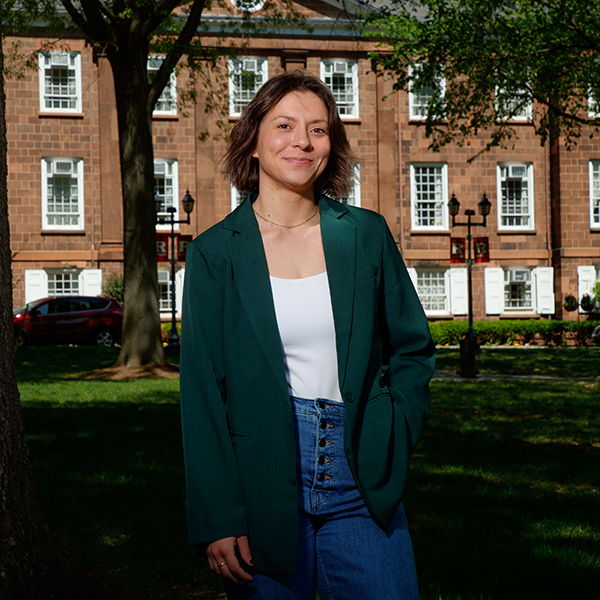
Rebecca Levitsky
Master of City and Regional Planning, Class of 2025
Concentration: Transportation Policy and Planning
Hometown: Levittown, PA
Activities at Rutgers: Research Assistant, Alan M. Voorhees Transportation Center, Outreach Coordinator, Bloustein Enthusiasts and Advocates for Transportation (BEAT), Student Grader
Rebecca Levitsky was exposed to urban planning through a favorite undergraduate professor at Temple University. But it really began with a place: specifically, Levittown, Pennsylvania, one of America’s first planned suburbs, which offered her a firsthand look at how design decisions shape lives.
“Telling people I’m from Levittown usually saves me from a long-winded explanation as to how I became interested in the field,” she said with a smile. “Growing up in, quite literally, the blueprint of a suburb exposed me to the simple fact that our communities don’t often look the way they do by chance. They were planned that way. Once I realized this, I became interested in the mechanisms that influenced those decisions.”
In Levittown, cars were the only way to get around, and everything felt far away. Going to an urban setting for college was transformative. “I realized two things very quickly: that I was much freer being able to walk, bike, and ride transit than I was before, and that the places I now lived had a much stronger sense of community. I witnessed how thoughtful transportation planning can encourage density, diversity, and community, and I wanted to be a part of that process.”
Before applying to graduate school, Rebecca knew she wanted to focus on transportation policy and planning. The same undergraduate professor who introduced her to urban planning became her neighbor in West Philadelphia. “She quickly became my go-to resource when considering master’s programs, and she nudged me toward Bloustein because of the quality of the faculty and the impact of their research on real-world, policy-focused planning issues.”
For Rebecca, Bloustein stood out among planning schools because of its focus on public policy. “Planning programs are typically situated in either Schools of Architecture/Design/Arts or Schools of Public Policy. During my research and discussions with graduate students, I began to notice how these respective focuses impacted the courses that were offered and the research direction of the faculty,” she said.
“I am committed to working in the public sector. I wanted a graduate program that focused on the political and social aspects of planning work—in other words, a program that encourages students to leverage skills gained for the public good,” she continued. “Bloustein has been everything I’ve hoped for and more.”
Among the faculty, Professor Will Payne stood out as being approachable, supportive, and genuinely invested in the growth of students. “Professor Payne was incredible at demonstrating how spatial data and analytical tools should be used responsibly alongside qualitative data,” she recalled. After taking two of his GIS courses, Rebecca genuinely feels equipped to use these tools to find and communicate data responsibly in her day-to-day work.
Rebecca also worked as a research assistant at the Voorhees Transportation Center (VTC), gaining exposure to real-time transportation policy in New Jersey. “The experience I gained at VTC will stay with me throughout my entire planning career. It gave me the opportunity to dig further into topics and policies I had covered briefly in courses, such as complete streets projects and transportation funding regulations.”
“I also got the opportunity to work long-term on a research report on trail funding and development in New Jersey,” and was fortunate to gain additional experience presenting this research at several conferences, including the New Jersey Bike and Walk Summit and New Jersey TransAction.
“Both were incredible experiences in improving my networking and presentation skills to diverse stakeholders, often much more experienced than myself in these topics,” she noted.
To students considering the Bloustein MCRP program, her advice is clear: “Talk to current students and faculty. Planners are kind people by nature and are always happy to talk about their work. Those conversations gave me such great insight into what to expect from the program.”
She also encourages prospective students to think critically about what they want to get out of their program. “Look at the course offerings to make sure they support your goals. I came to Bloustein specifically looking to build technical planning skills while maintaining a people- and policy-focused approach. Every course I have taken—whether centered on spatial analysis, technical skills, or planning theory—has focused on the real-world impacts of the tools we learn.”
Committed to working in the public sector, Rebecca began working as a Transit Project Coordinator with the City of Philadelphia’s Office of Multimodal Planning right after graduation in May 2025.
“I will be working on complete streets projects with the goal of improving transit service alongside bicycle and pedestrian safety,” she said excitedly. “Primarily, I’ll be working with the City and with SEPTA on prioritizing and improving the rider experience and making sure that everyone can access transit safely.”
“My interest in planning stems from a desire to strengthen the communities where I live and work. I love that I am entering a career where I can serve the public good and work to improve the quality of life of my community members,” she concluded.
Outside of school and work, Rebecca is out exploring her city. “In my free time, you can probably catch me riding my bike or jogging throughout Philadelphia. I love being outside, and really enjoy camping, hiking, and bikepacking in the warmer months.”
She also plays in a co-ed softball league and volunteers with after-school programs with local elementary schools and community development organizations through the team. “It’s strengthened my desire to get involved in my local community through volunteering and supporting Philadelphia neighborhoods in a non-planning capacity.”