Small Wins, Big Impact: On the Front Lines of Local Public Health with Peter Tabbot
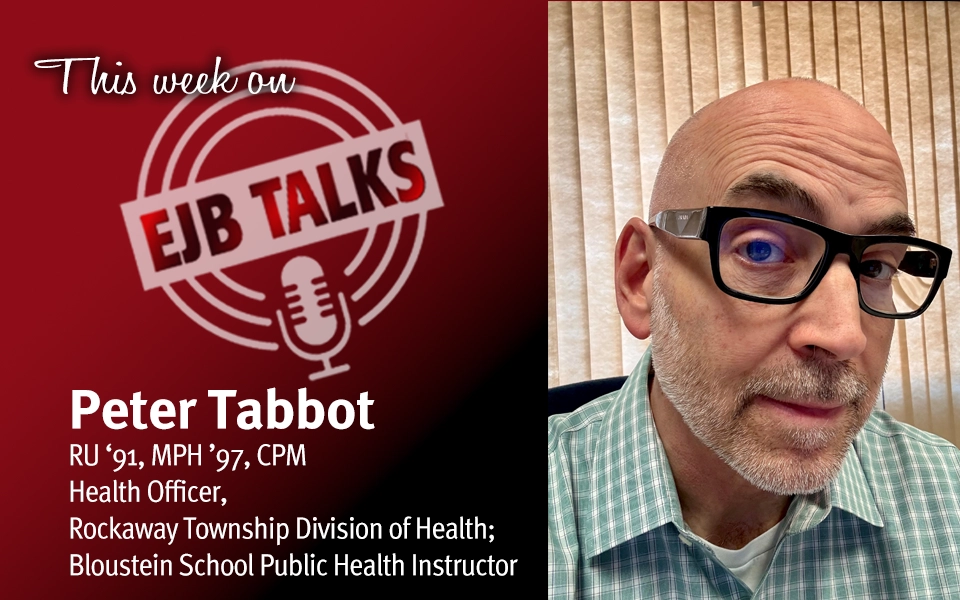
In this episode of EJB Talks, Peter Tabbot ’91 MPH ‘97, CPM, longtime local health officer in Rockaway, NJ and a Bloustein School public health lecturer, shares his path into public health with Dean Stuart Shapiro, and what it means to lead at the community level. He explains the wide-ranging role of health officers, from managing essential services to working with governments and residents. Reflecting on navigating the COVID-19 pandemic, Tabbot calls it both the most challenging and most rewarding period of his career, marked by rapidly changing policies, public resistance, and the need for constant local coordination. He also discusses ongoing challenges, including vaccine hesitancy, funding uncertainties, and growing skepticism toward public health. His message to students and future professionals: envision yourself making a difference in individual’s lives and embrace the “small wins” in improving community health, one person and one municipality at a time.
Transcript
Stuart Shapiro
Welcome to EJB Talks. I am Stuart Shapiro, the dean of the Bloustein School, and the purpose of this podcast is to highlight the work my colleagues and our alumni in the fields of policy, planning and health are doing to make the world a better place. Today, we’re very lucky to have one of our lecturers from our public health program, who is also the health officer for the town of Rockaway, New Jersey. Pete Tabbot, welcome to the podcast.
Peter Tabbot
Thank you so much. Dean Shapiro!
Stuart Shapiro
Well, we always start…. long time listeners know… we always start with an origin story question. So if you could dig back into your past and let us know how you became interested in public health?
Peter Tabbot
Oh, I’d love to. There’s probably two ways to describe it. One would be through osmosis, and the other would be more formally, through undergraduate education. My father was a dentist. Had passed away in 1990, but was a dentist for many years. And my mother worked for municipal government… 27 years.. in land use management. And I think this combination, perhaps, of government service and something in the health field; plus, I know my father consulted to a local Board of Health in the late 70s when I was a child, about fluoridation of drinking water. So I think it was kind of ingrained in me, in a in a way, by what my parents were doing. But probably more directly when I was at Rutgers as an undergraduate, I took a course called Public Health Practice and Administration, which was through the Environmental Science major at the former Cook College at SEBS. And this was a course that eventually I wound up teaching for 17 years.
Stuart Shapiro
Wow.
Peter Tabbot
And going through that course, a great instructor, Joe Soporowski, Sr.– because his son went on and got a PhD at Rutgers also–he had been a health officer, he had been a mayor. He had a PhD in air pollution. And, you know, was kind of a renaissance guy in a lot of ways. And, he had guest lecturers who were subject matter experts. And one of them spoke about Public Health Administration and government and at the local level. And I was completely sold. And I decided then that, I was going to go into governmental public health and that I wanted to be a health officer specifically. Which, you know, back in the late 80s, was kind of in my younger years, but I kind of knew it. I still opted to pursue a degree in journalism, because I love writing. But I did have more credits in environmental science and ecology.
Stuart Shapiro
Gotcha. Gotcha, all right. Well, you mentioned the very focused goal of wanting to become a health officer. That’s probably not terribly typical. Why did you want to be a health officer? And what does a health officer do?
Peter Tabbot
Well, it just appealed to me to be doing something at the local level and to be managing services, a variety of services. So what a health officer does? The simple answer is, a health officer manages local health departments and corresponding services. New Jersey’s local public health system is pretty complex, with several types of local health departments. But all licensed health officers have, for the most part, the same job. The same basic job responsibilities. Which is to say, assuring the delivery of services in five areas: maternal and child health, Administration, environmental health, communicable disease, and adult health services like chronic illnesses. There are nuances, like the type of agency or grant management that may distinguish one health officer’s job from another, but the job is really an amalgam of responsibilities. Which includes managing personnel, assuring compliance with dozens of code statutes and local policies, troubleshooting ridiculous numbers of issues depending upon what’s happening in the world. And hoping to motivate staff, and some of those other things that you wish to do.
But being health officer also means serving as liaison to elected officials, to professionals from government agencies at every level, boards of health, concerned residents, local businesses. And if you’re like me, it’s also including a fair amount of time devoted to professional development and volunteerism with professional associations and advisory committees. And it’s an amazing job. It’s one that I still adore 28 years later and 35 years into this field of work.
Stuart Shapiro
That’s great. Now I know New Jersey has 560 whatever, the number of municipalities are. Does everyone have a health officer?
Peter Tabbot
Nope. We have 565 municipalities thanks to Princeton Borough and Township consolidating a number of years ago.
Stuart Shapiro
((laughing)) Yes!
Peter Tabbot
And there’s about 100 and… we’re told by the state health department there’s 104 health officers. Which means 104 local health departments.
Stuart Shapiro
So some people cover multiple municipalities.
Peter Tabbot
Yeah. Yeah, you know, regionalization, consolidation of services, have been popular to the state legislature and to some local governments for maybe 15 years now. But public health has been doing it since late 70s, with success.
Stuart Shapiro
I see. Well, that’s that’s actually heart heartening, because it… we should be doing that kind of stuff on on the public stage. Now, you were a public health officer through what will be, the defining public health crisis of our our time. Hopefully our… a long time, but certainly the biggest one you or I have lived through, which is the COVID-19 pandemic in 2020-21 in particular,
Peter Tabbot
Oh yeah.
Stuart Shapiro
Can you talk a little bit about, sort of, being a health officer through that?
Peter Tabbot
Sure. And I could talk for eons about that, but I’ll make it very brief. That was definitely the most challenging episode in my career to date. Everything was turned upside down. So it’s interesting sometimes, when I talk to friends or colleagues and they reminisce about limitations during that time. I just want to say, you just really have no idea, unless you were working in public health, like what it meant to have limitations.
But if I had to name just a few of those challenges, I mean, health officers were responsible for implementing all the Governor’s executive orders and the Commissioner of Health’s executive directors. Excuse me, executive directives. For me, it was in five municipalities, a population of about 65,000 residents. But it’s all the commercial establishments, and it’s all the different policies that had to be enforced. And they were changing weekly and even daily, in some cases. For the business community, for the residential communities. And on top of that, you’re dealing with vaccine hesitancy from individuals, non-compliance from some businesses, and even defiance and some confrontation at times. All that said it was, still without question, the most rewarding professional challenge in my career.
Stuart Shapiro
Yeah, that’s great. So you mentioned defiance and vaccine hesitancy. And unfortunately, in my view, and I think in the view of many, the post-pandemic has has brought its own challenges. And they grew largely out of what happened during the pandemic, right? That the defiance against vaccines, that defiance against mask orders, against businesses closing. All of that. Can you talk about the sort of, changes that you’ve seen in the past few years due to these doubts that have come up about public health?
Peter Tabbot
Yeah, absolutely. And you know, some of that obviously has to do with the change of an administration at the federal level, and things that came after COVID. And at the risk of maybe sounding just a bit partisan, it is interesting and sometimes troubling that, public health went from the high visibility and the value of fighting the biggest challenge we’ve seen in 100 years, to doubts and counterintuitive policies emanating sometimes from our very own Department of Health and Human Services.
So, it’s no secret there are some entities or some individuals that don’t necessarily profess or believe some of the same things about, whether it’s vaccination or services that are provided. And it all boils down to budget and to understanding when it comes to public health, regardless of level of government. So some effects of national policies or changes did trickle down to my level, to the local and regional level, like the clawing back of several federal pass-through grants and associated, if temporary, losses. Some of those things were returned. Then again, public health has always had to, and continues to, fight for dedicated funding, especially here in New Jersey, where most of the expenditures for public health come out of local tax dollars. Other states are a little bit different.
Um, so public health officials do have to remind themselves, ourselves, that what we do matters, especially in the face of recent scrutiny. And in some cases, maybe naivety. And I don’t mean that in an insulting way, just a lack of understanding about what happens when you take away critical public health services, or you underfund them or defund them. So, I mean, having said that, I’m very lucky to have a great relationship with the elected officials and professionals with whom I work, and I’ve consistently received strong support at the local and regional level. So some of those changes in attitude, you know, philosophy, or even changes in funding, have had minimal effect on me and my department locally.
Stuart Shapiro
Well, that’s great to hear. You talked about sort of problems coming from above. Have you had to deal with this doubt and defiance coming up from the ground level as well? Obviously, those two are interconnected. People get elected because they mirror those views, and people are affected by elected officials with those views. But, to what degree can you… or can you give us an example of… sort of dealing with these these doubts at the very local level?
Peter Tabbot
Sure. It’s probably best to give just a couple of quick examples at the local level. For one, we had had during the shutdown of retail food establishments, for example. A part of what public health does is to inspect and train food handlers and food establishments. And there were some places that refused to close, even though there were governor’s orders to not open. And so it would be up to me to send my inspectors out, my environmental health specialist, to respond to complaints of places being open. And in some cases, I went out myself. And sometimes there were some hard words exchanged because of a complete disagreement about, what the words of the governor might have meant, or what good public health might mean during the throes of a pandemic.
In another instance, a gymnasium refused to close and was taking people in. And health spas, health clubs, just like any place where people are getting together in close proximity, particularly bad during the height of a pandemic, and that required some significant work with the local court and police just to make sure that we were keeping people safe.
And then some of that vaccine hesitancy and some of the doubt in, you know, believing that there was overstepping of local, state or federal powers, really boiled down to individual opinion. So sometimes I would have to send a patrolman from our local police department with a simple letter written by me asking a resident to please call us and follow up if they were identified during contact tracing during the early stages of the pandemic as being at risk, because they were exposed to someone who was quite sick. So, it really was on a local, local level, like granular as it gets. But some of the trends were, unfortunately, common and had to be dealt with pretty routinely at the time.
Stuart Shapiro
Yeah, that’s difficult, and I assume you’re still dealing with some of that. It’s… you don’t have the measures anymore, but the doubts linger.
Peter Tabbot
Yeah, you know, local public health. One of the things, many things that we do, is we provide vaccinations for childhood preventable diseases. And you may be aware that in some states there are growing trends in people employing philosophical differences to not vaccinate their kids. New Jersey has legitimate religious exemptions and medical exemptions, but not a philosophical exemption. But some people are finding ways, and the rates have gone up. And vaccination rates of… vaccination resistance, I should say. Which means the rates of vaccination have gone down even here in New Jersey. So we have to watch for that herd immunity we strive for and hopefully not see too many people that are choosing not to vaccinate their children. And not just if there is a an infectious emerging disease at the adult ages or at that level.
Stuart Shapiro
So we were we were talking before we started recording. And you’ve been teaching at Bloustein longer than I have! And what do you see in the classroom? How do you… do these doubts creep through into classroom discussions? Or do you have to teach your students how to be ready to be reactive to these kinds of sentiments?
Peter Tabbot
You know, it’s very hard sometimes being in the classroom and wishing to remain objective. And you know, but public health doesn’t always come with subjectivity. Sometimes, you know, it’s hard not to express. Because I’m very passionate about public health, as many practitioners are and instructors are. And when it comes to the classroom, you know it’s important to remind students of a few things.
You know, for one when the current state of things becomes topical to students, I just try to remind them on occasion, just as I remind myself. That it is temporary. That it may be discouraging and hard to see the positives at times, especially when we look at some of the decisions at different levels of government. But this will change. Secondly, I think it’s important to remind students, or anyone with interest, that at a time when there is doubt to funding or philosophical differences that call public health into question. That there’s no better time to be an advocate for public health. There’s no better time to embrace public health. And that’s my enduring message with students, is that we need exactly the type of public health students that Rutgers produces as our next generation of leaders. And to sometimes, you wind up telling students to, perhaps let a less than savory climate fuel their interest and ignite their passion for this field of work. So those are the the enduring messages, if they do come out that I try to leave for students.
Stuart Shapiro
Any other message that you would leave for our listeners who are considering a career or a major in public health?
Peter Tabbot
Oh, absolutely! And thank you so much for this discussion. I really appreciate you having me and thank you for asking that question, in particular. When it comes to students, you know, I guess some of the leading things that I would say or people who are considering a public health major is, try to see yourself making a genuine difference in people’s lives with public health in particular. Regardless of what sub discipline that may interest you: environmental, clinical health, education, administration, epidemiology, whatever it may be. There’s a role for everybody to make some kind of difference in their community.
Um, little victories are so important in public health because, we’re not under the illusion that we’re going to change the world. But if every public health practitioner does a little something and you connect with one person or one group, you’re going to make progress. So, many years ago, probably a year after I became a health director, which was about 28 years ago, I was asked by a senior council member of the local government in the West Essex area to do a presentation for a group called The Old Guard.
To make a long story short, this was about 75 or 80 older gentlemen, and I was talking. A very uplifting conversation for about 10 minutes, talking about some of the leading causes of death and things they should be concerned about at their age and, you know, etc. But also talking about the things we were doing at the local health department, like screenings and clinics and education. So there’s one gentleman…and most people, I was the only thing separating the group from their lunch, which is true, and of course, that’s never a good place to be in. But there was one gentleman in the back of the room who had one of those spiral pocket pads. And he was making notes and looking at me from the back wall, standing up with enthusiasm. And I’m thinking to myself, again, it’s all about little victories. I’m going to connect with this one guy who’s paying attention to me and making notes. And this is the person who’s going to go and get a screening. Or this is the person who’s going to come to our next health promotion program.
And so this goes on for about 10 minutes, and he just looks so engaged. I was very happy that there’s one person that I’m going to be able to connect with. So he comes up to me after I’m done and says, Mr. Tabbot, great presentation. I love what you had to say about about your clinics and screenings and things that we should be concerned about. But I wish to let you know that you said, um, seven times; er, 11 times; and uh, eight times, or something like that. So of course, it was a little deflating and also amusing. But it turns out he was a representative of the local Toastmasters. And for any listener who’s not familiar, the Toastmasters practice speaking skills and, you know, and public speaking in general. And he was critiquing me. So he may not come to the male cancer screening, but it was amusing nonetheless.
Stuart Shapiro
But someone else might have! ((laughing))
Peter Tabbot
Exactly! So again, little victories. You’re not going to reach everyone, but never stop trying. These are things that I tell students or people that are thinking about a career in public health or people that maybe are becoming a little discouraged. Because you know, public health is not going to bring you celebrity, it’s not going to bring you wealth, but you can help make our communities healthier and make people safer. And probably, the last things I say to people thinking about public health is, if you believe in it, you be passionate about the work of public health. Be passionate about your studies. And always think critically, because if we keep the ball moving forward, then we’re doing our job. If we’re moving the dial even a little bit for people’s health. And I guess that just kind of sums it up.
Stuart Shapiro
Yeah, that’s a great note to end on. Although I do have to note I love that there’s a group called The Old Guard. ((laughing))
Peter Tabbot
Yeah. ((laughing)) Well, it was pretty self identifying. It was pretty accurate.
Stuart Shapiro
((laughing))
Peter Tabbott
I don’t know what they were, I don’t know what they were guarding, but…
Stuart Shapiro
((laughing))
Peter Tabbott
They were intent on eating their salad!
Stuart Shapiro
Tradition? Something! Wonderful. Peter, thank you so much for coming on today.
Speaker 1
Again, Dean Shapiro, thank you so much for having me. It was absolute pleasure.
Stuart Shapiro
Thanks also to our producer, Tamara Swedberg and to Karyn Olsen, for all the work they do on this podcast. We’ll be back in a week or two with another episode with experts from the Bloustein School. Until then, stay safe.