
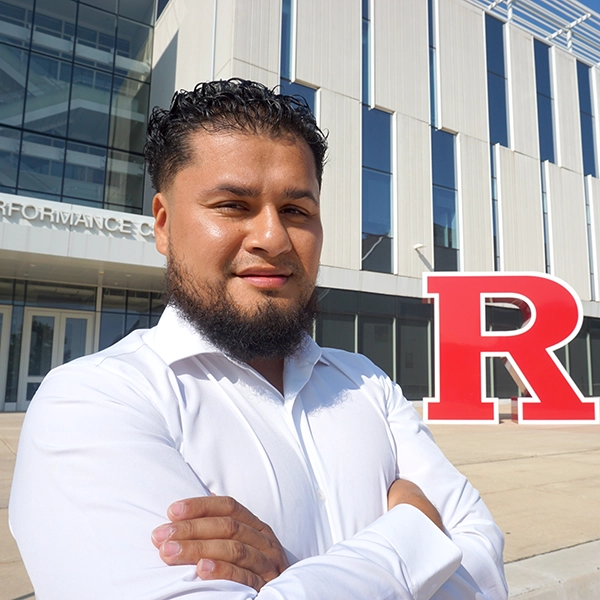
Christian Castillo
Master of Health Administration, Class of 2027
Hometown: Freehold, NJ
Activities at Rutgers: President, Rutgers Graduate Society of Healthcare Leaders (GSHL)
Growing up, Christian Castillo had to translate complex health issues and insurance bills for his parents when they received care. “That was a heavy responsibility for a young kid. But those experiences sparked my passion for healthcare administration.”
Christian chose the Rutgers MHA for practical reasons as much as academic ones. “I chose the Bloustein School because of its flexibility, which allows students to work during the day and study in the evening,” he said. “Having worked full-time throughout my entire college career, this program fits my exact needs.”
The program’s rising national profile also factored into his decision, giving him the confidence that he was in the right place to continue his education and maximize his potential to reach personal and career goals.
That confidence has been rewarded. “The MHA program completely transformed my perspective compared to what I thought of Rutgers during my undergraduate years,” Christian said. “The connections and opportunities presented to me have been nothing short of exceptional. If I had to choose all over again, I wouldn’t hesitate to make Rutgers my top choice.”
Christian’s path to health administration was directly shaped by his work with medically complex patients. “My background working with high-acuity dialysis patients highlighted the delicate balance between urgent clinical crisis management and rigid administrative frameworks,” he explained. “Navigating the tension between hands-on patient care and bureaucratic hurdles made it clear to me that better operational systems and technology are needed to absorb administrative friction, allowing professionals to focus on high-stakes human needs.”
“This experience inspired me to pursue a Master of Health Administration to help bridge the gap between clinical reality and administrative practice.”
At Bloustein, Christian found that mentorship extends across the entire faculty. “Every single professor truly wants to see their students succeed and is always willing to lend a hand. Professor Jane Kaye’s Finance class has really stood out,” he said. “It challenged me to deeply understand the complexity of financial systems in healthcare, while providing a strong foundation that prepared me for subsequent coursework. That level of academic rigor and support has made a lasting impact on how I approach my professional goals.”
Drawing on his leadership as President of the Rutgers Graduate Society for Healthcare Leaders (GSHL) and the discipline earned through his Lean Six Sigma Green Belt, Christian is already aiming high for his post-graduate career path. “I love to shoot for the stars! My primary goal after graduation is to secure an Administrative Fellowship at a top health system on the West Coast.”
Alternatively, he has plans to build a career path in health operations, starting in a managerial role and working his way up into C-Suite leadership at a major healthcare system.
For students considering the Rutgers MHA, Christian recommends doing the legwork. “I highly recommend networking with current students and alumni to ask about their firsthand experiences at Bloustein,” he said. “Additionally, do your research and recognize the value of CAHME accreditation. It speaks volumes about the quality of the MHA program, where it’s headed, and everything we’ve accomplished so far.”
A first-generation graduate student who loves playing and watching soccer, traveling, and trying foods from different cultures, he values the early experiences helping his parents navigate their healthcare. “It has motivated me to build systems that reduce healthcare and administrative barriers for children and families navigating similar challenges today, especially those from underrepresented or immigrant backgrounds,” he concluded.