From Corruption to Ballot Reform:
Fighting for Government Accountability in New Jersey
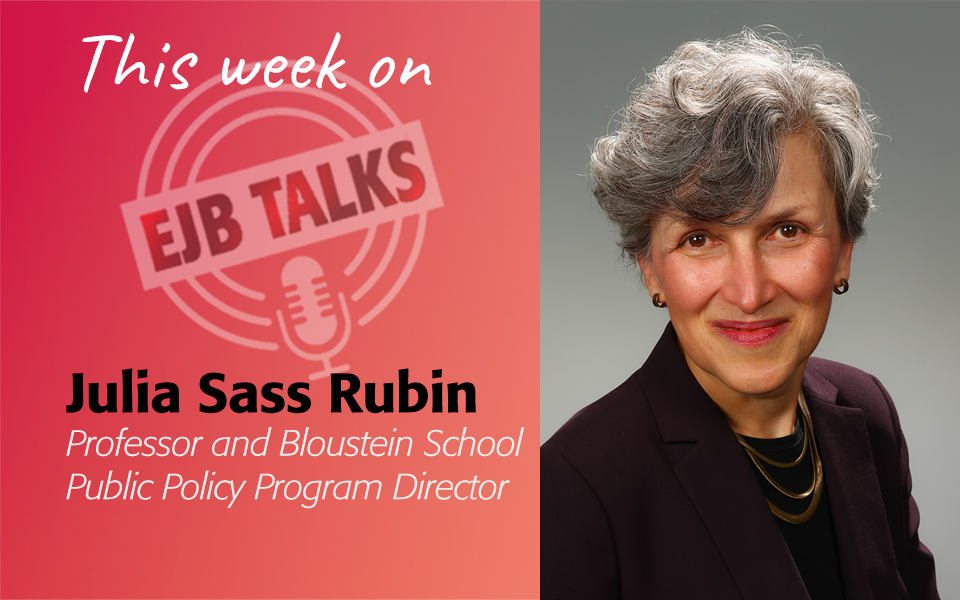
As we close out our 13th season of EJB Talks, Dean Stuart Shapiro asks Public Policy Program Director, Professor Julia Rubin, about why New Jersey has long been considered one of the most politically corrupt states. She explains how a consistent pattern of high-profile cases have contributed to this perception, citing the influence of the state’s longtime political machines and the now-abolished “county line” primary ballot that heavily favored party-backed candidates as primary examples. Julia then walks us through how years of research, lawsuits, and the more recent Menendez scandal have culminated in a major reform that replaced the county line with fairer office-block ballots, leading to more competitive races, higher voter turnout, and a growing number of reform-minded legislators. She also discusses how recent rollbacks and attempted rollbacks to some of NJ’s transparency and accountability laws, including OPRA and the work of the state Comptroller’s office, show the fight for accountable government in New Jersey is still very much ongoing. As part of this episode, we encourage you to read the transcript below, where we include links to the articles and legislation being discussed. We’ll see you in 2026!
Transcript
Stuart Shapiro
Welcome to EJB Talks. I’m Stuart Shapiro, the Dean of the Bloustein School. And the purpose of this podcast is to highlight the work my colleagues and our alumni in the fields of policy, planning, and health are doing to make the world a better place.
Today, we are concluding our 13th season with a discussion with our Associate Dean of Academic Programs, and the director of our Public Policy Program, Professor Julia Rubin.
Welcome back to the podcast, Julia!
Julia Sass Rubin
Thank you very much.
Stuart Shapiro
So, we’re going to talk about a number of government reforms here in New Jersey that have recently been enacted or are being debated. But I want to start with some background.
New Jersey does not have, let’s say, the best reputation in terms of corruption. Usually we get mentioned in sentences with states like Louisiana and Illinois, ((laughing)) which is not the company you want to keep. Where does this come from?
Julia Sass Rubin
That’s such a great question. Yeah, we’ve had a consistent pattern of high-profile cases that I think help contribute to that perception. Most notably recently, of course, is the indictment and conviction of Senator Menendez on corruption. Gold bars, anybody?
And then there’s like, you know, social media, and film. “On the Waterfront” is set in New Jersey for folks like us who might still remember “On the Waterfront.” And “The Sopranos.”
Stuart Shapiro
Everyone should watch it!
Julia Sass Rubin
Absolutely. And then “The Sopranos,” right, more recently? Mob, ah… very New Jersey-based.
But unfortunately, it’s not just perception. So, Professor Oz Dinser of Illinois State University developed a measure of corruption. Both legal and illegal corruption in the U.S. And yeah, we tend to rank pretty highly. Higher than most states. I think there’s multiple reasons for this. (Editor’s Note: His related book: Corruption in America: A 50 Ring Circus goes into more detail. It is available for purchase on Amazon).
So, we have a lot of government bodies. We have 21 county governments. Obviously, we have state government and we have 21 county governments. We have 564 municipal governments, I believe, still.
Almost 700 local educational agencies like school boards and charter schools. We have almost 250 authorities, commissions, and all kinds of special districts. That is a lot of opportunity for corruption, right? That’s a lot of government to corrupt.
We also have a pretty weak press ecosystem. We’ve never had a very strong one, but because we are, you know, we have the New York market, we have the Philly market. And so, there’s not one source of news that the state watches or reads.
And then of course, media coverage just nationally, has really degraded in the last couple of decades. And so, there isn’t an easy place to get your news or a lot of coverage, what’s happening in all those municipalities? But I think that the thing I would argue is the most important in why we have this ecosystem, perpetual ecosystem of corruption, is that we have been a state controlled by political machines for more than a hundred years.
And while the rest of the country has actually seen a weakening of political machines, that has not happened in New Jersey. And I think the primary reason for that is, that we have all these institutional structural things that keep the machines in power. Perhaps the most powerful is our county line primary ballot, which has enabled these county political organizations, which many of which are political machines, to decide who is essentially, who is elected to office. Including governor, Senate, U.S. Senate, House Representatives, the state legislature, all the county and local offices.
And this has given the political machines the power to run the state. Because they can decide who’s going to serve in the legislature, etc. And so, politicians understand where that power lies, and they are beholden to this few dozen powerful officials. Many of whom are really powerful. There’s five counties that essentially have enough votes, democratic votes, to elect statewide office. And so those five men, and they are all men, have an incredible amount of power. And it’s not just, you know, it’s not just illegal activities. I’m not saying that these people are all participating in illegal activities by any measure.
Stuart Shapiro
It’s not all gold bars.
Julia Sass Rubin
No, it’s not all gold bars. You have something called soft corruption. Former New Jersey State Senator Bill Schluter wrote a book called “Soft Corruption,” which I highly recommend, to anyone who’s interested in this issue. And there he’s talking about things that are legal, but unethical. So, officials doing things to gain personally or politically, like patronage, or trading campaign donations for favorable actions, or using their influence on behalf of their political cronies. And all of that creates a culture that contributes to our reputation as a corrupt state.
Stuart Shapiro
Gotcha. So, you mentioned the county line. And I know you’ve done a ton of work on this. And, we also had an earlier podcast. I refer listeners back to that (Editor’s Note: EJB TALKS Podcast July 2020: New Jersey politics: Why primary ballots make all the difference)
Julia Sass Rubin
Yes.
Stuart Shapiro
Where you sort of explained the issue back in I think 2020. The first or second season of the podcast, a long time ago.
Julia Sass Rubin
Ooh, I’m honored! ((laughing))
Stuart Shapiro
That’s right. We don’t have a lot of repeat guests either. You’re on a small list there! ((laughing)
Julia Sass Rubin
Extra honored! I’m extra honored.
Stuart Shapiro
So I know a ton has happened there, but if you could sort of briefly talk about how that has been to some degree a success in moving away from this corruption.
Julia Sass Rubin
Yeah.
Stuart Shaprio
And in getting rid of that county line.
Julia Sass Rubin
Yes, in the last five years, an awful lot has happened. Absolutely!
So as I mentioned, the county line is this primary ballot design, as you noted. And most New Jersey counties used it for decades and decades. As of two years ago, 19 counties out of our 21 used a county line ballot.
And it gave this preferential ballot position to candidates that were endorsed by the county party organizations. And I was on the podcast, I think, in July of 2020. And I had just published research showing that we were the only state that had this ballot design.
And then in August of that summer of 2020, I published another analysis that showed–this was an analysis of the 2020 primary–and it showed that candidates performed 35 percentage points better on average when they were on the county line, than when their opponent was on the county line.
And so this was, you know, this was the first real measure of the impact of the line. That July, a woman who had run for Congress, Christine Conforti, and had lost in the Democratic primary, filed a lawsuit in federal court challenging the legality of the county line ballot.
And then New Jersey Working Families Party joined for the lawsuit, and five other plaintiffs, and others filed amicus briefs. But nothing really happened over the subsequent four years. It just, there were multiple minor movements in the lawsuit, a change in judges, things like that, but it didn’t move forward very much. (Editor’s Note: Related Rubin research, November 2023: The Impact of New Jersey’s County Line Primary Ballots on Election Outcomes, Politics, and Policy)
And then coming back to Senator Menendez, he was really the linchpin in September, late September of 2023. Of course, he was indicted on charges of corruption. And then the next day, then-Congressman Andy Kim declared that Menendez should step down, and he threw his hat into the ring to replace Menendez.
And this was really daring because that’s not how things work in New Jersey. You don’t just decide to run. You have to work your way up the system and get permission from the party bosses. So, this was a big move by him. A couple of months later in late November, Tammy Murphy, the, of course, the wife of Governor Phil Murphy, also entered the race to replace Menendez.
By then, the Democratic Party in the state had come out against Menendez. The charges were pretty egregious. Anyway, Tammy Murphy quickly got a lot of high-powered endorsements, including from the most powerful Democratic County Party chairs. And I mentioned, you know, five chairs can essentially guarantee a win across the state when you have the county lines. This was really powerful. And the presumption was that those county party chairs were going to give her the county line.
And so in February, Kim and two congressional candidates filed a separate lawsuit to the one filed in 2020 against these counties that used the county line. challenging its constitutionality. And they said they felt that they could not get a fair hearing in the June primary. And so, they asked that that primary use office block ballots, like every other state essentially uses, almost every other state.
And in in office block ballots, you have the position at the top, and then all the candidates are listed below that. Which is very different from the county line ballot. In March of 2024, Judge Quraishi, U.S. District Judge Quraishi, granted a preliminary injunction, basically giving them what they were asking for. And that was upheld by the Third Circuit Court of Appeals.
And so, in June 2024, because all the people who filed the lawsuit were Democrats, this only applied to Democrats. So, in June of 2024, all the Democratic primary ballots used an office block design like other states use instead of a county line. But it was, you didn’t really see a huge impact because the decision came after the filing deadline. So, we have very few people running and for office in New Jersey because candidates know that if they don’t get the endorsement in the county line, they’re going to lose. So, they tend to drop out after the endorsements are made by the county party organization. So, the 2024 primary was not very contentious because of that.
But what happened after that was what’s really exciting. So, in the subsequent eight months, most of the counties that had used a county line ballot settled the lawsuit. So they agreed to use an office block ballot going forward.
And then the Assembly…the State Assembly and the State Senate took up this issue. They wanted legislation and they ended up basically codifying this judgment by Judge Quraishi, even though they did not want to. And they tried every which way to kind of do… go back to a ballot structure that could be controlled by the county parties. But they were not able to. And Governor Murphy signed this into law in March of this year. And so, now both parties, in all the counties in the state, have to use an office block ballot design for their primary ballots.
So the June 2025… and this is huge. I mean, this was just an earthquake for New Jersey. But I think people didn’t necessarily know how it would look in terms of primary results. So, the 2025 primary, you really saw the impact in a lot of different ways. First of all, traditionally, when, as I mentioned, when you didn’t get the county line, high profile candidates tended to drop out because they understood the system. They knew that they would lose.
In this case, we did not have high profile candidates dropping out. And we had a very a heavily contested primary on both the Democratic and Republican side. And there were a number of very serious, legitimate, you know, electable candidates. There were six what I would call “viable” candidates competing in the Democratic primary for governor. And three “viable” candidates competing on the Republican primary. There were other Republican candidates, but they weren’t, they didn’t have resources or name recognition.
And the election polling suggested a pretty close race for the Democrats, not so much for the Republicans. So just having all these candidates was a huge change. And even… and the Assembly also had a lot more candidates than usual. So, there were almost 28% of the seats were contested. That doesn’t seem like very much. But in 2023, when we had a record number of retirements, because it was the first election for the Assembly after redistricting, after the census, we had only 11% of seats being contested. And here, we had almost 28%. So that was a big, big change. This is just the Assembly. We didn’t have the Senate up in 2025.
And so, the other thing is that, a number of the Democratic and Republican gubernatorial candidates did not seek the county party endorsements. And without the county line, the county party endorsements just didn’t really give them as much. This also was historic. That had never happened. If you were going to win in New Jersey you had to go for the endorsement because that’s what brought you the county line.
The third thing that was really different was voter turnout. We have not seen this high of voter turnout since the 1980s.
Stuart Shapiro
Mmm hmm.
Julia Sass Rubin
Almost 33% of all registered Democrats and Republicans voted. And again, that doesn’t sound very high, but that is really high for a primary New Jersey. And we, you know, in New Jersey, you can’t vote in the primary if you don’t declare a party. So that’s why it’s all registered Democrats and Republicans. Independents don’t get to vote if they don’t declare.
You know all this, of course, but just in case our listeners aren’t aware of that. And you can’t vote for non-Democrats or Republicans in the primaries. They don’t…they’re not allowed to hold primaries, which we can get into if people are, if you’re interested. I think the thing…
Stuart Shapiro
Now that’s, yeah, that’s great.
Julia Sass Rubin
Yeah, go ahead. I’m sorry.
Stuart Shapiro
I mean, one of the reasons I love this story is its analysis actually resulting in change and meaningful change. (Editor’s Note: Related Rubin article: The 2026 Midterms: In New Jersey, a new voting law may be loosening the grip of the state’s political machines)
Julia Sass Rubin
Right.
Stuart Shapiro
And the analysis looked at what the effect of the county line was. People saw that. And yes, there were a lot of other factors, including the gold bars from Menendez.
Julia Sass Rubin
Yes.
Stuart Shapiro
But, you know, the result was in part because of this analysis we now have a fairer system. I want to get to a couple of the other, sort of, things that are going on. Because I suspect many of our listeners have heard a limited amount about them at most. But they are important. Let’s hit OPRA. Can you quickly explain what OPRA is?
Julia Sass Rubin
Sure.
Stuart Shapiro
It’s the state equivalent of FOIA, if any listeners know FOIA, and what the changes being proposed are.
Julia Sass Rubin
Sure. So, OPRA of course stands for Open Public Records Act. And this is legislation that enables people–law basically–that enables people to obtain information from various levels of government, and it’s meant to ensure a transparent and accountable government. Prior to 2024, New Jersey actually had one of the strongest OPRA laws in the country. Our law goes back 22 years, and it was a real model for other states.
And unfortunately, in June of 2024, Governor Murphy signed legislation making it much harder for the public to access government records, especially emails and texts. And it did this through a number of changes.
It added costs. It narrowed the scope of the request. It extended the response times for government. And, this is maybe the most important thing. It removed the mandatory attorney fee recovery for unlawful denials. It used to be that if you were turned down and an attorney took the case to court and could show that the denial was unlawful, their fees were paid by the government.
And so, these changes really weakened the OPRA law and limited government transparency and accountability. These changes were opposed by, you know, journalists, by ACLU-NJ, and by the League Women and Voters and every good government group in the state.
I mean, if you went to the hearings for this legislation in the state house, you know almost no one spoke in favor of it. But unfortunately, that’s not really relevant. It has not been relevant to New Jersey and how our legislative process works.
Stuart Shapiro
Do you see any chance of it getting reversed with the new legislature and new governor that we have coming in?
Julia Sass Rubin
Well, it’s interesting. I don’t know if it’ll get reversed yet. But, you know, there, perhaps the biggest earthquake from getting rid of the county line is that in the state Assembly races in June. In the primary, of course. Five candidates endorsed by the county party organizations lost.
Stuart Shapiro
Mmm hmm.
Julia Sass Rubin
And several others came very close to losing. And that doesn’t sound like a big deal. But no endorsed Assembly candidate has lost in the 14 years. And so, to have five lose in one cycle is a huge deal. And the people who won, a lot of them were running against the machines. They were overtly running as reformers. And, you know, five candidates, that doesn’t feel like a big deal, but they actually all won the general election.
Stuart Shapiro
Mmm hmm.
Julia Sass Rubin
And so, I think 12% of the Democrats in the Assembly are now these, will now be, these reformers, right? People who are trying to change the system.
So I think that if you see that kind of cycle a couple of more years. And of course, the state Senate will be up next time, and it has to be something we see in the state Senate as well. I think you will start seeing real changes. You know, we saw to some degree with what happened with the efforts to curb the power of the State Controller.
Stuart Shapiro
And can you talk about that a little bit?
Julia Sass Rubin
Yeah.
Stuart Shapiro
Because I was going to contrast that with the OPRA outcome.
Julia Sass Rubin
Yeah. Yeah, absolutely. And it’s, by the way, it’s not just the OPRA outcome. There’s been like, a pattern, of efforts to reduce transparency and accountability. We had the, kind of, Orwellian named “Election Transparency Act” the year before the OPRA reduction.
Stuart Shapiro
Right.
Julia Sass Rubin
That also reduced transparency and accountability. Jeff Tittle, who used to run the New Jersey Sierra Club, wrote a great article for, I think it’s for Insider NJ, that summarized 15-16 like, years of efforts to reduce government transparency and accountability in the state, starting with eliminating the Public Advocate under Governor Christie and then-Senate President Steve Sweeney. So, this is like an ongoing pattern. I recommend that all your listeners who care about honest government and transparent government take a look at his article. Again, it’s Jeff Tittle, T-I-T-T-L-E.
But, so what happened with the State Comptroller is… the Comptroller is a watchdog agency responsible for investigating fiscal misconduct by state leaders. And they look at state contracts, government contracts. And they release–it’s a “he” in this case, I think it’s always been a he–releases corruption, and reports pinpointing corruption and waste. And he has been–the current comptroller –is very, very good at his job. And he’s made a lot of very powerful people uncomfortable.
So the Senate president, Nick Scutari, introduced legislation in late November that would substantially weaken the power of the state Comptroller. And it was supposed to be a done deal. I mean, everyone I spoke to who was in the know said, yeah, this is happening, right? And that’s how it usually worked in New Jersey. That’s how it worked with the OPRA gutting. That’s how it worked with the Election Transparency Act. And this would have removed the Comptroller’s subpoena powers, And I mean, I won’t go too deep into the rabbit hole, but it would have weakened his ability to do his job quite a bit. And this is one of the last real checks on waste and corruption in the state.
And what happened was, two weeks after it was introduced, it was pulled by Scutari. In large part, I think, because of Senator Andy Kim. So, it kind of comes full circle, who has become an anti-corruption advocate, you know, not just nationally, but in the state. I could go into that if you’d like.
Stuart Shapiro
Yeah, it was no it was, you know, you had almost the, like, cartoonish example of them not letting Kim testify at the hearing on it.
Julia Sass Rubin
Yeah. Mmm hmm.
Stuart Shapiro
It was shocking, I think. And I think sort of it was things like that. The attention that Kim brought to the issue and the refusal of the legislature to let him testify when he wanted to testify was…really caught a lot of attention.
Julia Sass Rubin
Absolutely.
Stuart Shapiro
You know, I don’t generally see those things on my feeds a lot, but I saw that one a lot. So it clearly had an impact.
Julia Sass Rubin
But I think it really… it had an impact, not just because it’s so outrageous. I mean, he waited five and a half hours to testify, right? And then after three minutes, the committee chair, Senator Jim Beach, cut him off? And when he said, could I just finish what I’m saying? He said something like, ‘do you think you’re special?’
Stuart Shapiro
((laughing))
Julia Sass Rubin
Right? He obviously thinks he’s special! But Jim Beach, I mean, this was sort of, epitomizing, New Jersey politics because, Beach is the chair of the Camden County Democratic Party. A very powerful political machine, Camden County.
And when Senator Kim was running for the nomination for the Senate, for the Democratic nomination, the Camden County Party would not allow him to speak at their endorsement conventions.
Stuart Shapiro
Wow.
Julia Sass Rubin
They wouldn’t allow anyone except Tammy Murphy, whom they had endorsed, to speak at the endorsement convention. And even after Tammy Murphy dropped out, because she actually ended up dropping out of the primary before the vote, Beach wouldn’t support Kim. And wouldn’t allow Kim’s name to be included on their campaign materials in Camden.
He was the Democratic nominee, but the Democratic Party in Camden County wouldn’t allow his campaign materials to, their campaign materials to have Kim’s name! So this goes back a ways. And really reflects just how, how entitled the political machines have felt in the state. How powerful they feel they are. But I do think it speaks to how things are starting to shift.
Stuart Shapiro
Yeah, no. And let’s, you know, let me let you wrap up with a comment on that.
Julia Sass Rubin
Sure.
Stuart Shapiro
Because it is a fascinating sort of montage of things going on. You have the progress on the county line, and the impact that that had on the Comptroller debate. I think you’re absolutely right about that. But at the same time, you have all the sort of backward steps like the ah the OPRA example that you gave.
Julia Sass Rubin
Yeah.
Stuart Shapiro
And so, what what’s your… let me let you end with what’s your prognosis? Where do you see New Jersey going over the next several years? You know, can we get out of the maybe the bottom 10% of states and maybe move up to the middle somewhere?
Julia Sass Rubin
((laughing)) Yeah. Aspirational.
Stuart Shapiro
Hey, you can dream!
Julia Sass Rubin
((laughing)) Yeah, exactly! I’m optimistic. You know, Kim is clearly making this an ongoing campaign. The day after Scutari pulled the bill to gut the Controller’s office, Kim declared that he was going to support primary challengers against Beach and any other elected officials who block anti-corruption policies. And who support corrupt political machines.
And he has a megaphone, right? He has the ability to elevate this issue, which is what’s been so challenging is A, informing people. Like you said, there was really no data to show the impact of this ballot. But then also, just getting that word out at a scale that people would pay attention when we have this weak press coverage of the state. And the state is so divided between North Jersey and Central Jersey and South Jersey. So I do think he brings that ability to focus folks on what’s happening.
I think between his involvement and the fact that we are seeing a change in the composition of the legislature. I do think, I am optimistic, that I do think that there will be less of this kind of behavior. It might take a few years. Again, we have to get more people into the legislature who don’t… haven’t been elected through this system and don’t want to operate this way. But I do, I am optimistic that in, I don’t know, five to 10 years? It will feel very different in this state. And we can have many podcasts about the changes that are needed. So I won’t go there! But at the very least to have a legislature that does not feel beholden to political machines and is willing to do what is right for their constituents.
Stuart Shapiro
Yup. We could also do a podcast on why at one point, I think machines were actually very beneficial because they brought people into the political process that were otherwise disenfranchised.
Julia Sass Rubin
Yes!
Stuart Shapiro
But that we’ve moved beyond that now. Julia, thank you so much. It’s been a great conversation, and it’s nice to end the year on a on a somewhat upbeat note given everything else that’s going on. ((laughing))
Julia Sass Rubin
Oh, so true. Thank you!
Stuart Shapiro
Thank you, also to Tamara Swedberg and Karyn Olsen, who make this podcast happen. We will be back in late January, early February, with another season of experts from the Bloustein School. Until then, stay safe!