From Campaigns to Classrooms: Teaching a New Generation About Advocacy with Bob Sommer, GSNB ’84
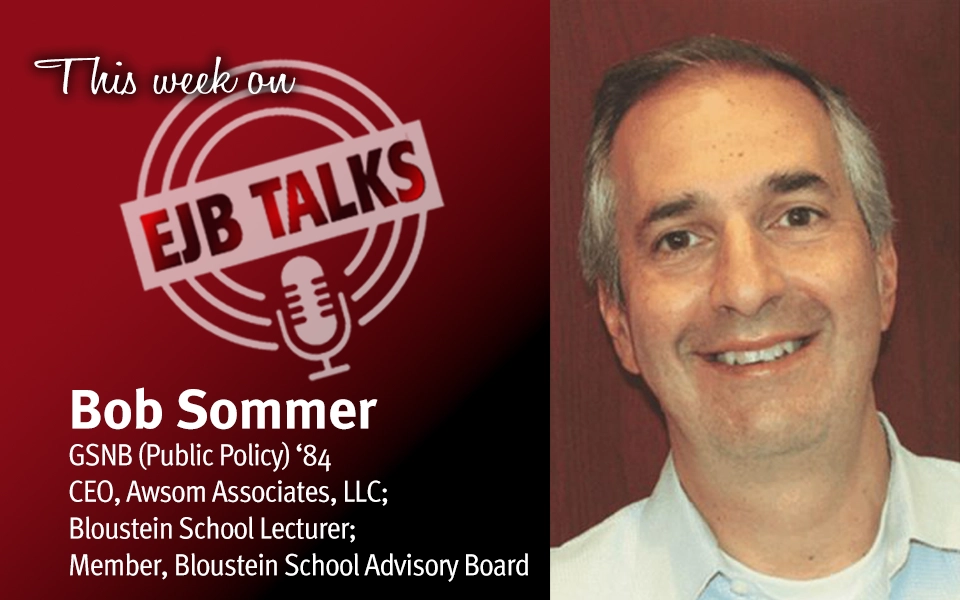
As we wrap up our 14th season of EJB Talks Dean Stuart Shapiro talks to Bob Sommer GSNB ’84, a Bloustein School alumnus and former Eagleton fellow, lecturer, and member of the school’s Advisory Board. As Bob talks about his journey from an accounting major to a career in public policy, he discusses his transition from working on a congressional campaign to roles in government and lobbying. His early career included a stint at the EPA during the Reagan administration, and he highlights how a chance meeting with the late governor,and then Congressman Jim Florio, set him on his path to a career in government affairs. Bob emphasizes that lobbying is a fundamental part of the American system, and explains how advocacy has evolved with time and changes in technology and regulations. Part of his approach to teaching advocacy, he explains, is focusing on practical skills and the importance of listening and adapting to different perspectives, stressing the importance of understanding the other side’s arguments while also being able to articulate one’s own position effectively. He concludes by emphasizing the need for more effective advocacy and the role of educators in preparing the next generation of advocates.
Transcript
Stuart Shapiro
Welcome to EJB Talks. I am Stuart Shapiro, the Dean of the Bloustein School, and the purpose of this podcast is to highlight the work my colleagues and our alumni in the fields of policy, planning, and health are doing to make the world a better place today.
To conclude our 15th season, we have a man who wears a number of hats. Bob Sommer is an alumni of the school, a member of our Advisory Board, and also a lecturer in our public policy program.
Welcome to the podcast, Bob!
Bob Sommer
Thanks, Stuart, for having me. I appreciate it!
Stuart Shapiro
So, we always start, or almost always start, with an origin question. Let’s, let’s go back in time here. Why did you get interested, why did you want a degree in public policy?
Bob Sommer
So, having listened to several of the podcasts that you’ve done so far, I think I’m like a lot of your guests. This was not a calling for me to get into government and politics and advocacy. I kind of fell into it. My dad was a CPA, so I went to, as an undergrad, I was an accounting major, and pretty quickly I realized numbers and me? We don’t get along.
Stuart Shapiro
((laughing))
Bob Sommer
But words and me, we do. And I, and I…English didn’t seem particularly practical as a major, so I majored in political science.
Stuart Shapiro
Okay.
Bob Sommer
Which led me to work on a congressional campaign in 1980. The incumbent congressman from the district I grew up in, Andy McGuire, was running against Marge Roukema, and I got a full-time job on the campaign as a field organizer. And I loved it. It totally spoke to me. Everything was great. I learned a ton. The congressman was an interesting guy. It was terrific up until Election Day. We lost. In the Reagan landslide. And…but that’s when I realized that this is my calling. And I transferred schools, got much more serious about government and politics. Um, I did an honors program where I was writing about the history of New Jersey politics as an undergrad. And I asked to meet with Cliff Zukun. I reached out to him. And he was running the Eagleton poll then, and I said, can I talk to you about New Jersey politics? I was a couple weeks away from graduating, and he said to me….we had a great conversation, drove down to New Brunswick to meet with him….and he asked me what I was going to do after I graduated. And I’d gotten into an MPA, Masters in Public Administration program, and he said, “Don’t waste your time on that! Come…”
Stuart Shapiro
That sounds like Cliff, by the way!
Bob Sommer
Right! A little, yeah, it was pretty much as he said, come here, which, at the time, was Eagleton. He said, “Come here, we combine politics and policy. It’s a much better program, plus it’s only one year.” And he was exactly right. I made the change on the fly, applied immediately, got in. And loved my time there, and it led me to Washington, where I worked as a PMI, Presidential Management Intern. Which Carl Van Horn had advocated very seriously for me to do. And I interviewed, got a job at EPA. This is during the Reagan Administration. And a couple of months into my two-year commitment, I hated it. And I said, this is not for me, because I can’t agree with what the department is doing.
Stuart Shapiro
Right.
Bob Sommer
And I had written an article. It was published…Congressman Jim Florio, who was a professor of mine at Eagleton, saw the article, somehow tracked me down, called me. I met him in his office one day, and he said, you know, he’s asking me about EPA, and what, you know… he was.. He had just finished an investigation that led to the resignation of Ann Gorsuch.
Stuart Shapiro
Mother of current Supreme Court Justice Gorsuch.
Bob Sommer
Correct! And yes, and so he, you know, we finished the conversation, he had asked me about the article. And then I mentioned to him, I said, “Today’s my birthday!” And he said, “Happy birthday!” And, by the way, it really was my birthday. And I said I was hoping for something more substantial, maybe a job?
Stuart Shapiro
((laughing))
Bob Sommer
And now with that, no joke, that was a Wednesday. And on Friday, his chief of staff called me and said, if you can start on Monday, we got a job for you. We need a speech writer and a policy analyst. I said I’m in! And so I had a no notice, with a two year commitment at EPA. I had to go into my boss to say, hey, I know I got 18 months to go, but in two hours I’m done.
Stuart Shapiro
Mmm hmm.
Bob Sommer
And, and to his…Florio was the arch enemy of the Reagan administration EPA. So that was… saying I was quitting was not good news to him. Saying I was going to Florio was far worse news to him.
Stuart Shapiro
Uhh huh.
Bob Sommer
And that’s my story into government and politics.
Stuart Shapiro
Wow, that’s that’s great. By the way, my father was an accountant as well. I didn’t know that we had that in common, so that’s great.
Bob Sommer
Ha! Good to know!
Stuart Shapiro
And certainly, the Reagan EPA is almost worth its own podcast in terms of the experience there,
Bob Sommer
((laughing))
Stuart Shapiro
But let’smove on, because eventually you moved on to government affairs, or as the public generally knows it, lobbying, and talk to me about that transition.
Bob Sommer
So, I really enjoyed my time working for the Congressman. I worked on his committee; he was chairman of the Commerce Subcommittee of the Energy and Commerce Committee, which Frank Pallone is now the ranking Democrat on today. Rutgers’ Congress member, and I was a policy person for him and a speechwriter.
And I started a public relations and public affairs firm with a friend who I had gone to high school with. He was a year ahead of me, and…. But we started this firm, and for 20 years I worked as a registered lobbyist in Trenton and in Washington, also focused on public policy and advocating for my clients, both through the media and through, in government. And somewhere along the way, Cliff and Carl reappeared in my life and said, you know, you should start teaching what you know at Bloustein.
Stuart Shapiro
Uh huh!
Bob Sommer
And I said, I’m in! I mean, if you guys have that kind of confidence in me, I’m in, and I’ll figure it out. And I’ve had many jobs since my partner and I sold our firm, and all of them had to do with some level of advocacy.
Stuart Shapiro
Mmm hmm.
Bob Sommer
I was, I ran a media company. I was president of a media company for somebody who’s quite prominent in the news today. Then he was a Democrat, now he isn’t. Jared Kushner was my boss, as I was president of the New York Observer. Then I went on to become the president of the holding company for the New Jersey Devils and Prudential Center. Then for a period of time I was a senior counselor, I think was my title, for then-brand new Mayor of Jersey City, Steve Fulop.
Stuart Shapiro
Ah!
Bob Sommer
Then my own firm again, and that’s what I do today, as well as teaching at Bloustein.
Stuart Shapiro
So when we see government affairs specialists, or again, as they’re commonly known, lobbyists. We see them in movies or pop culture, they’re often the bad guys. And you do see a public perception of, you know, oh, that’s what’s wrong with the American system, the special interests have all the power, the lobbyists have all the power. So, how did this evolve, and why is this unfair? Because I assume you think it’s unfair, and I also know that I agree that it’s unfair.
Bob Sommer
It is, because Americans want to believe that their government is all about their representatives representing them. And that’s great, and it’s as it should be. But literally from the get-go, the founding fathers writing the Constitution, it was an incredibly lobbied, heavily lobbied… which states have more power. Was it going to be farmers or coastal interests? I mean, there was lobbying in Philadelphia as the constitution was being written. That hasn’t changed.
How advocacy has changed is incredibly dramatic, and it matches changes in technologies and rules and regulations, and things. But, but again, it beats…. There is no Jimmy Stuart in Congress.
Stuart Shapiro
Right.
Bob Sommer
Nobody gets there by accident. People are elected, and they’re elected to support certain kinds of positions. And then there’s party loyalties as well. So voters, constituents, don’t want to believe that they’re not a part of the process, and in fact they are.
Stuart Shapiro
Mmm hmm.
Bob Sommer
Pretty much every American in some way, shape or form is part of an advocacy organization, whether they know it or not. If you’re A-A-R-P, American Association of Retired People/Persons, they are an incredibly important lobbying organization. If you’re a student, there are student advocacy organizations. If you’re, if you’re a labor member, you know, a union member, they have strong advocacy. So people who, voters who, feel the system is not talking to them take it out on the incumbent sometimes…
Stuart Shapiro
Right.
Bob Sommer
And…but sometimes they don’t realize they’re part of an advocacy organization that is pursuing that organization’s goals.
Stuart Shapiro
Yeah, no. Let me bounce this off of you, and it sort of touches on money and politics and all that. I think one of the fundamental misperceptions is that politicians vote the way they do because they are paid to do so. Or they’re in the hand of influence, influencers. Whereas I think the reality is, organizations like yours, like other advocacy groups, support the politicians that support the views that they have, you know? The unions are going to support pro-labor candidates. Those candidates aren’t pro-labor to satisfy the unions.
Bob Sommer
It’s a great…The simple answer is yes. I completely agree with you. The next step of that is, I… only on the rarest of occasions, including in New Jersey, which, you know, we don’t have the… as you’ve talked about in some of your podcasts, we don’t have the best reputation as the most honest government in the world. But even with that, I don’t believe money buys votes.
Stuart Shapiro
Right.
Bob Sommer
With the exception, perhaps of this president, and I’m…
Stuart Shapiro
Yeah, we’ll put him aside!
Bob Sommer
Okay! ((laughing)) So, I don’t…So, what I always say in my course is that, I don’t believe money buys votes. I do believe that money buys access.
Stuart Shapiro
Right.
Bob Sommer
And, you are much more likely to be able to meet with policymakers if you’ve been a supporter of that candidate. and you know why not? Because you’re supporting the candidate, he or she is far more likely to sit down and talk with you.
Stuart Shapiro
Right.
Bob Sommer
But it does not buy a vote. I absolutely believe that. I don’t just believe it, it’s been my career, it does not buy a vote.
Stuart Shapiro
So, what then are the keys to being a good advocate?
Bob Sommer
Great question! And I do… I inherited, when I started teaching at Bloustein, I inherited the name of the course.
Stuart Shapiro
Mmm hmm.
Bob Sommer
And I jokingly call it…well, it’s called Public Policy Advocacy. And it’s a much better term than lobbying. Because advocacy is what it is, and people sometimes forget that not-for-profits also lobby for things.
Stuart Shapiro
Right.
Bob Sommer
And it doesn’t seem as unseemly.
Stuart Shapiro
Mmm hmm.
Bob Sommer
But advocacy is advocacy. So I do think that the most important thing about advocating is asking. You have to be able to ask. And literally, how I got my first job in working on Capitol Hill was, I asked Congressman Florio, my former professor, for a job. He said yes. Sometimes the answer is no. Maybe more often than not, the answer is no. But if you don’t ask, you don’t get.
Stuart Shapiro
Right.
Bob Sommer
And that is the key kickoff point for advocacy, advocating. And the second point is, just because you believe you’re right, it’s kind of irrelevant.
Stuart Shapiro
Mmm hmm.
Bob Sommer
You have to understand that if you’re advocating, there’s somebody on the other side advocating as well, and they believe they’re right too. And if it’s a yes or no vote, even with a compromise, it’s still ultimately a yes or no vote. You’ve got to understand what the other side is asking for even better than you understand what you’re asking for. So you’re, you can, you know how to answer their questions in advance for people who, elected officials, who want to support your position.
Stuart Shapiro
Yeah, I love that. Because we’ve gotten so bad at understanding the other side, right? And we’re moving in the direction as an institution of thinking about, how do we learn to talk to each other again, and such. But a key to that is understanding what the other…. those opposed to you think, and many don’t.
Bob Sommer
and this could be the dark part of our conversation. Which is, you’ve hit the nail on the head. What has been, essentially, for 250 years? With the horrific exception of 1860 to 1865?
Stuart Shapiro
Mmm hmm.
Bob Sommer
The system has worked because both sides were able to talk to one another.
Stuart Shapiro
Right.
Bob Sommer
And we didn’t think of the other side as evil.
Stuart Shapiro
Right.
Bob Sommer
And I will say this. I’m going to put in a plug for state Senators Bramnick and Cryan.
Stuart Shapiro
Mmm hmm.
Bob Sommer
They are… these are two, 60ish year old white men, as am I, by the way! ((laughing) who talk to students. And they came and spoke to my class last year. They talked to students about what the system is, our system is built on. Our system of government. Which is compromise. And by definition that means you’ve got to listen to the other side.
Bob Sommer
And what struck me when the two senators came into my class, is all the graduate students that… there were 20 last year. They’re, they were all…. virtually all of them were in their mid to late 20s. And their whole… their whole time of starting to get into the being citizens, who vote and participate in the system, has been dominated by one personality. And how that personality has affected or infected the system. That was actually pretty good! “Infected the system!” ((laughing))
Stuart Shapiro
((laughing))
Bob Sommer
And they spoke to a time, 10 years ago. And their whole careers prior to that, where they worked to understand each other’s side and find… and found places to agree to disagree? And found places to, let’s meet in the middle.
Stuart Shapiro
Right.
Bob Sommer
Or let’s meet, you know, two thirds/one third. And the students in my course found that so inspirational or inspiring, because it was something that they haven’t experienced. And these are all public policy students, or in that field. They all want to be advocates, and they were learning a system that I grew up in that Senators Bramnick and Cryan grew up in, that they’ve never seen.
Stuart Shapiro
Right.
Bob Sommer
And I think we need more Cryans and Bramnicks advocating for that. And it informed me almost as much. The students’ response informed me almost as much as their talk informed the students, and I…Our system is shaken right now.
Stuart Shapiro
Right.
Bob Sommer
And it’s going to be dark before it gets light again. That said, understanding how to re-form, how to rebirth the system that has made, I believe, our country the best country on earth? And the best place to advocate for things? The key is listening, and right now there’s not a lot of that.
Stuart Shapiro
To your point, thought, this terrifies me, but…no one under the age of 33, when the next presidential election occurs, will ever have voted in a presidential election that Donald Trump was not on the ballot. And that tells you exactly sort of, the world that they came of political age in. And it’s going to be a challenge in dealing with that. So, with that in mind, What are your goals for your students in your course? What do you want them to get out of it?
Bob Sommer
Great question! And I always start out the course saying to the students each semester, I work for you, not the other way around. And I have failed you as your professor if you haven’t learned how to become a more effective advocate in the American system of government.
I make the point that it is an incredibly practical course. And in fact, earlier, you know, you focused on lobbying. I’m looking at my syllabus right now. The schedule stays the same semester to semester. And I don’t get to lobbying until the middle of October.
Stuart Shapiro
Mmm hmm.
Bob Sommer
Because there’s so many other components of advocacy that come into play first. Which is, understanding how to organize. Understanding the role that interest groups play. And interest groups are almost as…it’s almost as negative a connotation as the word lobbying…
Stuart Shapiro
Yes!
Bob Sommer
…but every American is part of an interest group, or multiple interest groups. As students, as homeowners, as renters, as commuters, as car owners, as car leasers. Everybody belongs to some interest group, whether they know it or not. And so, understanding who and what they are, and how they advocate is really important.
I talk about media. I talk about the different tools of advocacy, polling, advertising, social media. I’m building into the course now the impact of AI on advocacy.
Stuart Shapiro
Mmm.
Bob Sommer
And that is absolutely a rapidly moving target. And so I… that is a big part of what I do. And then understanding how journalists… media has changed a lot, but it is still here and a big part of the policy process. How media works to influence what elected officials do. And I also spend a whole class on fundraising and campaign contributions, because that gets back to your earlier point. What do campaigns, what do contributions buy, and what don’t they buy?
Stuart Shapiro
Right.
Bob Sommer
And, nobody. Nobody gets elected without spending money. And the money rarely comes from their own pockets, although that’s changing a bit too.
Stuart Shapiro
Yes.
Bob Sommer
It… money rarely comes from their own pockets. It comes from campaign contributors and interest organizations. So that’s what I teach, and I… and the students role play. So I try to make it as realistic a class as I possibly can. And I can tell by the end of the semester if students have, through their role-playing, have really understood, come to understand, the importance of the different components of advocacy. And that the least important thing out there is being right.
Stuart Shapiro
Right!
Bob Sommer
The most important thing out there is listening, and then adapting to what you hear.
Stuart Shapiro
That’s great. Well, that explains in part why your classes always get such high ratings and love from students.
Bob Sommer
Thank you!
Stuart Shapiro
Bob. This has been great. Thank you so much for coming on the podcast!
Bob Sommer
Thank you for having me, Stuart. This was a pleasure.
Stuart Shapiro
Also, big thank you to our producer, Tamara Swedberg and to Karyn Olsen, who helps get this out on the air. This is going to be a wrap for this academic year, and we will see you again in the fall with more episodes from more experts at the Bloustein School. Until then, stay safe.