Understanding Climate Risk at Home: Sea Level Rise, Community Engagement, and New Jersey’s Environmental Future with Janine Barr
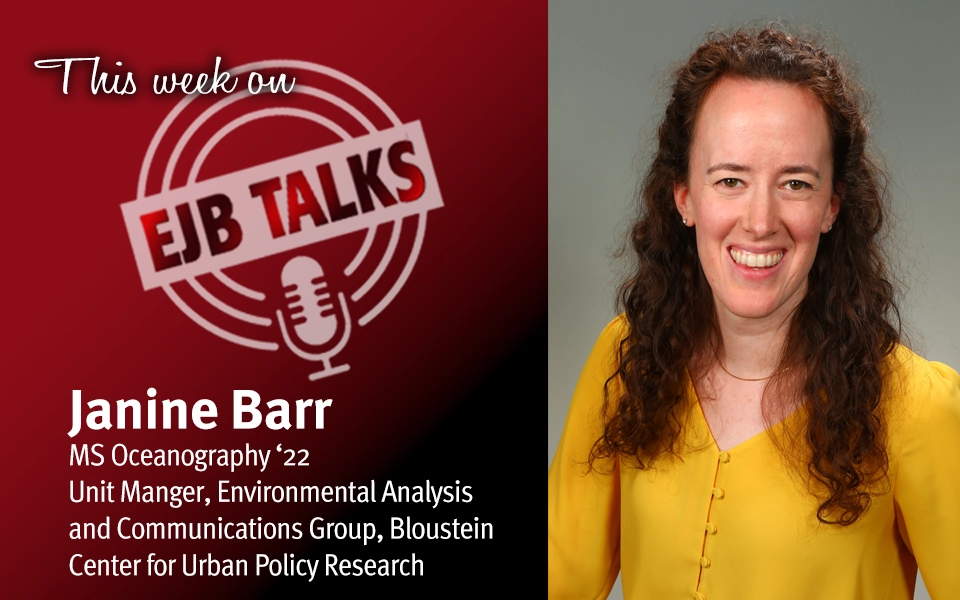
Janine Barr, a researcher at the Bloustein School’s Environmental Analysis and Communication (EAC) Group, joins Dean Stuart Shapiro this week on EJB Talks to discuss the center’s work on climate change impacts. A self-proclaimed Jersey girl, Janine traces her path to environmental policy back to an internship with the U.S. Department of State’s Bureau of Oceans and International Environmental and Scientific Affairs. The internship not only drew her toward environmental policy, but specifically toward issues affecting her home state. She describes how the EAC Group brings together the branches of policy, planning, and public health to integrate community needs into local, regional, and state planning initiatives, supported by robust stakeholder engagement and data analysis. Janine also speaks to her involvement with the New Jersey Sea Level Rise and Coastal Storms Science and Technology Advisory Panel (STAP) Report, a major effort to equip decision-makers with updated science on sea level rise and coastal storms. The report projects sea level rise of 1.8 to 4.3 feet by 2100 depending on emissions scenarios. She closes by stressing the importance of clear, ongoing communication with the public, so communities can meaningfully engage with questions of risk tolerance and long-term planning needs.
Transcript
Stuart Shapiro
Welcome to EJB Talks. I’m Stuart Shapiro, the dean of the Bloustein School. And the purpose of this podcast is to highlight the work my colleagues and our alumni are in the fields of policy, planning and health are doing to make the world a better place. Today, we have Janine Barr, a researcher and manager in our Environmental Analysis and Communication Group who also works for Rutgers Climate Change Resource Center. Welcome to the podcast, Janine!
Janine Barr
Hi, it’s great to be here! Thanks for having me!
Stuart Shapiro
So, we’ll get to the origin question in a second. I usually start with that. But just so our audience knows, can you explain what type of work the Environmental Analysis and Communication center, or “eek” (EAC), as we call it here, does?
Janine Barr
Sure, of course. So, as everybody who might listen to this podcast knows, the Bloustein School is a nationally ranked center on theory and practice of planning and public policy, scholarship and analysis. EAC, or the Environmental Analysis and Communications Group, is one of several applied centers of research and practice at the Bloustein School.
So one of the roles that EAC plays, like you said, is to co-direct the New Jersey Climate Change Resource Center, which was established by state law adopted in 2020, that establishes the center at Rutgers as a climate service center, designated to provide expertise, support, research and service to government, non-government, organizations, communities and other sectors throughout New Jersey to address all the complex, multi-sectoral impacts of climate change on New Jersey’s economy, communities and ecosystems and residents. So, it’s a tall order, but a really exciting order. And it’s it’s been really great to work here, almost for three years now in that intersection.
But EAC, specifically, is focused on that intersection of science policy and communities. So we do a lot of stakeholder engagement to ensure community needs and interests are integrated into local, regional, and state planning initiatives. We also do a lot of data analysis and collection to ensure the most updated science is integrated into that local, regional and state decision making process. We actually have three branches within EAC. We’re growing in numbers, which is really exciting. So we have the policy branch, the planning branch and the public health branch.
We also have a data informatics group, which is its own entity, but it is affiliated with EAC. And it’s a group that builds some really exciting online, interactive tools, data portals and maps to communicate all kinds of environmental, socioeconomic and community relevant information. So…
Stuart Shapiro
I’m…
Janine Barr
Oh, go ahead…
Stuart Shapiro
As I said, with policy, planning, public health and informatics, you’re essentially building a mini Bloustein School!
Janine Barr
We are, yeah. We’re, we are small but mighty. But yeah, there’s a bunch of expertise to draw on within the university. And I can talk a little bit about what each of those branches does, if that’s interesting? But otherwise, yeah, it is a really great place to work with so much in-house expertise.
Stuart Shapiro
That’s great!
Janine Barr
Yeah.
Stuart Shapiro
Let’s get to you a little bit. Sort of, talk a little bit about your trajectory and how you got interested in environmental planning and policy and climate change.
Janine Barr
Sure. So, I will start by saying I am a Jersey girl.
Stuart Shapiro
Woo hoo!
Janine Barr
I was born, yes, I was born and raised here, and I think my heart was always embedded in New Jersey environmental policy, or at least working in New Jersey. My family is still here, so it’s really great to be doing work in the state. But my origin story is, I started off in my undergrad at Gettysburg College. I graduated in 2015 which is almost… it’s over a decade now! But I got my degree in environmental studies and biology, and I actually had a really great internship experience in Washington, DC, the summer before my senior year of college. It was an internship with the United States Department of State. I was working for their Bureau of Oceans and International Environmental and Scientific Affairs.
So I applied for this internship on a fluke. It seemed really interesting to me. I never really thought that I would get it just because I was so science focused in what I was doing in my undergraduate career. And then when I got it, it completely turned my career trajectory around. I got the policy bug. I had such a great experience working for the State Department that I knew that I wanted to work for the government at some point in my career, and I was just lucky enough to start my career at the Environmental Protection Agency after I graduated from college. So, I spent about three and a half years there. I was doing environmental policy work, specifically regarding water quality standards. So, it’s the regulations that help to make sure that, you know, the lakes, the rivers, the coastal environments are supporting the designated uses that communities want for those water bodies. So if you wanted to go fish on the local waterway, you would know that the fish you were eating were healthy.
So I was always really passionate about, at that point and still today, making sure that there’s science that informs policy. So science sitting in academia, in peer reviewed journals is a wonderful pursuit. I just wanted to take that type of information and make sure it was available to help folks make decisions that impact their daily lives. So, to do that, I wanted to embed myself a little bit more in the science in my career. So I ended up coming to Rutgers for my graduate studies. I ended up working for Professor Daphne Munroe. I was her graduate student, and we did research at the Haskin Shellfish Research Lab down in South Jersey. I would recommend anybody go there. It’s such a beautiful part of the state. But I was doing work on–surprise, surprise–marine things and water things. So I was able to do research that quantified the water quality benefits that oyster farms in New Jersey provide.
So we got a lot of oysters. They’re really delicious, and not only they good to eat, but they do a lot of good stuff for the planet and improving local water quality. So, I also, after going to Rutgers for grad school, I ended up getting a fellowship called the Knauss Fellowship. It’s a pretty selective fellowship that puts folks who are interested in the marine/ Great Lakes/fresh water science space, and places them in parts of the federal government so they get that exposure to the environmental policy space. And can, you know, better advocate for science and policy. And I ended up working for a senator from Delaware, Senator Tom Carper. He was the head, or the chair of, the Environment and Public Works Committee when I worked for him. And it was just a great opportunity. Opened my eyes to how politics works and the legislative process, and will be forever grateful for the things I learned about compromising and negotiations and what it takes to make the world a better place in the legislative space.
So that was in DC, though. So New Jersey was calling me, and I reached out to some people who had been my professors at Rutgers and ended up getting this great job at the Environmental Analysis and Communications group. So that’s my story.
Stuart Shapiro
I have to wonder, and I don’t want to go off track here, but I do have to wonder whether the office where you did your internship still exists now.
Janine Barr
I think it does. I looked at them a little while ago, and hopefully, because they’re so, I think, pivotal in even non climate things that they would stick around. But yeah…
Stuart Shapiro
It’s probably the key.
Janine Barr
Yeah!
Stuart Shapiro
Yeah! Excellent. So I invited you on the podcast because I saw a presentation you did. And it was a part of the Climate Change Resource Center’s Science and Technology Advisory Panel Report. Can you briefly explain what that is?
Janine Barr
Yeah, so this is actually the third edition of this report. It essentially is, the findings and the culmination of a group of scientists and practitioners who have come together to collect the most updated science on sea level rise and coastal storms. And putting that into a report that has the most updated science to help decision makers think about how much sea level rise they would like to plan for in their coastal environments. So it is… I think we had about 20 scientists involved in the process this year, not including some peer-review specialists who kind of looked at the report once it was drafted to see and to check for robustness and analysis. So, about 25 scientists, and maybe 20 to 30 practitioners were involved. So those were folks…
Stuart Shapiro
Wow.
Janine Barr
…who worked for municipalities, who worked for nonprofits, watershed organizations, community groups, who would be using the findings from the STAP Report in their day to day work. So. It was a project that was funded by the New Jersey Department of Environmental Protection. The first report came out, ooh, I gotta, I gotta look up the year. But the, the most recent report came out in 2019. And so this was a report that was the update to the 2019 sea level rise or STAP Report.
Stuart Shapiro
I see.
Janine Barr
Yeah, we try to update it every five years to reflect the most updated science.
Stuart Shapiro
So you’re pretty close there too.
Janine Barr
Yeah. We’re close!
Stuart Shapiro
So talk about what you guys found. Particularly what you talked about in your presentation was ice sheet loss and sea level rise. And you used the phrase just now that the “amount of sea level rise people would like to plan for.” And I want to, sort of, delve into what that means as well.
Janine Barr
Yeah. So the undercurrent of the STAP Report and the STAP itself, that group of scientists who shaped the report was to be policy relevant, but not policy prescriptive.
Stuart Shapiro
Mmm hmm.
Janine Barr
So the scientists who were working on this wanted to make sure that readers had the full breadth of sea level rise estimates that they could choose from. Rather than saying, Oh, hey, here’s this one number of what we think sea level rise will be in the future, only use this number. And so as part of that process, there are a lot of different pieces of information that get put in to make this beautiful puzzle understandable. So, it’s important to project sea level rise over time.
Stuart Shapiro
Mmm hmm.
Janine Barr
So you’re not just going to give people an estimate for the year 2150. That might be helpful for some people, but not everyone. So we did sea level rise projections from the year 2040 through 2150. So for folks who might be interested in a more immediate risk planning analysis, they might look a little bit earlier in that time period. And folks who really want to look long term and look at long term risk, they might look at 2150.
The other thing that you want to think about is, well, what are the different greenhouse gas emission scenarios that could be possible moving forward. There is an international body called the IPCC, the International Panel on Climate Change, who sets those standards for what are the various emission scenarios that could be in our global future. And so, using that as our foundation, we were looking at a low emission scenario, an intermediate emission scenario, and a high emission scenario. That’s very technical. But what it breaks down to is, a low emission scenario is basically if we locked into the Paris Agreement and the emissions that were promised there? What amount of sea level rise would that trigger? Intermediate emissions is basically where we are now. That’s kind of the trajectory for some of the really great national and international greenhouse gas emissions reductions projects and initiatives that have been put into place. Where we are most on track for an intermediate emission scenarios right now. And then the third that we looked at a lot was the high emission scenario. So, that’s more consistent with about 3.8 or like 4 degrees Celsius of warming by 2100. The intermediate emission scenario only looks at about 2.6 degrees of warming, so high emissions…
Janine Barr
If you were under a low emission scenario, you would expect to see between 1.8 and 3.3 feet of sea level rise by the end of the century. But if you were on the more extreme side, with the high emission scenario, you would expect to see 2.6 to 4.3 feet of sea level rise.
Stuart Shapiro
So…
Janine Barr
Oh, go ahead!
Stuart Shapiro
How much sea level rise do those translate to? What are we talking about?
Janine Barr
Yeah, so. It depends on what your level of risk tolerance is. So, what we, the numbers that we normally share, just for easier communication, is looking at the year 2100.
Stuart Shapiro
Mmm hmm.
Janine Barr
Because that’s something that a lot of planners and folks look at is, the end of the century, like, what are things going to be like? And so, if you look at the intermediate emission scenario, where we’re most likely to… what we’re most likely to experience. We would expect to see between 2.2 and 3.8 feet of sea level rise by the end of the century.
Stuart Shapiro
Mmmm.
Janine Barr
So basically, between 2 and 4 feet by the end of the century.
Stuart Shapiro
Right.
Janine Barr
And that, that likely amount of sea level rise does not include something called rapid ice sheet loss processes.
Stuart Shapiro
Right.
Janine Barr
And so, something for folks to be aware of is that there is ongoing discussions and ongoing research about this very specific part of the sea level rise estimation puzzle. And so when you do these sea level rise estimates, you’re modeling all these different environmental processes that could cause, and is found to cause, sea level rise. So things like melting glaciers or melting ice sheets. Things like, you know, ocean thermal expansion, because as water gets warmer, it actually expands. So some of sea level rise is actually caused by just the ocean warming from climate change.
Stuart Shapiro
Mmm hmm.
Janine Barr
But ice sheet loss is different than rapid ice sheet loss.
Stuart Shapiro
Hmmm.
Janine Barr
Ice sheet losses, you know, the atmosphere is getting warm, warmer, and the ice that’s on our planet is melting.
Stuart Shapiro
Right.
Janine Barr
Rapid ice sheet loss is a very specific process, and I like to use the analogy of, if you’ve, have you ever seen one of those videos online of somebody who has maybe, like five feet of snow on their roof. It’s the dead of winter, and they’re like, oh no, like, I can’t keep this on my roof. It’s going to collapse. Like, I need to get it off. So they’re standing under their roof with like a lacrosse stick or a golf stick or something. And they’re just poking at the gutter, at the very edge of their roof, trying to dislodge all that snow. Inevitably, in those videos, the snow comes like whooshing down off the roof.
Stuart Shapiro
Right!
Janine Barr
And hopefully the person under the roof is okay. But that’s actually a really good analogy for this rapid ice sheet loss process. So that lacrosse stick or that golf stick that the person was using to dislodge the ice from the roof can be thought of as the warming ocean.
Stuart Shapiro
Right.
Janine Barr
So when the ocean warms and it’s hitting up against these ice sheets that stick out from land, it can erode that interface and cause a lot of ice to enter the ocean…
Stuart Shapiro
All at once.
Janine Barr
… much, much, much faster…
Stuart Shapiro
Yup. Right!
Janine Barr
… than it would during normal ice sheet melt. And so if you consider that that lacrosse stick or that golf stick, the sea level rise estimates would increase. So if we’re going to go back to that intermediate emission scenario, the one that we’re most likely to experience right now. If we don’t consider that guy with the golf stick, we’re expected to see between 2.2 and 3.8 feet of sea level rise by 2100.
Stuart Shapiro
Right.
Janine Barr
If we do include the golf stick, that likely range extends to 4.5 feet of sea level rise.
Stuart Shapiro
So let me… before we let you go, I want to sort of tease out the sort of, planning implications for this. What is the difference between what we need to do with a 2 foot rise by 2100, a 3 foot rise by 2100, and a 4 foot rise by 2100? I mean, they all sound bad, right? And so if you know…and obviously, as you mentioned, there’s, you have to figure in the degree of risk aversion in here, and there’s political processes and all that. But if you were planning for each of those rises, and you don’t have to go into much detail, just give us a general idea, what should planners do?
Janine Barr
Yeah, so that’s a really good question. And I think the first step, kind of, getting to your community risk, would definitely be make sure you interact with local communities to see what level of sea level rise risk they’re most comfortable with taking on? Again, going back to the fact that that’s kind of the undercurrent of our report, trying to make sure folks know what the scope or the scale of options would be for them to consider. So that’s the first step. Planners should interact with communities to hear what they are interested in. And then the second would be making sure you’re aware of the state regulations and rules that have recently actually been updated surrounding this. So the NJ REAL Rules–and in a nutshell, this is going to be a very big generalization–are asking folks who will have new builds, new construction, new roads, new infrastructure, need to plan for 4 feet of sea level rise.
Stuart Shapiro
Mmm hmm.
Janine Barr
I know this is being recorded in late April. And on April 20, there was a hearing in the state legislature about the rule, because there were some communities and some constituents and representatives who were expressing concern for the 4 feet rule.
Stuart Shapiro
Mmm hmm.
Janine Barr
And I think part of that discussion is making sure folks know what’s within scope of the rule? And clearly articulating that to constituents. So for sure, making sure planners understand what the scope of the NJ REAL Rule is. But at the end of the day, it does change the areas that might require some additional planning and some additional kind of engineering studies to identify what the very local sea level rise impacts would be in an area. To be able to identify where that 4 foot influence is in different parts along the coast, in different areas along the coast. Yeah.
Stuart Shapiro
So yeah, there’s a lot, a lot there, and obviously a lot more. Is there a website we can send people to who want to look at this report in more detail?
Janine Barr
Yes. So if you even just Google New Jersey Sea Level Rise Report…
Stuart Shapiro
Perfect!
Janine Barr
it will take you to the New Jersey Climate Change Resource Center’s website. And the report from 2025 is there, and the older reports from 2019 and 2016. I would encourage, I would encourage people to look at the report summary and FAQ document. That’s about a 10-page report where we tried to plain languageify the more technical report.
Stuart Shapiro
Right.
Janine Barr
The technical report, where I’ve been kind of saying some numbers from, is almost 200 pages long. So check out that, that summary document first, and we’re here if people have questions. We want to make sure that folks know that we’re a resource to help answer questions and interpret some of the information that’s in the report.
Stuart Shapiro
That’s fantastic. Go check out the report. Maybe don’t do it right before bedtime, because you might not sleep well if you hear about all these these sea level rises!
Janine Barr
Can I give a really quick anecdote?
Stuart Shapiro
Yes, absolutely.
Janine Barr
I was at Rutgers Day this past weekend, which is a really great day for folks of New Jersey to come and hear about the great research and groups that are at Rutgers, doing things. And we had a table where we were talking about sea level rise. And one of the questions I asked the nearly 250 people who came up to talk to us was, how much sea level rise do you think New Jersey will experience by the end of the century? And the guesses range from like 6 inches to like 50 feet.
Stuart Shapiro
((laughing))
Janine Barr
And so, for the folks who were thinking 50 feet, it’s a good conversation, because then you can say, well, it’s not going to be that bad. It’s going to be likely between 2 and 4 feet. But 2 and 4 feet still can cause a lot of damage. So, there’s actually a website that you can go to called NJ Flood Mapper, where you can see how much, how far inland, this amount of sea level rise will inundate different communities. We’re working on updates now. That’s part of the data information group at EAC. But definitely check out NJ Flood Mapper, because I think it helps to demystify some of the sea level rise information.
Stuart Shapiro
That is amazing. And we could get into this in much more detail. I do wonder if the people that think 50 feet really are thinking the effects that would occur with 4 feet or 5feet, you know? It’s…we’re not good at sort of, holding numbers in our mind and understanding what they mean, you know?
Janine Barr
Yeah. And like, they might not remember that, like a one story building is, like a 10 foot structure.
Stuart Shapiro
Exactly!
Janine Barr
So like, like, breaking it down, like, just, you know, sharing information.
Stuart Shapiro
Yup.
Janine Barr
That’s what matters at the end of the day!
Stuart Shapiro
And it seems like you’re very good at that! Janine, thank you so much for coming on today.
Janine Barr
Thanks for having me. This was great! Thank you for listening to me nerd out!
Stuart Shapiro
Anytime! We’ll have you back and you can nerd out again! Thank you also to Tamara Swedberg and Karyn Olsen, who make this podcast happen. We’ll be back in another week or two with another episode with experts from the Bloustein School. Until then, stay safe!