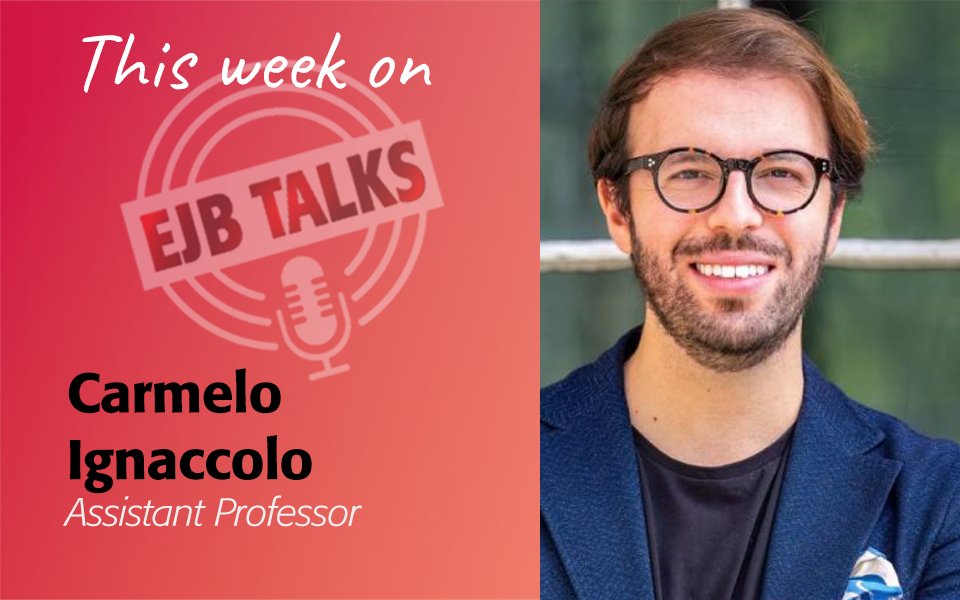
Uncovering Inequality Through Design: A Conversation with Carmelo Ignaccolo
This week on EJB Talks, assistant professor Carmelo Ignaccolo shares with Stuart Shapiro how his path into urban design was both inevitable and accidental. A native of Sicily, he explains how its complex political and geographic history contributed to his appreciation of how cities form. At the same time, his educational and professional journey through architecture, engineering, and planning guided him toward an interdisciplinary approach to design. Carmelo also explains how, in both his research and teaching, he has focused on how design has had the power to shape inequality over time, showing how decisions such as highway placement or waterfront redevelopment leave long-lasting impacts on communities. He discusses how he incorporates these ideas into his book project, which explores how the design of port cities has historically masked inequality and how inherited infrastructure can be reimagined for climate resilience. Carmelo concludes with his teaching philosophy, explaining that he tells students that he believes the most visionary planners understand design, and the most impactful designers are those who understand policy.
Transcript
Stuart Shapiro
Welcome to EJB Talks. I’m Stuart Shapiro, the Dean of the Bloustein School. And the purpose of this podcast is to highlight the work my colleagues and our alumni in the fields of policy, planning, and health are doing to make the world a better place.
Today, we have our newest professor in our world-ranked urban planning program, Carmelo Ignaccolo. Welcome to the podcast, Carmelo. Did I say your last name right?
Carmelo Ignaccolo
Perfectly! So, thank you, Stuart!
Stuart Shapiro
Alright, alright! The podcast is now a win, regardless of what happens after! ((laughing)) So we will start, as we almost always do on these podcasts, with your origin story. Tell me a little bit about how you got into urban design.
Carmelo Ignaccolo
Sure. Thank you for having me on the EJB podcast. Really, really excited about that. So I often say that my path into urban design was inevitable and accidental at the same time. Inevitable, perhaps because of where I grew up. And accidental because of the sort of, like, professional and educational trajectory I had in my career through architecture, engineering, urban design, and city planning.
So the inevitable component perhaps starts from the place I’m from. I’m originally from Sicily, in southern Italy. And by birth, I think, that that place puts you in a very complex spatial identity position. You are politically part of Europe, but geologically you’re standing on the African tectonic plate. You are in Italy, but your language draws from Arabic, Spanish, and French. And you walk streets that were planned by the Arabs in the 11th century, but they’re now filled with baroque Catholic churches.
So, I think in this overall complex historical situation, that my hometown sits on the at the footsteps of Mount Etna. So, you have nature and history really challenging the presence of humans and the idea of, like, how cities can develop in this very challenging context. And that somehow trained me to see urban environment and cities as physical archives. And I needed a vocabulary to explore those. And this is what really pushed me into urban design.
The more accidental part perhaps, is the sort of professional and educational journey. As I mentioned, I started, like, my bachelor and master’s degrees in Italy, are in architectural engineering. I didn’t like, perhaps, too much, the building focus. I wanted to see more of the urban scale how like cities and buildings are sort of, coming together and defining the spaces of cities. And so, that’s how I got a post graduate degree in urban design.
But even there, the people and the sort of social, economic and the dynamics of cities were somehow missing in that analysis. And this is how I decided to pursue a PhD in city planning. So in the hand, I think that urban design for me became the place where these different slices finally overlapped, and where policy meets form, and history informed the legacies of how physical environments are shaped.
Stuart Shapiro
Yeah, that’s great. It’s amazing how many of our faculty, and even people I meet as fellow Deans and such, there’s a large element of accident in their stories. And a lot of us got here. I know, I never planned to be an academic, much less a dean! So, sometimes we just have to ride the waves a little bit there.
Carmelo Ignaccolo
Yeah, no, absolutely. And then there is also, I would say that professional experimentation, right? I mean, I worked as an urban designer in a private firm then transitioned to more design and planning for the UN. And that sort of like, made me understand a bit like the real challenges and the hands-on implication that design and planning thinking have for the shaping of cities. So it’s as you said, like it’s a combination of two, right? Like the accidental component in your education, and also the test and try effort that you do in your professional career. ((laughing))
Stuart Shapiro
Yeah, absolutely. So, you mentioned a lot of different fields in your background there.
Carmelo Ignaccolo
Yeah.
Stuart Shapiro
Urban design, architecture, planning. You also mentioned engineering, policy. So you’ve got a, clearly a variety of influences playing on you. And I want to, sort of…let’s talk about, sort of, your research work first. How do you integrate all these things? I mean, we live in a world where it is much easier to publish if you’re very specialized.
Carmelo Ignaccolo
Yeah.
Stuart Shapiro
But I think the bigger contributions come from being able to bring multiple disciplines into your work, and I’m wondering how you do that and how you think about that.
Carmelo Ignaccolo
Yeah, I think integration and being interdisciplinary, it can be a challenge, but also an asset. And I really like to see the asset side of it, of course.
Stuart Shapiro
Right.
Carmelo Ignaccolo
And I would say that, especially for what I do, like, integration really comes from multi-scaler thinking. So, architecture really teaches us to care about materials and individual buildings and people in those buildings. Planning teaches us to really understand systems. So you have mobility, housing, ecology component and of course governance. So to me, what is really like, exciting, is how urban design as a sort of multi-scaler and interdisciplinary research endeavor sits between this world, right? Translating efforts across scales.
And I like to think about their efforts also somehow historically. You know, the first urban design program in the country started in 1956 at Harvard.
Stuart Shapiro
Mmm hmm.
Carmelo Ignaccolo
Where like, Spanish Catalan architect was the Dean. Sert started the program also in response to the sort of like, destruction that happened during World War II. And so, the idea of finding the scale, like the physical scale to respond to those challenges that architecture was not able to address was the real drive for that effort. But now we are like in the 21st century with the climate crisis, ramping spatial and social inequality. How and what is the role of urban design in addressing those? And I really want to challenge like, somehow, the position that the urban design critic Michael Sorkin had in 2006 about the end of urban design. It’s like, what is the responsibility today, urban design? It was like, really arguing the fact that we’re like, trapped as a discipline in between the idea of like, following form-based coding of new urbanism and becoming a sort of like, execution of coded-built environment.
So, where is the sort of more civic imagination needed in this field? And I think like, it’s really fundamental to use that framing to address the contemporary challenges that we are seeing. So, integrating architecture, planning, and urban design is really about [prepping] ourselves and our students with the tools to respond to the social and climate urgencies of our time, with somehow clarity, imagination, but also civic purpose, which is, I think, clear and strong in the Bloustein mission.
Stuart Shapiro
Yeah no, that’s great. Whenever anyone writes the end of something, it’s almost always wrong, right? The end of history, the end of politics. The end of urban design. ((laughing)) Somehow, all these things keep going despite that.
So you mentioned students. With this varied background that you bring to the classroom. How does it affect your teaching? How do these fields sort of come into the classroom for you?
Carmelo Ignaccolo
Yeah, I think it’s perfectly situated, I would say, in the Bloustein DNA. I mean, Bloustein is interdisciplinary at its core, right? Because of the different types of programs that we offer. But also even within the urban planning program, the different types of concentrations that we have.
So, I’ve already shared about multi-scaler thinking, interdisciplinary thinking. So, these are all things that I’m trying to bring into like, my classes where I’m like, really trying to speak to the different concentrations of our program, not just the urban design one. We have like people concentrating in like, environmental policy and transportation. So it’s really that cross pollination, it makes the class environment better. And like people trying to understand how and where physical form, the design of the built environment, matters for these different fields. So I would say that like, my approach has two pillars. Like, first I teach visualization almost as a civic skill. So in my courses we look at how to build 3D-modeling, how to craft maps and different sort of representational techniques. Not just to make beautiful and compelling drawings, but really to communicate arguments to communities and city officials and clients. So a plan, in the end, is never just a drawing. It’s a way to show evidence, but also persuasion that it’s really fundamental in the field, especially when we try to communicate something.
The second pillar of my teaching is more related to the sort of, like, larger ethical project of urban design. So how do we craft spaces that signal inclusion? How do we think about like, climate adaptive urban design? So it brings students to a wide series of examples and design efforts across the world to equip them with the thinking of designing places that have, that are designed for multiple audiences and have different types of environmental and social performances. In the hand I would just say that it’s a combination of again, creating technical precision, but also situated understanding, in classes that deeply care about the meta-reality and the physicality of cities.
Stuart Shapiro
And how do you find they react to this?
Carmelo Ignaccolo
Oh, it’s quite fascinating. Like I see that, especially depending on the different type of concentration they are part of, so I see transportation planners deeply caring about streets, intersections and like, looking at the shape of the buildings that are part of those intersections. So, going beyond the street level and looking at façade, checking and understanding questions of transparency, and like, sort of, connection between what is happening in the building and what is happening in the public space.
Then you turn and then you have the folks in environmental policy who are really interested, for example, at bioswales or like, how do we equip those street corners with design toolkits that can increase sort of, like, water drainage in case of flood and other sort of extreme weather events. So, it’s really fascinating to see the different lenses coming together in one physical space. So I train them with the skills, but we also tend to work in our classes with the blocks around the Bloustein School. So, we’re, like, slowly covering downtown New Brunswick by having this sort of experiment in the blocks around the Bloustein School.
Stuart Shapiro
That’s great. I want to give you a chance to talk a little bit about your research and for listeners, please check it out. There’s lots of interesting things that we’re not going to get to cover here. But one thing that particularly fascinated me was you’re talking about spatial inequality. How does design and the things that you study contribute to inequality over the long term? Because obviously this inequality is one of the burning issues of our time.
Carmelo Ignaccolo
Sure, absolutely. So, well, as we know, cities are not the result of sort of biologically inevitable choices, right? They don’t grow the way plants grow. They grow because of like, power. They’re shaped by power. And the power is visible, physically, in the way in which the built environment is designed. And if you look at the history of the United States, you see this vividly, right? You see the federal highway system didn’t just connect places, it also cut through Black and immigrant neighborhoods, displacing families, depressing land values, and at times even fragmenting communities. And that happened, of course, on top of redlining and other sort of like, political and socioeconomic conditions.
So, these acts were not neutral engineering decisions. But to me what is kind of like, fascinating and alarming at the same time, is that this decision ended up having like a physical trace on the environment of cities. And that trace keeps enduring throughout time. Once you build something, it’s really hard to move it! Like, it’s not like people, or like vehicles, like, things endure in space, shaping opportunity and vulnerabilities for generations. And that’s really the key point of looking at spatial inequality as never created overnight. It accumulates quietly through design. And urban design, in the end, is not just about form. It’s about, like inquiring the temporal power the design has in accumulating certain condition over time.
So when I talk about spatial inequality, I’m talking about how design encodes power across time, but also what’s the role of urban designers today in intervening in those conditions that are not just about aesthetic, but also really about deeply reparative gestures that we need to think about to address those unequal accumulation of conditions over time.
Stuart Shapiro
Can you give me an example of an intervention?
Carmelo Ignaccolo
Yeah, sure. In my book project, for example, I’m looking at the design of port cities across the world. I started from cities in the Mediterranean, like looking at Naples and Beirut. But now I’m trying to like, have some hands-on primary research happening in the port of New York and Elizabeth to really answer the question of like, how can we go beyond the design of waterfronts and ports side of innovation and looking at what happened behind those façades of development on water. And so what happened to the communities that were not part of those major development plans?
And in cities today and I’m looking at this for example, in Naples, in southern Italy, you have neighborhoods that were primarily working-class neighborhood for workers related to the port, and now they’re not part of the economy. So, and they’re even like, isolated by that world by highway that was put on the water. What are the sort of conditions and solutions to provide better housing and environmental conditions for those communities that were not part of that development project? So there are ongoing efforts, I would say reparative efforts on those fronts happening across the world. In Naples, in Barcelona, Spain, in Marseille as well. About like, how to improve those connections that were neglected for such a long time. And now by using like, public space design and better access to ports, can be reclaimed by those very same communities that were not part of those processes.
Stuart Shapiro
That’s great. Tell me more about the book.
Carmelo Ignaccolo
Yeah. So the book that I’m working on really draws from my dissertation. And it really tries to answer key questions. How have ports historically masked the design of inequality on waterfronts? And how can those same inherited infrastructures help us design more climate-just futures? So I’m somehow bringing, again, a very deep historical dimension of the design of port cities with more contemporary challenges that those areas are experiencing these days.
And the framing that I’m somehow constructing in the book is rooted into two concepts. One is the masking concept. So how design is hiding or somehow creating views or moments that are covering those that are not supposed to be seen and so like, what happened with the prime design of waterfront edges and what never changes behind those glorious façade of development of water? And then the other component, it’s more the environmental dimension of it. We have old historic infrastructure that are sitting in those spaces. How can we equip those historic sites and heritage sites to be sites of adaptation for the escalating climate crisis? So I’m calling that the climate heritage framework.
And even in Elizabeth, in the port of Elizabeth, I’m looking at the legacy of a park that was designed by Olmsted in the 1920s and how that park can inform resilience and climate resilience policies for those communities that develop around the port. Especially in an area that is at high risk of sea level rise and storm surge. We know how that happened a couple of years ago and people died in Elizabeth in the area very close to that park. Because, you know, throughout the development and urban development of the 20th century, we ended up building buildings on what Olmsted brothers designed as ponds. So, topography never changed. So the topography of the pond it’s still the same, but then we ended up developing on top of that. And so that sort of brings up questions about legacies, but also reparation through climate adaptation on edited sites on port cities.
Stuart Shapiro
That’s fascinating stuff, and I’d love to dive deeper, but I don’t want to lose listeners, so I’m going to wrap up by giving one more question about students. Students often come in to, you know, a class or a discipline, thinking it’s about one thing, right? I want to be a designer or I want to be a city planner.
And how, given your interdisciplinary background and approach, what should students be thinking about as they enter any field? But obviously planning most particularly because that’s where you’re working in.
Carmelo Ignaccolo
Sure, sure. Thank you for asking this. And I mean I always tell students that the most impactful designers are those who understand policy. And the most visionary planners are those who understand design.
Stuart Shapiro
That’s great.
Carmelo Ignaccolo
So that’s the kind of combination of them trying to build with my teaching, and I somehow want to bring also reference and examples on how planning is situated in context that we somehow tend to think that it’s not part of those, right? There are like, planning offices within major architecture and urban design firms. So being in those environments and being able to speak the sort of design lexicon with the designers, but also the planning one with the city authorities and clients involved in the process, it’s really fundamental and key. So I really hope to communicate that with my teaching. And really equip the next generation of planners who can really think spatially and physically about those environments that are spatial and concrete, right? They’re not just the production of what it’s written into, like a policy document. They’re shaped by people determining why that angle of the building is to stay over there. And how that public space has to be organized. So it’s an extraordinary responsibility. But also, I would say a great opportunity to equip the next generation of Bloustein students with those skills.
Stuart Shapiro
Fantastic. Carmelo, thank you so much for coming on and for a great conversation.
Carmelo Ignaccolo
Thank you, Stuart, for having me here.
Stuart Shapiro
Also, a big thank you to Tamara Swedberg and Karyn Olsen who make this podcast happen. We’ll be back in a week or two, maybe right after Thanksgiving, with another episode from another expert at the Bloustein School. Until then, stay safe.