
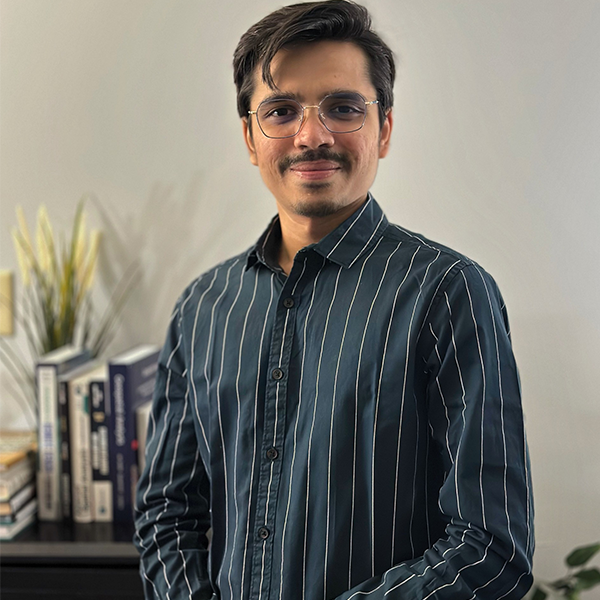
Neel Savalia
Master of Public Informatics, Class of 2023
GIS Specialist, City of Richmond, VA
For Neel Savalia, the Bloustein School stood out from the beginning because it offered a unique combination of disciplines. “Bloustein doesn’t treat urban planning, policy, and informatics as separate silos, it integrates them into one ecosystem,” he said.
“Many schools will teach you how to analyze data, or how to design cities, or how to shape policy. Bloustein pushes you to connect all three, so you’re not just studying problems, you’re building solutions that can actually run in the real world.”
Today, he works with the Department of Public Utilities in Richmond, where his role blends technical expertise with community impact. “My role focuses on editing and managing the gas utility enterprise geodatabase, making sure it accurately reflects the latest as-built drawings and engineering plans,” he said.
“I also handle GIS records management, scanning and archiving critical documents, and responding to mapping and analysis requests from employees, contractors, and customers.”
For prospective students and future graduates, the Master of Public Informatics program is not just career preparation. Neel calls it a ‘launchpad for leadership’ in a rapidly changing world. “The MPI doesn’t just prepare you for a job. It prepares you to engineer the future of cities, industries, and governance. With the blend of informatics, GIS, and policy, you’re equipped to move into public agencies, utilities, tech companies, research labs, or even launch your own ventures.”
Neel credits the Bloustein School with providing the tools to think beyond maps and data. “It gave me the opportunity to combine my background in urban planning with advanced coursework in GIS, AI, and informatics, which is exactly what I needed to start designing the kind of spatial intelligence systems I envision for cities,” he said.
“Bloustein taught me to see spatial data not just as a record, but as a living system that can inform decisions, optimize infrastructure, and ultimately improve lives.”
He is optimistic about the role of AI and the next generation of Bloustein graduates. “For me, AI is about building the core systems for civilization, so we can make smarter, faster, and more sustainable decisions at a global scale. But with that power comes responsibility,” Neel noted. “AI can amplify progress, but if used poorly, it can also amplify errors or inequalities. That’s why the MPI training, blending informatics, planning, and governance, is critical. It equips us not just to deploy AI, but to deploy it wisely.”
What makes the Bloustein School special, he said, is that it is training people to think across disciplines. To use spatial intelligence, AI, and informatics to solve problems that matter, from climate change to smarter cities to sustainable energy
“If you’re someone who doesn’t just want to learn about the future but actually build it, Bloustein is the place. And if you step into it with ambition, you’ll come out not just with a degree, but with the mindset and tools to design the systems that shape how societies live, work, and thrive,” he concluded.