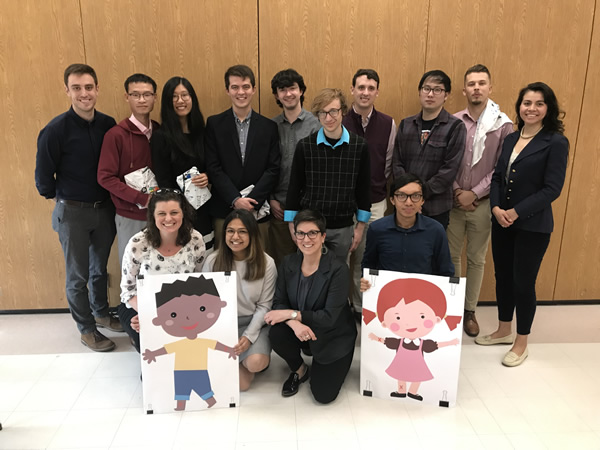
Twelve graduate urban planning students explored how to actively engage community stakeholders in the placemaking process to create economic vitality and inclusive healthy places in the Borough of Highland Park, NJ in the Bloustein spring graduate planning studio, “Placemaking in Highland Park: Making Connections between Place, Health, Equity, and Economy.”
Led by staff from the Bloustein School and Project for Public Spaces, students learned placemaking concepts including using the “Power of 10” as a framework to identify key destinations, how they might be clustered in neighborhoods, and the potential activities within each. They also learned how to engage the community in a tactical “lighter, quicker, cheaper” approach to short-term, low-cost interventions that can unite a community vision and serve as a catalyst for larger community-based improvements.
As a key component of the studio, students planned two days of placemaking and community engagement in consultation with the local government and business district in the Borough. The event, titled “Highland Spark,” sought to activate four outdoor living rooms (seating areas) located along Raritan Avenue at the intersections with 3rd and 4th Avenues. Through a variety of placemaking activities, the Studio Team used activities at these locations to prompt discussion of a community vision for an inclusive healthy Highland Park. Each of the four living rooms hosted activities based around the following themes: social support and interaction, walking and biking, green and natural environments, healthy foods, and play and active recreation.
The final report examines the concept of placemaking, the interaction between health and place, the outreach placemaking events hosted by the Studio Team, recommendations for the Borough, and potential funding opportunities for Highland Park’s future placemaking efforts. The recommendations are intended to be ongoing and iterative and serve as tools for use by the Borough in any evaluative or future placemaking efforts. The engagement strategy findings can also assist the Borough in gathering community input for future initiatives.
Students participating in the studio were Silvia Cuevas, Ian Girardeau, Harsheeta Gupta, Christopher Henchey, Daniel Hutton, Edward ‘Ted’ Metz, Andrew ‘Max’ Natanagara, Yoga Pratama, Samuel Rosenthal, Qingyang Xie, Chen Zhang, and Zhaoming Zhang.
The studio was taught by Leigh Ann Von Hagen, AICP/PP, senior research specialist at the Alan M. Voorhees Transportation Center in partnership with Project for Public Spaces staff Laura Torchio, AICP and Cailean Kok MCRP ’14, AICP.