
The saying “demography is destiny” is particularly true about New Jersey.
On Tuesday, April 12, the Bloustein School’s Center for Urban Policy Research will host a panel discussion that will explore the historical, current, and post-pandemic demographic landscapes of New Jersey with particular attention to New Jersey’s remarkable history of immigration; racial, ethnic, and national origin diversity; generational changes and disruptions; as the well as the changing composition of New Jersey “Big Six” cities: Camden, Elizabeth, Jersey City, Newark, Paterson, and Trenton.
“Post-Pandemic Demographic Futures: Population Trends in New Jersey”* will also explore the population and economic impact of New Jersey’s centers of technological advancement, including the Bell Labs “Idea Factory” and the life sciences and pharmaceutical sector.
This event will be presented in-person and live-streamed. The event will begin at 4:30 p.m. at the Gov. James J. Florio Special Events Forum, Civic Square Building, 33 Livingston Avenue, New Brunswick, NJ. All registrants will be sent the Zoom link when registering.
The panelists will include
- James W. Hughes, Dean Emeritus, Bloustein School of Planning and Public Policy and University Professor, Rutgers, The State University of New Jersey
- Charles E. Menifield, Dean, School of Public Affairs and Administration, Rutgers University-Newark and Co-Principal Investigator, New Jersey State Policy Lab
- Connie O. Hughes, New Jersey State Demographer, 1977-1995 and President & Commissioner, New Jersey Board of Public Utilities, 2001-2007
- David Listokin, Distinguished Professor, Bloustein School of Planning and Public Policy and Co-Director, Center for Urban Policy Research
Marc D. Weiner, Associate Dean of Academic Administration and Associate Research Professor, Bloustein School of Planning and Public Policy, will moderate the discussion.
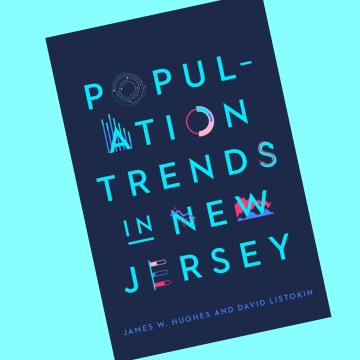
The discussion is based on the 2022 release, Population Trends in New Jersey (Rutgers University Press, 2022), in which authors James Hughes and David Listokin detail how present-day New Jersey is the result of a centuries-long demographic and economic journey, which has been constantly influenced by national and global forces. In review, Richard Florida – author of The Rise of the Creative Class and The New Urban Crisis – writes:
From great battles of Colonial times to the Industrial Revolution and the world-changing inventions of Thomas Edison to mass suburbanization, deindustrialization, immigration, urban decline and the remaking of its older cities, and its signature contributions to popular culture from Frank Sinatra to Bruce Springsteen… this book shows how New Jersey is a great bellwether of change for America and the world.
*1.5 AICP Certification Maintenance credits available for in-person attendance.