
 A core element of the John J. Heldrich Center for Workforce Development’s mission is to “raise the effectiveness of the American workplace by strengthening workforce education, placement and training programs, and policies.” To improve the effectiveness of such programs, it is necessary to first increase transparency and determine to what extent certain programs are already effective. New Jersey highlighted this goal, ensuring system integrity through metrics and greater transparency, in its 2016 Combined State Plan for the Workforce Innovation and Opportunity Act (WIOA).
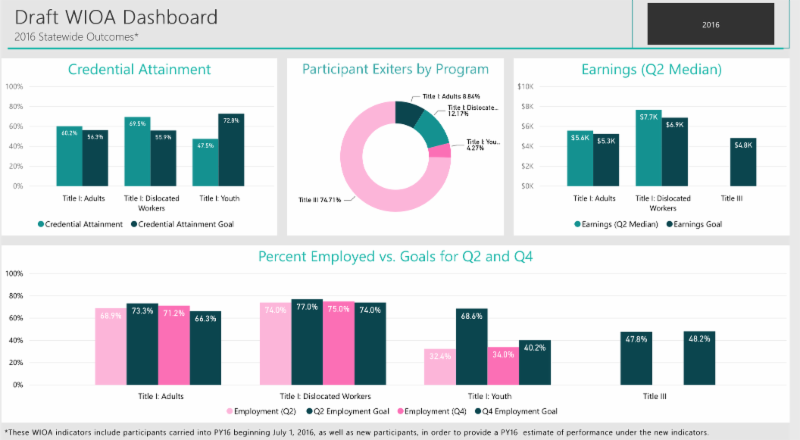
As a part of that effort, Heldrich Center researchers, led by Stephanie Holcomb, worked closely with the New Jersey Department of Labor and Workforce Development (NJLWD) and the New Jersey State Employment and Training Commission (SETC) to produce a performance metrics dashboard now available to the public (see links below).
This dashboard uses quarterly and annual data from WIOA-funded workforce programs, reported by NJLWD, to illustrate the state’s performance compared to its goals. In the first iteration for Workforce Investment Act (WIA)-funded programs, the dashboard highlighted employment and earnings outcomes statewide and by local workforce investment board area. While the most recent WIOA dashboard does not yet include local workforce areas, it adds a final page on participant demographics.
With technical assistance from the Heldrich Center team, SETC can now use this dashboard to highlight program performance and target areas for further discussion. Though these data were previously reported through annual reports, the creation of this visual tool allows SETC to analyze and compare the data visually, over years, and across areas.
View the most recent WIOA dashboard.
See the previous WIA dashboard.
View the SETC website performance page.
Lead staff member:
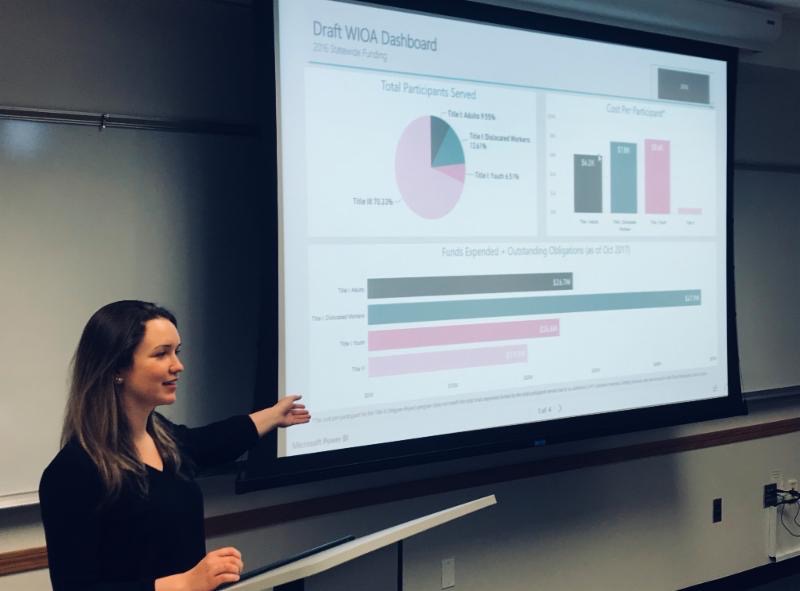 Stephanie Holcomb, Research Associate, is a member of the Heldrich Center’s research and evaluation team, and conducts quantitative and qualitative research, such as implementation and process evaluations, in several policy areas such as employment and training, higher education, and social welfare. She specializes in synthesizing and analyzing complex administrative datasets, in developing data stories that visually display data findings, and in the development of interactive dashboards.