
The Organics Waste Management Research Team is conducting research on methods of how to keep food waste out of landfills, reduce greenhouse gas emissions, and enhance food rescue practices in New Jersey. Since Anna Heckler’s post in early October, our team has been working towards wrapping up our literature review and gathering information through interviews. The team is interviewing representatives from state government, non-profit organizations, and higher education institutions around the country who are engaged in best food waste practices that we hope to emulate in New Jersey.
Interviewees are providing invaluable context on topics including the implementation of food policy councils, manure management policy, and food waste educational initiatives. Some of our recent conversations have revolved around implementing share table practices in schools1, the use of depackaging facilities2, financing for food policy councils, and enforcement mechanisms for food waste bans. Our team is beginning to write up our research findings with the goal of completing our report by the end of the semester.
History of Food Waste in NJ
To gain a better understanding of New Jersey’s food waste history, we met with our advisor, Gary Sondermeyer, Vice President of Operations at Bayshore Recycling Corporation, an expert in the food waste field. He relayed that the passage of the Federal Resource Conservation and Recovery Act (RCRA) in 1976 (United States Environmental Protection Agency, n.d.) and the subsequent United States Environmental Protection Agency (US EPA) interpretation of RCRA spurred a state-wide inventory of waste facilities in New Jersey.
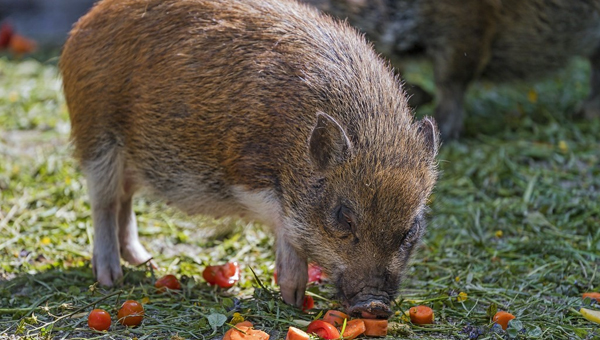
Mr. Sondermeyer, who took part in the inventory process, said that after evaluating all 630 town-managed open dumps, New Jersey decided to close all of them due to poor siting and waste management practices. This was in line with New Jersey’s contamination reduction initiatives at the time, but also had the side effect of reducing food composting which was taking place at some of these town dumps. Additionally, pig farming was previously more common in New Jersey. Pigs consume just about any food and are a great way to divert food scraps from landfills. The closing of pig farms throughout the state led to less food waste being removed from the waste stream (G. Sondermeyer, personal communication, October 5, 2021).
With the closing of the town dumps, New Jersey moved waste management to the county level, where it currently resides. More recently, in 2017 the New Jersey legislature passed P.L. 2017 c. 136 which echoed national legislation at the time to cut food waste 50% by 2030. Part of this law tasked the New Jersey Department of Environmental Protection (NJDEP) with writing a Food Waste Reduction Plan. The NJDEP released the Draft Food Waste Reduction Plan and held three public hearings in 2019 (New Jersey Department of Environmental Protection, 2019). Per a Fireside Chat with current NJDEP Deputy Commissioner Sean Moriarty at the NJ Composting Council Summit on October 27, 2021, the NJDEP is planning to release the final version of the report in early 2022.
NJDEP is currently reviewing regulations, including those for small-scale and neighborhood composting facilities, to ensure they align with the State’s new Environmental Justice law while not unnecessarily impeding growth of the small-scale organics processing industry (S. Moriarty, personal communication, October 27, 2021). This brings us to the current efforts to reduce food waste, which was outlined in a previous blog post. If you would like more information about how you can bring composting into your home life, please see the Rutgers Home Composting resources page. You can also consider how you can impact composting in your community by starting conversations with your neighbors and encouraging entities like local schools to start on-site composting programs.
Notes:
1 Share tables are a solution to food waste in schools where students put food they don’t consume during lunch on a specific table so that others can eat it. Each state we are studying has different requirements for what can go on a share table, but generally there are some packaging requirements for all food and temperature requirements as necessary.
2 Depackaging facilities are a space where food waste is separated from its packaging. Some examples of why this is needed are food that is wasted because it expired or spoiled before sale and separating coffee grounds from single use coffee pods.
Resources
- Heckler, A. (2021, October 4). Organic Waste Management: An opportunity for New Jersey policy leadership. Retrieved from Rutgers New Jersey Policy Lab: https://policylab.rutgers.edu/organic-waste-management-an-opportunity-for-new-jersey-policy-leadership/
- New Jersey Department of Environmental Protection. (2019, September 19). Food Waste – Food Waste Reduction Plan. Retrieved from State of New Jersey Department of Environmental Protection Site Remediation & Waste Management Program: https://www.nj.gov/dep/dshw/food-waste/food_waste_reduction_plan.html
- United States Environmental Protection Agency. (n.d.). History of the Resource Conservation and Recovery Act (RCRA). Retrieved from United States Environmental Protection Agency: https://www.epa.gov/rcra/history-resource-conservation-and-recovery-act-rcra
- Tamboko the Jaguar. (2019). Brown pig eating tomatoes [Photograph] Flickr. https://www.flickr.com/photos/tambako/49001737423/in/photostream/