

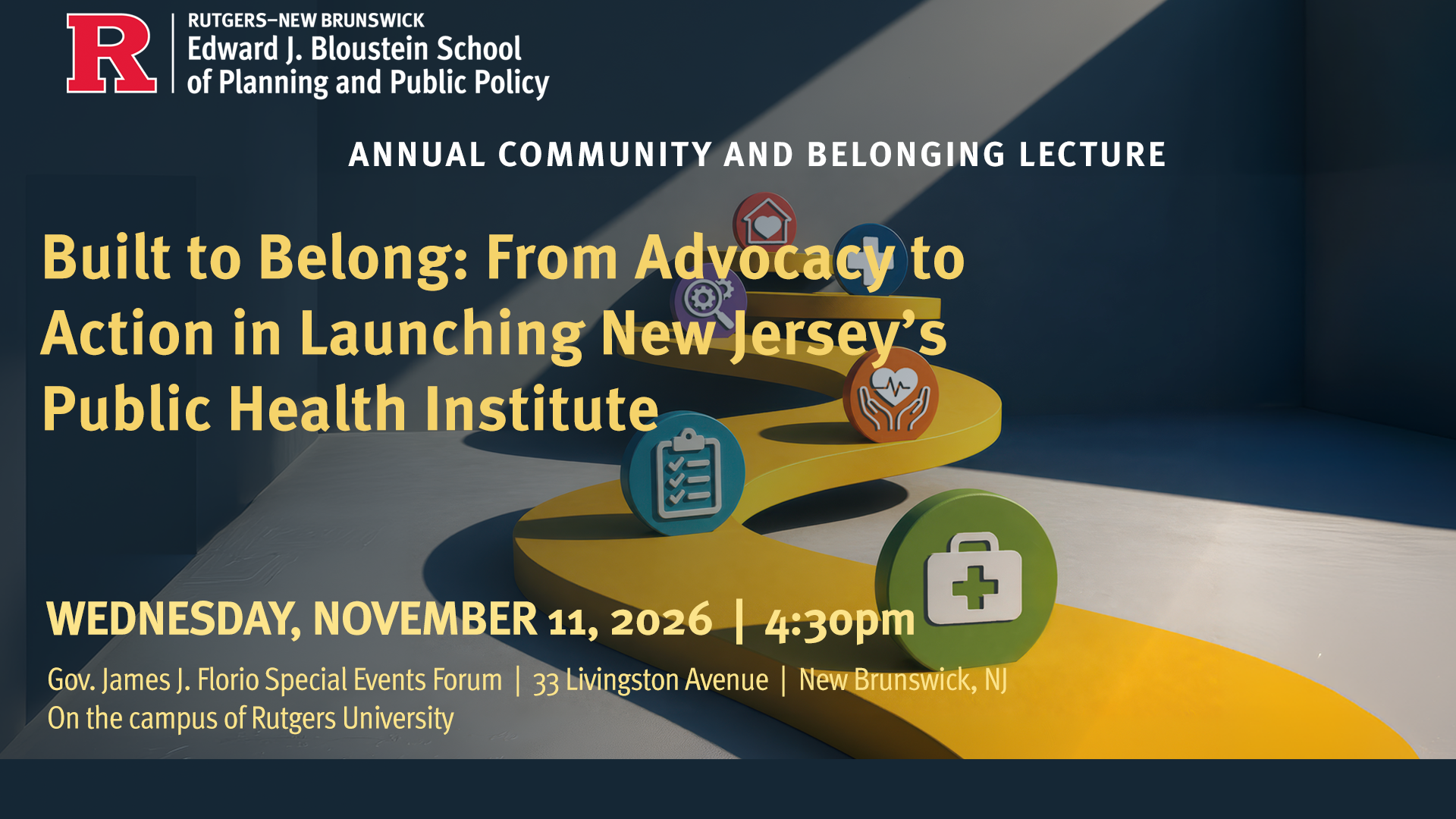
Community and Belonging Lecture | Built to Belong: From Advocacy to Action in Launching New Jersey’s Public Health Institute
 The Bloustein School Annual Community and Belonging Lecture is presented by Dr. Denise Anderson, an accomplished public health executive with experience in hospitals, government, nonprofit organizations, and academia. She is the Inaugural Executive Director of The Center for Health Equity & Wellbeing, New Jersey’s newly designated Public Health Institute. She serves on the boards of the African American Chamber of Commerce of New Jersey (AACCNJ) and is President-Elect of the New Jersey Public Health Association (NJPHA). She holds a BS in Human Ecology, an MPH from Rutgers, and a Ph.D. in Urban Systems from Rutgers and NJIT. Further, Dr. Anderson is a Centers for Disease Control and Prevention Public Health Prevention Service Fellow, an Eagleton Institute of Politics Fellow, and a Yale Pozen-Commonwealth Fund Fellow in Health Equity Leadership.
Registration is requested by visiting go.rutgers.edu/anderson26.
Public institutions do more than administer programs and distribute resources; they communicate whose experiences matter, whose voices influence decisions, and who belongs within the systems designed to protect our collective well-being. Building equitable public health infrastructure therefore requires more than creating a new organization. It requires challenging entrenched systems, cultivating trust, sharing power, and translating community priorities into sustainable policy and action.
Drawing from her experience launching the Center for Health Equity & Wellbeing—New Jersey’s Public Health Institute (CHEW-NJPHI)—Dr. Denise Anderson will offer a candid examination of what it takes to build a statewide institution from the ground up. The discussion will trace CHEW-NJPHI’s journey from advocating for authorizing legislation to establishing an administrative and incubation partnership with Acenda Integrated Health, developing a community-centered strategic plan, and assuming a significant role in New Jersey’s Rural Health Transformation initiative.
In this case study, Dr. Anderson will explore the tensions and opportunities of turning vision into infrastructure: building legitimacy while building capacity, balancing urgency with sustainability, and navigating relationships among government, communities, funders, and institutional partners. The lecture invites participants to consider how public health institutions can be intentionally designed to advance belonging, strengthen community power, and embed equity not only in their programs but also in their structures, partnerships, investments, and measures of success.