
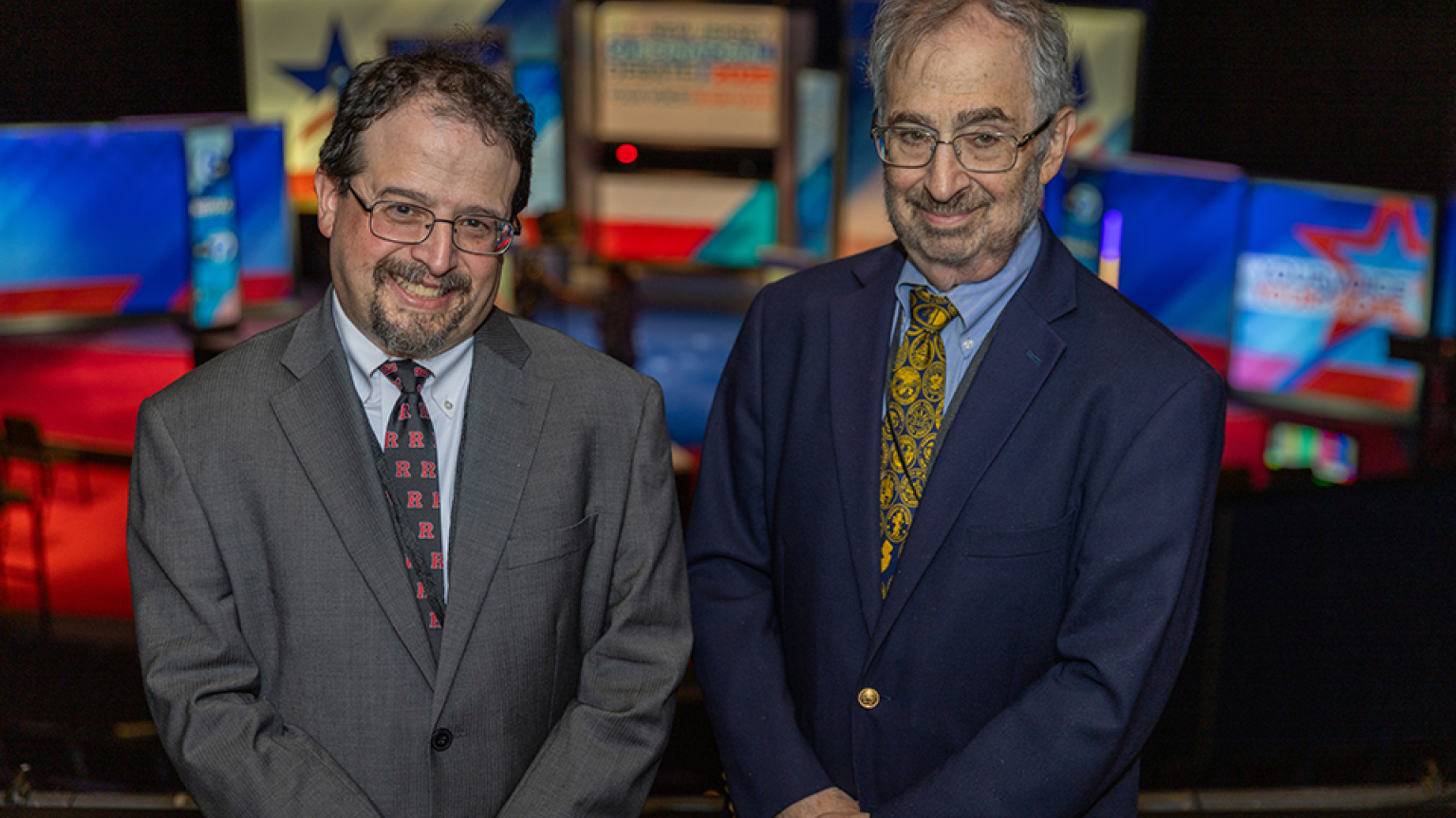
Stuart Shapiro, dean of the Edward J. Bloustein School of Planning and Public Policy, and Marc Pfeiffer, a senior policy fellow, provided the expertise to shape the debate questions.
Photo by Jeff Arban
by Greg Bruno for Rutgers Today
In co-hosting the final debate before Election Day, Rutgers scholars worked to elevate the public policy discourse.
Before the gubernatorial candidates took the stage at the New Brunswick Performing Arts Center on Oct. 8 for their final debate, very little had been left to chance.
What couldn’t be agreed upon – who would speak first, who would have the final word – was resolved by a method as old as democracy itself.
“They did a coin toss, Super Bowl-like,” said Marc Pfeiffer, a senior policy fellow at the Edward J. Bloustein School of Planning and Public Policy at Rutgers-New Brunswick, which co-organized the debate between Mikie Sherrill and Jack Ciattarelli. “The winner got to choose.” (Ciattarelli’s team called it correctly.)
When the results of the 2025 New Jersey gubernatorial election are tallied, pundits will look for clues from this week’s debate that could explain how victory was sealed – or squandered.
But for the policy wonks from Bloustein, the focus instead will be on the candidates’ promises and how, after months of collaborating with ABC7/WABC-TV New York, 6abc/WPVI-TV Philadelphia, Noticias Univision 41, and the performing arts center, millions of New Jersey voters were better informed as a result.
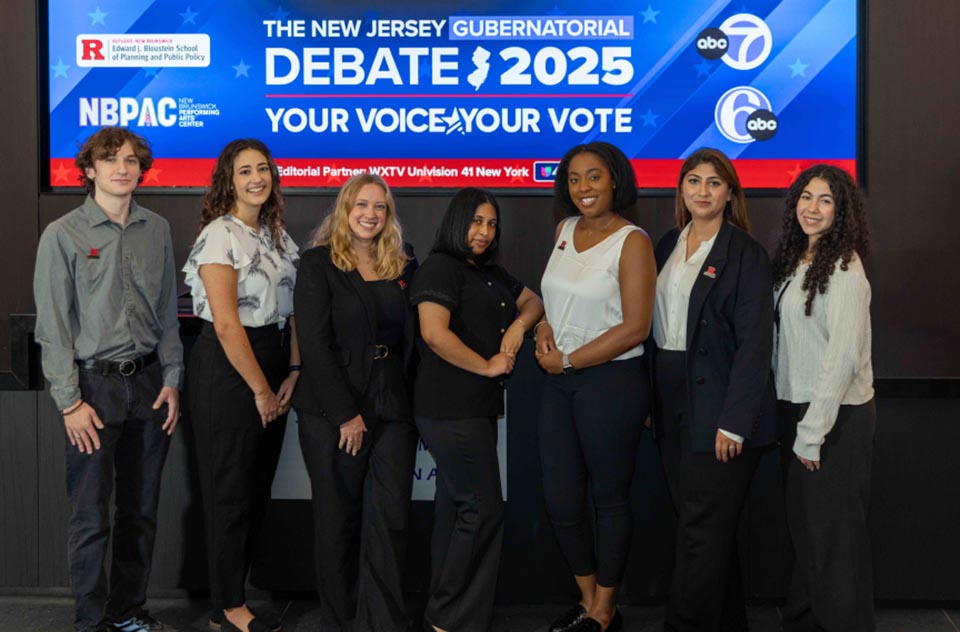
Students from Edward J. Bloustein School of Planning and Public Policy volunteered at the debate: Jake Papa, Caroline Chovanes, Emily Evers, Tara Aldrich, Tiffany Granger, Rimshah Jawad and Dina Abdelfattah
“Sponsoring the debate is part of how we fulfill our civic responsibility to help the voters of New Jersey choose their next governor,” said Stuart Shapiro, the school’s dean. “Anything we can do on that front is at the core of our function.”
For more than 30 years, the Bloustein School has been a trusted source for rigorous analysis on issues affecting the residents of New Jersey. “We are the place to go to for the state” on everything from economic trends to housing, health and transportation, said communications director Karyn Olsen.
That reliance has grown in recent years with the founding of the of the New Jersey State Policy Lab and the revival of the Center for Urban Policy Research. These centers, along with other Bloustein School units – such as the Alan M. Voorhees Transportation Center and the John J. Heldrich Center for Workforce Development – help the state and municipalities to strengthen the quality of data used to design, implement, and evaluate public policies and programs.
Shapiro said co-hosting a high-level political debate would raise awareness of the school’s ongoing work and reintroduce New Jersey to its public policy powerhouse.
Competition to host the debate was fierce. The N.J. Election Law Enforcement Commission evaluated the entries and announced the winners in July. It was the first time the Bloustein School was chosen to host a state-level debate.
Media partners WABC and WPVI proposed the format. Unlike the first town-hall style debate at Rider University on Sept. 22, questions for the New Brunswick debate were prepared by journalists – with support from Bloustein scholars – and posed by professional news anchors.
Arts center staff handled the on-site logistics. Bloustein staff managed media requests and gathered event volunteers. Rutgers helped with day-of logistics, and when the cameras rolled, two Bloustein students were on hand to soak it in. Attendance was limited to about 40 in-person viewers.
Jake Martinez (Master of City and Regional Planning and president, Bloustein Graduate Student Association) and Alecxis Villapando, B.S. in Health Administration, watched the debate live.
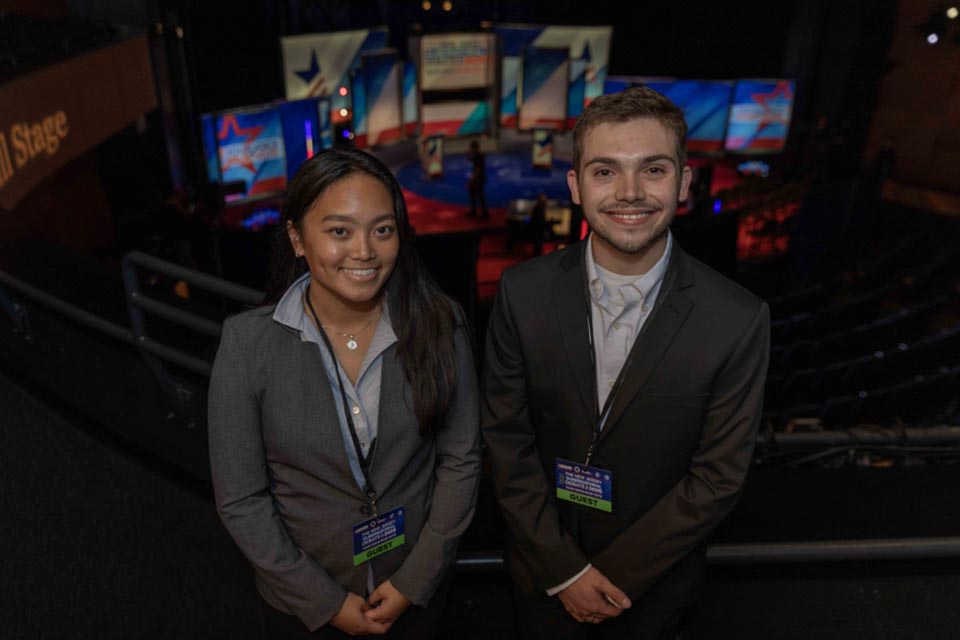
Jake Martinez (Master of City and Regional Planning and President, Bloustein Graduate Student Association) and Alecxis Villapando (B.S. in Health Administration) were among the small audience invited to watch the debate live.
Photo by Jeff Arban
But Bloustein’s most consequential contribution was providing the moderators with guidance long before the candidates took the stage. “Maybe they were putting together questions on the budget, energy policy, health care, Medicare or employee health benefits,” said Pfeiffer. “We provided data to support that preparation.”
“Our job,” Shapiro said, “was to provide expertise so that our partners were as informed as they could possibly be.”
Now that the cameras have stopped rolling and the candidates’ entourages have moved on, the experts at Bloustein can pause to ponder what they just accomplished.
They will also ask their own questions, which could inform future research. Did the debate move the needle in a close race? Were the candidates’ answers substantive, their promises achievable? And perhaps the most philosophical question of all: Do debates even matter in an era of disinformation and 24/7 news cycles?
“What happens typically is the debate puts a temporary jolt into the race, and then it settles back to the equilibrium that it was at beforehand,” Shapiro said.
There are exceptions, of course. “Sometimes there’s a moment in a debate that goes viral and has a significant impact,” he said. But those moments are rare.
Instead, the true value of political debates lies in the issues discussed and policies proposed. “In politics, theater matters,” Shapiro said. “But we’re wonks. To us, substance matters more.”