
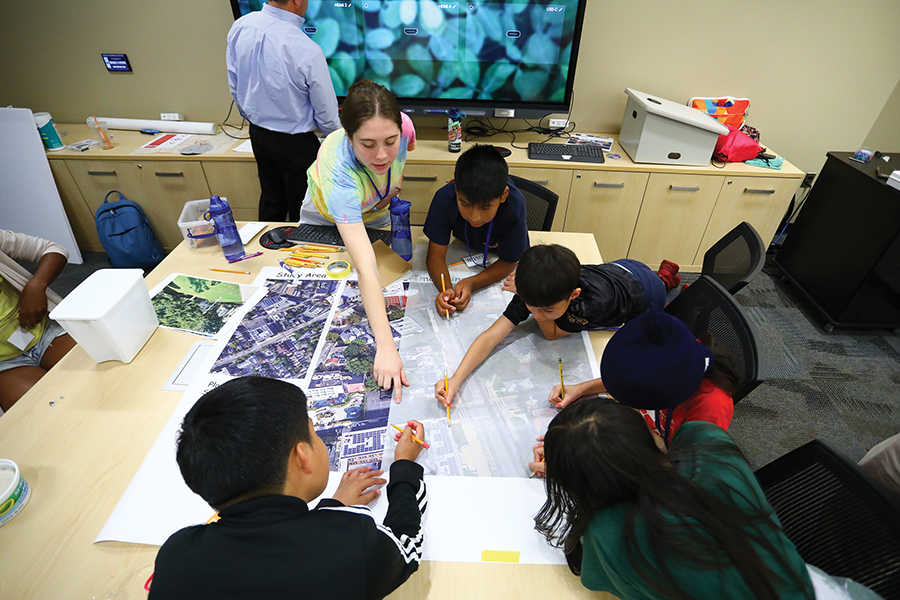
Bloustein student Zoe McGowan BS UPD ‘25 assists New Brunswick students with their mapping techniques at the 2024 Creative Cities Design Camp.
A generous gift from alumnus Walter C. “Wally” Evans MCRP ’74, helped the Bloustein School create a three-year summer program that introduced resident New Brunswick students to the field of urban planning.
Partnering with coLAB Arts and New Brunswick City Center, the Bloustein School sought to provide an innovative STEAM summer enrichment program to help students develop an understanding of urban planning and public policy solutions through a socially-engaged research and design process.
The Creative Cities Design Institute, a weeklong intensive program, was held during the summer from 2022-2024, partnering middle school students from New Brunswick public schools with professional urban planners and artists in workshops that included building artful cities, 3D printing, community engagement, and social justice.
“I had the pleasure of viewing the projects and photos and was quite impressed by the presentation and reactions,” said Mr. Evans. “Each year, the final projects reassured me that the introduction of urban planning and design to elementary and middle school students, through a hands-on project in their home community, was rightly ordered.”
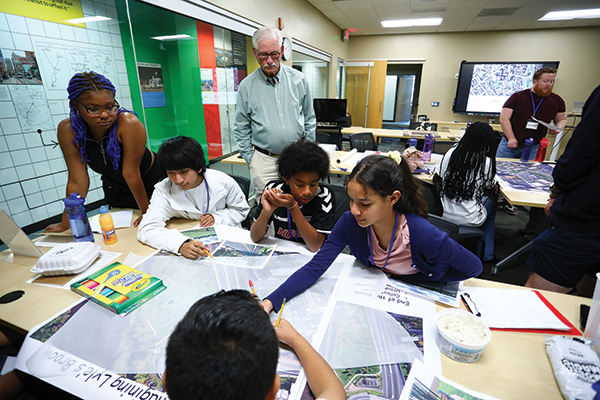
Walter C. “Wally” Evans MCRP ’74 (standing, back center) observes student participants of the Creative Cities Camp during one of their small group sessions in the Bloustein School’s graduate studio space.
Mr. Evans watched as children became fully engaged in reimagining their downtown and had fun while being exposed to the many facets of the planning practice. He explained to the students that a similar high school experience served as his spark to the pursuit of a planning degree and a fulfilling career.
Taught by coLAB Arts resident artists along with faculty and graduate students from the Bloustein School, students were engaged in what it means to engineer an artful and just city. John Keller, coLAB Arts Director of Education, and his team work with and engage artists, social advocates, and community stakeholders to create transformative new artwork in the communities in which they work.
Adding the element of urban planning, he said, was a new challenge.
“Our imagination was going to be applied to something that we’d never tried before–planning a city street. By combining socially engaged arts with urban planning, students learned about becoming agents of change in their own communities but more importantly, about working together to develop a vision for the future of downtown George Street.”
The end goal of each summer institute was for students to create an original art installation project to expand the intersection of city planning, art, engineering, environmental science, and social justice.
“Part of what we did was design ways to make our city of New Brunswick better, and decided as a group what ‘better’ in urban planning means,” said one institute student. “And it means safer, appealing, walkability, and maintenance.”
Observational walks on George Street and demonstrations of 3-D printing were just part of the experience. Students also discussed the importance of poetic language in preserving thoughts, feelings, and expressions beyond data, journalism, and fiction.
The New Brunswick students were also given demonstrations of the technology used by urban planners by Bloustein School faculty and graduate students in the urban design studio spaces of the school. Technical and political processes used in urban planning to develop and design communities, common terminology and symbols, and a large-scale model of George Street created by Bloustein students provided the middle schoolers with hands-on experience. Associate Teaching Professor Juan Ayala also demonstrated different 3D-modeling software used by graduate students.
“It is important to open this type of opportunity to young students. I teach undergraduate students who don’t know where cities come from or how cities are designed,” said Barbara Faga, Bloustein School Professor of Practice.
“Much of the information used in the Creative Cities Design Institute was the product of the Bloustein School’s graduate design studios, Imagine New Brunswick. The graduate student work was a great place to start when teaching middle school students how to design cities.”
“I can’t think of a field that impacts a municipality, a community, more than urban planning,” said New Brunswick Mayor Jim Cahill. “It is people like our Bloustein School colleagues that are teaching and learning in their graduate and undergraduate programs, and the coLAB artists who understand what happens in a community at the grassroots level, that help to translate the message through art so everybody can understand. That’s how you transform a community.”
For their final presentations each year, students created an interactive mural of painted tiles and sound recordings titled, “I Dream of a City Where…” which reflected their experiences, feelings, and what they learned and created throughout the week with coLAB teaching artists and Bloustein graduate students. Students were also able to share their own vision of George Street through the 3-D model created with the guidance of Professor Ayala and the resident makers at FUBAR Makerspace Labs in North Brunswick.
“The Creative Cities Design Institute got these students excited about planning cities,” said Doug Schneider, Chair of the New Brunswick City Center Board of Directors and owner of Tavern on George and Clydz restaurants.
“New Brunswick is something that we are all passionate about. Everybody that these students worked with is extraordinarily passionate about the city that we live in, that we play in, that we work in. And it’s a place that is ever-changing. And what they learned over the course of the design institute is teaching future leaders how to make our city the best it can be.”
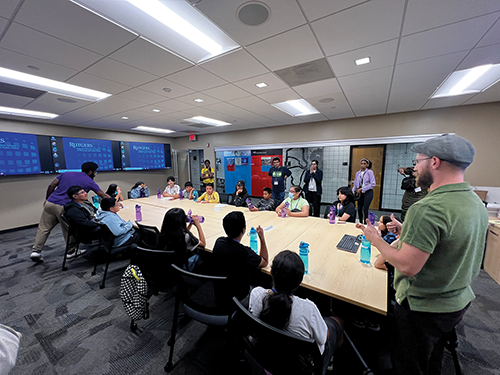
Creative Cities camp participants were instructed in design principles from coLAB Arts staff and Bloustein School faculty and students
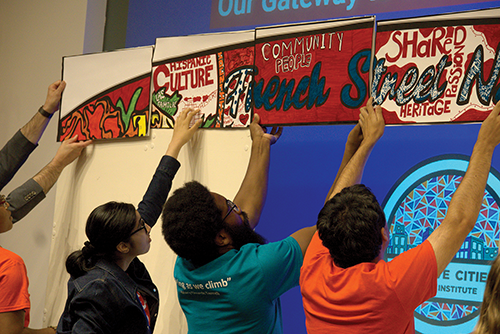
Individual tiles designed by the students were mounted and displayed during the final presentation.
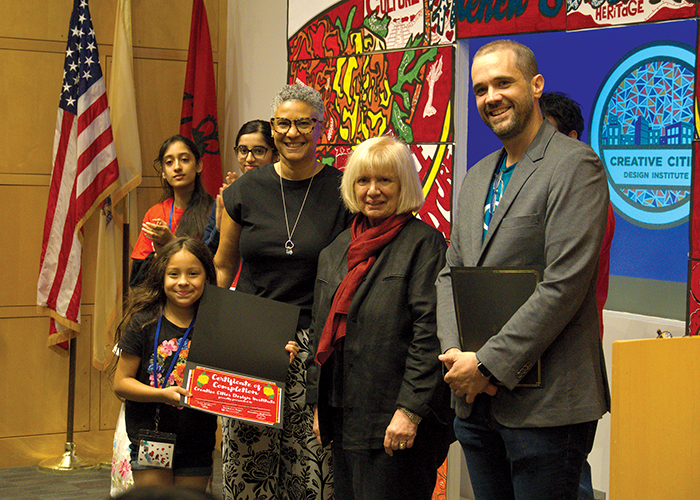
Bloustein School professor Barbara Faga (second from right) and coLAB Arts Director of Education John Keller (far right) presented students with their participation certificates.
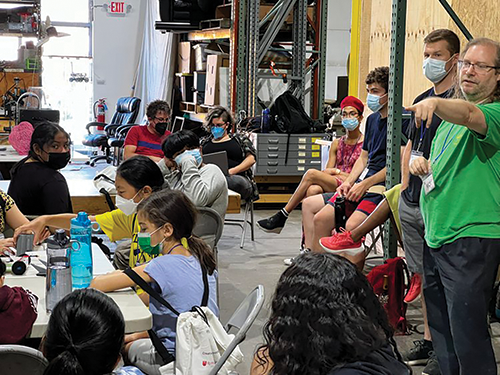
Camp participants were given a tour of FUBAR (Fair Use Building and Research) Makerspace Lab in North Brunswick.