
Guest Speaker Lerrel Pinto: Robot Data is Not Enough Data

February 13, 2026

How can robots make physical labor easier for humans?

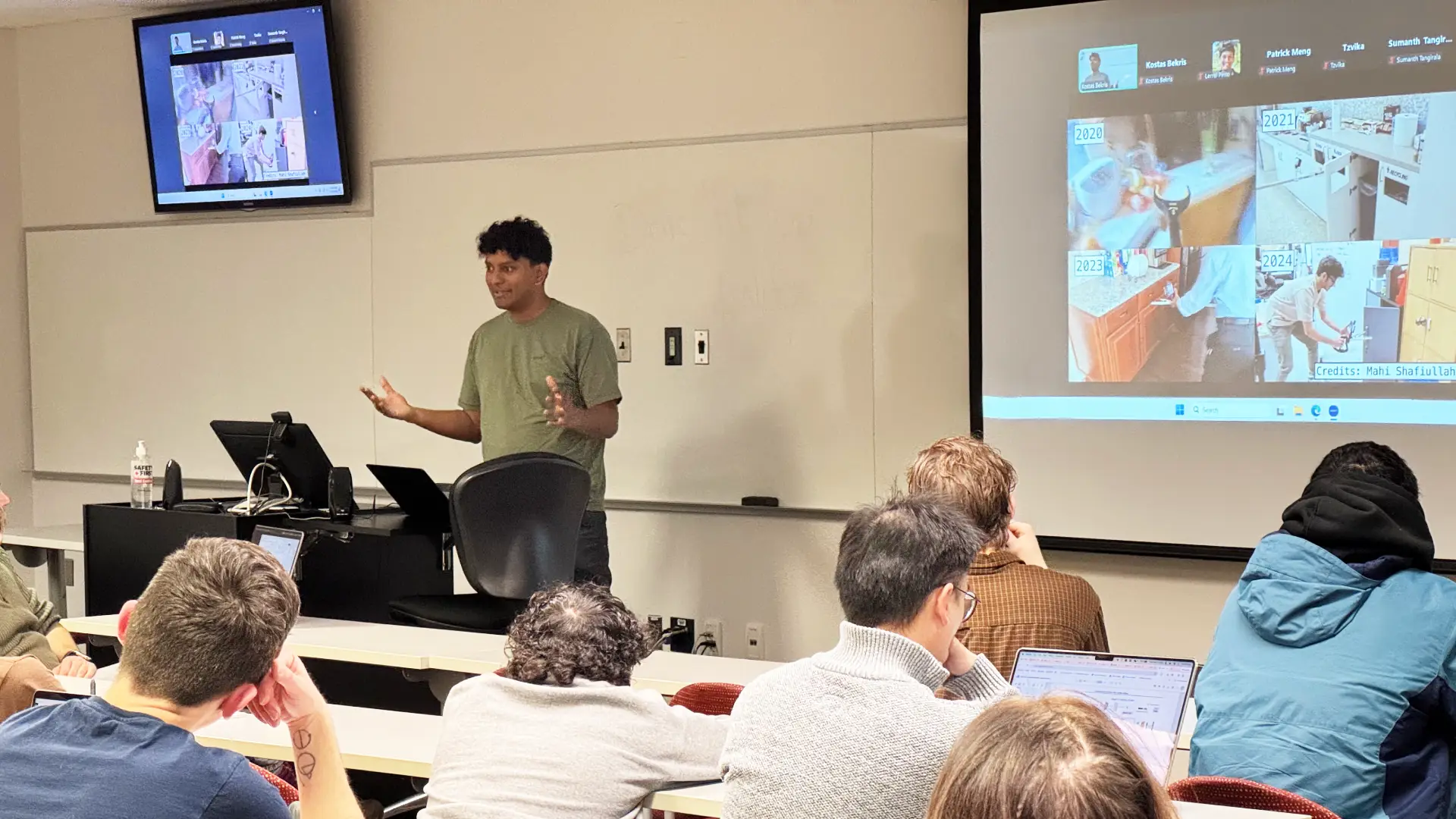
This past week, Prof. Lerrel Pinto gave a talk at the Bloustein School titled “Robot Data is Not Enough Data.”

Lerrel Pinto is the co-founder of Assured Robot Intelligence (ARI) and an Assistant Professor of Computer Science at NYU. His research is aimed at getting robots to generalize and adapt in the messy world we live in. To this end his work focuses broadly on robot learning and decision making, with an emphasis on large-scale learning (both data and models), representation learning for sensory data, developing algorithms to model actions and behavior, reinforcement learning for adapting to new scenarios, and building open-sourced affordable robots. This work has received best paper awards at ICRA 2016, RSS 2023, and ICRA 2024. Lerrel has received the Samsung AI researcher of the year award, Sloan Fellowship, Packard Fellowship, CIFAR Fellowship, TR35 innovator under 35, IEEE RAS Early Career and NSF CAREER awards. Several of his works have been featured in popular media such as The Wall Street Journal, TechCrunch, MIT Tech Review, Wired, and BuzzFeed among others. His recent work can be found on www.lerrelpinto.com.
The past decade of robot learning has been fueled by piles of human-teleoperated robot data. But this strategy is hitting a wall. Unlike computer vision and natural language processing, fields supercharged by mountains of passive, internet-scale human-labeled data, robotics faces a harsher reality. Robot data is expensive. It is slow. It is narrow. And most critically, we don’t even know which demonstrations or labels truly matter for embodied intelligence. Chasing more of the same is a dead end. 
 
In this talk, Pinto argued that robot data alone will never deliver the leap we need. We must demand more. Robots should learn directly from humans. They should feel the world through touch, rather than staring at pixels alone. And they must go beyond purely reactive modes and instead reason, plan, and act with foresight. If we are serious about building intelligent machines, we must move beyond the fixation on “just more data” and instead embrace the hard, messy, human-centered problems that will define the next era of robotics.
 
Watch videos of robots learning from humans and access Dr. Pinto’s papers on his website https://www.lerrelpinto.com/ 
 
Professor Lerrel Pinto Giving a Talk at the Bloustein School Room 261

Photo of Dr. Pinto courtesy of Dr. Clinton Andrews

Recent Posts

What Do People Think of E-bikes? A Closer Look by Younes and Xie

What Do People Think of E-bikes? A Closer Look at Perception, Safety, and the New NJ Law Authored by Hannah Younes, Yingning Xie E-bikes are having a moment. They’re showing up in neighborhoods, on trails, at work and transit stations, and in the hands of people who...

New NJSDS Report: Noncredit Education in New Jersey

As more adults pursue nondegree pathways for skill development and career advancement, and with the enactment of Workforce Pell in July 2025, which authorizes Pell Grants for training programs as short as 150 hours or eight weeks, the need for clear definitions and...

“Work Trends RU” Podcast with Margo Chaly

Margo Chaly of the New Jersey Office of the Secretary of Higher Education Guests on Work Trends RU Podcast In the latest episode of Work Trends RU, host Dr. Carl Van Horn speaks with Margo Chaly, Acting Secretary of the New Jersey Office of the Secretary of Higher...