
Half of U.S. Workers are Not Confident in the Federal Government’s Ability to Boost the Economy
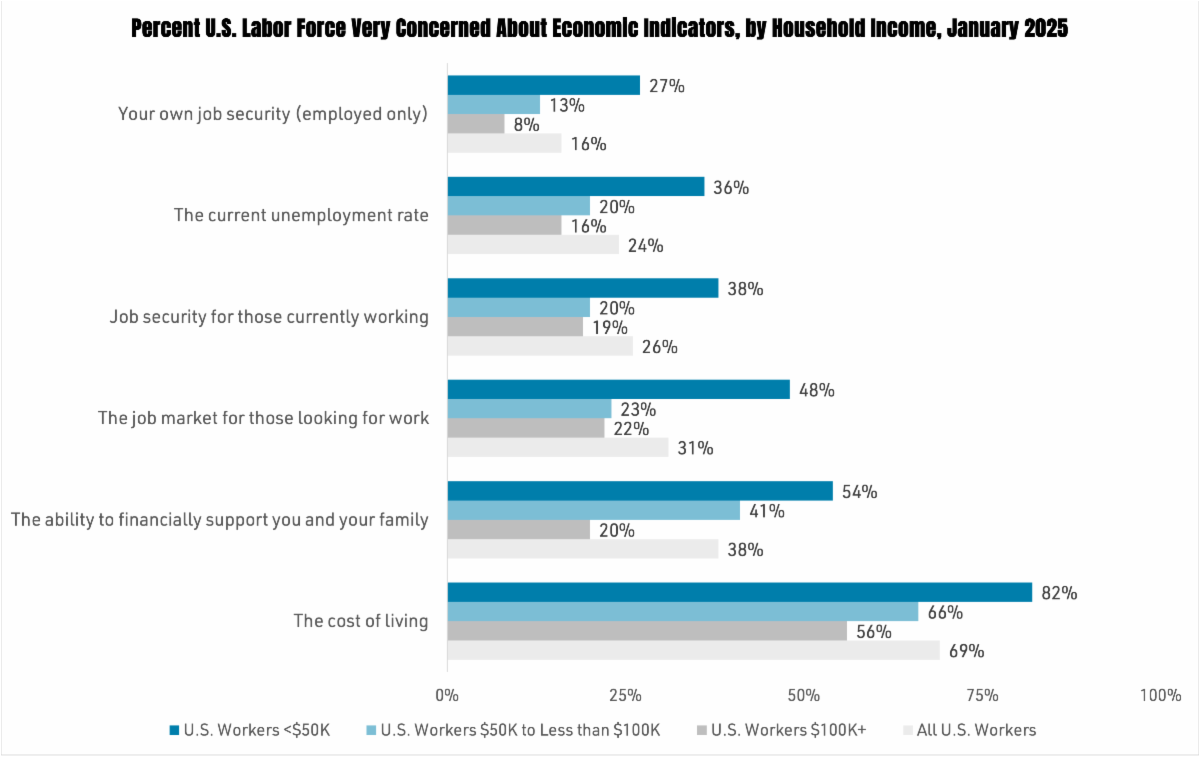
Deep concerns about inflation and the labor market are widespread throughout the country as Republicans take control of the White House and Congress — even amid low unemployment rates — according to a national probability survey of 648 members of the U.S. labor force conducted from January 17 to 19, 2025 by the John J. Heldrich Center for Workforce Development at Rutgers, The State University of New Jersey.[1] Seven in 10 U.S. workers say they are very concerned about the cost of living (69%), including 82% of workers living in households earning less than $50,000 annually.
- Workers living in households earning less than $50,000 per year are twice as likely to say they are very concerned about supporting their families (54%) and their own job security (employed adults) (27%) as workers living in households earning $100,000 and more annually (20% and 8%, respectively).
- Half of the country’s lowest-income workers say they are very concerned about employment opportunities for people looking for jobs (48%).
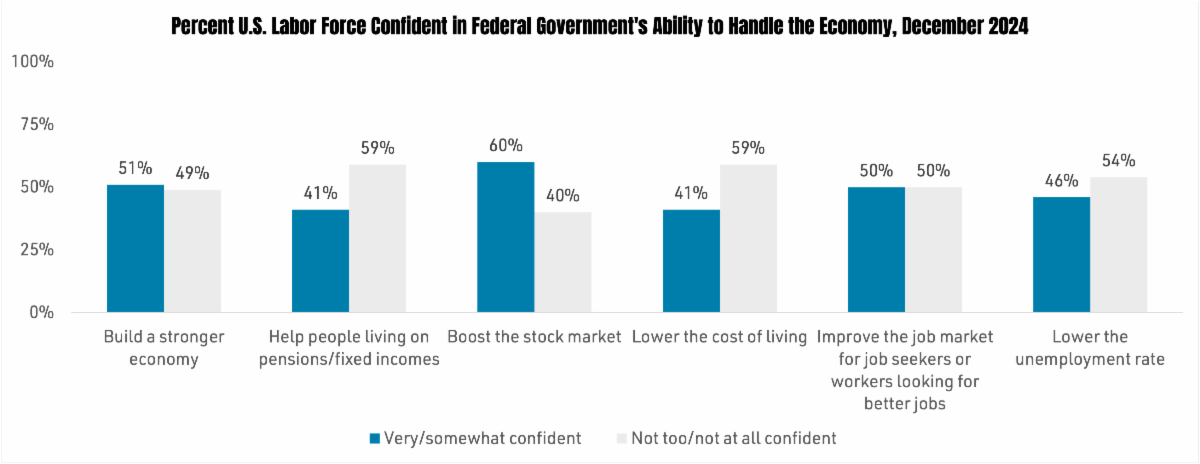
Half of workers interviewed for a December 2024 survey conducted by the Heldrich Center are not confident in the federal government’s ability to boost the country’s economy. That survey of 631 U.S. workers was conducted from December 16 to 18, 2024, and found that:
- 76% of U.S. workers rate the economy as only fair or poor, and just half (51%) are very or somewhat confident that the government will build a stronger economy.
- 4 in 10 workers (41%) are very or somewhat confident that Republican control of the White House and Congress will lower the cost of living or help people living on fixed incomes.
- Only 16% of U.S. workers say they are very confident that the government can take action that will lower the cost of living, and
- 23% are very confident that the new government in Washington, D.C. can build a stronger economy.
There are no important differences among workers by household income, except for confidence in boosting the stock market; 70% of workers living in households earning $100,000 and more annually, but 49% of workers living in households earning less than $50,000 per year say they are very or somewhat confident in the new Republican government’s ability to advance the stock market.
“Despite 4% unemployment and a healthy job market, U.S. workers — especially lower-income workers and job seekers — are looking to Washington to address the economic challenges that concern them,” said Carl Van Horn, Ph.D., Distinguished Professor and Director at the Heldrich Center.
These and other findings, including workers’ opinions about labor market policies, will be the subject of several reports that will be released by the Heldrich Center in the coming months. Click here to access the topline data from the January 2025 and December 2024 surveys.
# # #
The John J. Heldrich Center for Workforce Development is based at the Edward J. Bloustein School of Planning and Public Policy at Rutgers University. It is one of the nation’s leading university-based research and policy centers dedicated to raising the effectiveness of the workplace through improved workforce education, placement, and training. The center identifies innovative workforce practices and practical policy changes that can help job seekers and workers receive the education and training they need to be productive and prosperous in a global knowledge economy. Learn more at heldrich.rutgers.edu.
The American Association for Public Opinion Research (AAPOR) honored the Heldrich Center’s Work Trends research on the Great Recession with its Policy Impact Award in 2013. The Heldrich Center is a member of the AAPOR Transparency Initiative.
[1] The labor force is workers who are employed, unemployed and looking for work, or on temporary furlough from a job.