
by Yingning Xie
Pedaling Toward Access: How E-Bikes Could Bridge the Healthcare Gap
Imagine needing medical care but being sidelined by the simple fact that you can’t get to your provider. In New Jersey, and across the U.S., accessing healthcare and wellness support is anything but simple, especially for those without a car or those who need travel to facilities that are not accessible by public transit. The cost of this disconnect? Missed check-ups, untreated conditions, and a healthcare system that remains out of reach for too many.
Social determinants of health significantly impact people’s well-being, and transportation is a key factor. Access to reliable transportation connects individuals to essential resources, such as income, nutrition, physical activity, and, critically, healthcare. In the U.S., the average travel time to a doctor’s appointment is 28 minutes, typically by car. However, for those without car access, traveling by public transit can take considerably longer—if transit service is even available. The maps below illustrate the accessibility of Primary Care Providers (PCPs) per 10,000 residents. Within 30 minutes of travel by public transit, census tracts in NJ can access an average number of 1.1 PCPs per 10,000 residents. By e-bike, the value is 8 PCPs per 10,000 residents within 30 minutes of travel. In comparison, the accessibility by driving 30 minutes is 26 PCP per 10,000.
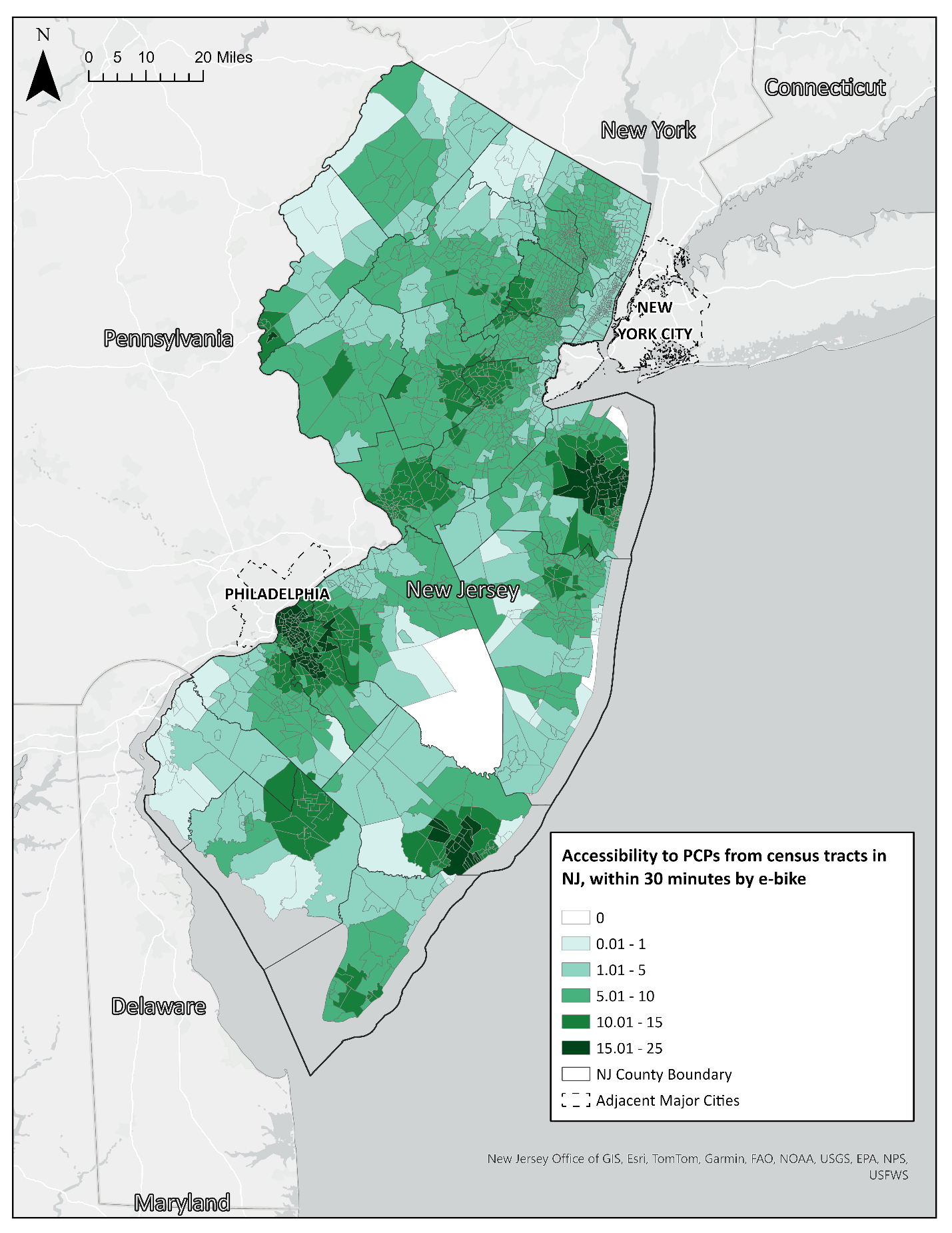
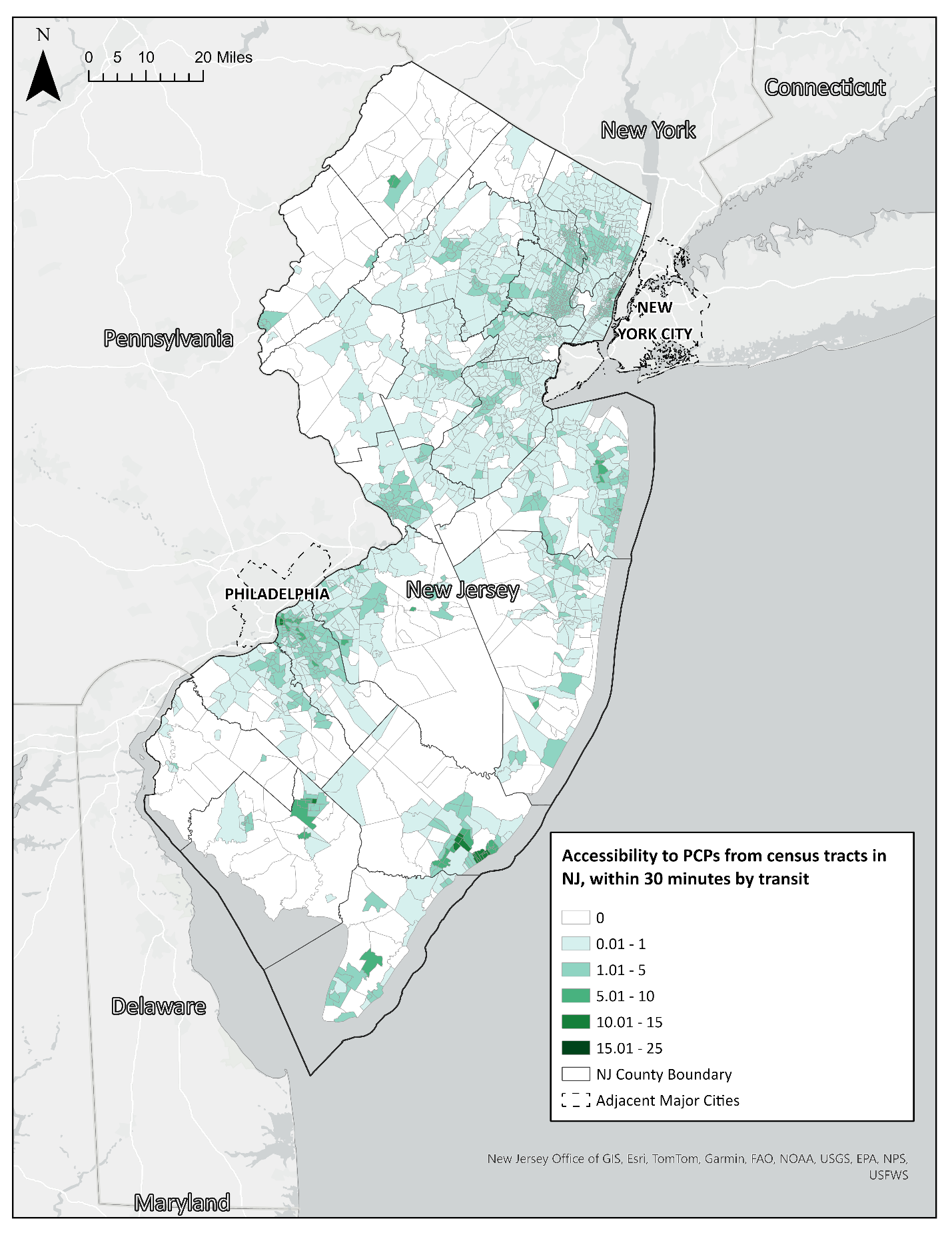
We analyzed data from nearly 28,000 primary care providers across New Jersey and surrounding states, sourced from HealthGrades.com, one of the largest healthcare review platforms in the U.S. We computed healthcare accessibility indices for each census tract in New Jersey. We found that if a patient in New Jersey relies on public transit to reach a doctor—even during peak service on a Monday morning—13% of census tracts cannot access a single primary care physician within 30 minutes via transit.
E-bikes offer a promising solution for individuals to access healthcare more easily, including reaching preferred providers. While healthcare providers are unevenly distributed—clustered in hospitals and urban areas—our analysis found that, with an e-bike, nearly every census tract can reach at least one primary care physician within 30 minutes. On average, from each census tract in New Jersey, a person can reach approximately 8 doctors per 10,000 residents on an e-bike, assuming a speed of 20 mph. They also have options of providers—individuals can access an average of 5 board-certified doctors, 3 highly rated doctors, 2 multilingual providers, and 1 Spanish-speaking doctor per 10,000 residents—within a 30-minute ride.
Despite this, significant barriers remain between theoretical access and real-world application. These include low e-bike ownership rates, limited cycling infrastructure, and a deeply entrenched car-oriented culture. Although our estimates excluded highways and major arterials where cycling is prohibited, we assumed riders would use other roads—even those without bike lanes. In practice, this is a major deterrent. Another issue is the lack of secure bike parking at healthcare destinations like clinics and hospitals. Without safe storage, riders are unlikely to ride their e-bikes that can cost thousands of dollars. Additionally, the cultural stigma and hostility toward cyclists in car-dominated environments further discourage e-bike use. Last but not least, while e-bikes are faster, more efficient, and less physically demanding than regular bikes, their higher price remains a barrier.
Since 2020, e-bike rebate programs have been rolled out across U.S. to reduce the cost of e-bike ownership. New Jersey is set to introduce one soon. While this may help hesitant users make the switch, more is needed to remove barriers to cycling. We need programs such as Complete Streets—to ensure that streets are safe, and feel safe, for all users, including e-bikers. By making arterial roads safer for cyclists through protected lanes and better design, we can not only expand the theoretical accessibility of e-bikes on paper, but also create a more connected, safer, and encouraging road environment, where people feel comfortable getting on an e-bike to ride to healthcare.