
By Derek DeLia, Joel Cantor, Bingxiao Wu, Yuhao Zheng
Hospital consolidation is drawing more and more attention from healthcare scholars, policymakers, and the media. This consolidation includes hospital mergers and acquisitions (M&A) and the growth of large, economically powerful hospital networks. Emerging evidence about consolidation raises multiple concerns about diminished healthcare access and health outcomes, especially for the most vulnerable populations.
Hospital consolidation enhances hospitals’ bargaining position with private insurers, which multiple studies have shown leads to higher privately negotiated prices for hospital services. Prior work by part of our blog team (Wu, Cantor) found that New Jersey hospitals in highly concentrated markets enjoyed significantly higher profit margins. Although competition occurs most often within a shared market area, recent research shows that hospital acquisitions that occur across markets also have a strong upward effect on prices.
As we have noted in prior blogs, hospital consolidation and concomitant price increases have important implications for healthcare affordability in New Jersey. In this blog, we delineate the scale and scope of hospital consolidation in New Jersey, including important aspects that cross state boundaries. The extent of consolidation has urgent public policy considerations.
Consolidation in New Jersey Hospital Markets
As shown in Figure 1, the recent wave of hospital consolidation has affected all of New Jersey’s Hospital Referral Regions (HRRs), which represent the distinct markets where most patients receive their hospital care. Hospitals recently acquired by a hospital system (represented in red) appear in every HRR and represent 72% of the state’s hospitals. Most of the remaining hospitals (23% of the total and represented in gray) were already part of systems before 2010. Only three hospitals (4% of the total and represented in black) have remained independent. The percentage of the state’s hospitals that were system affiliated grew from 79% in 2010 to 96% in 2025.
Figure 1: Distribution of Hospitals across Hospital Referral Regions (HRRs)

When the size of hospital networks is considered, the extent of consolidation is even greater. As shown in Figure 2, half of staffed beds among NJ hospitals are concentrated in the state’s three largest hospital systems. These systems are more dominant in some HRRs. For example, RWJ Barnabas Health owns 66% of all staffed beds in the Newark HRR, while Atlantic Health owns 75% of all staffed beds in the Morristown HRR. (Percentages by HRR include beds from the relevant out-of-state hospitals.)
Figure 2: Concentration of staffed beds in major hospital systems across NJ
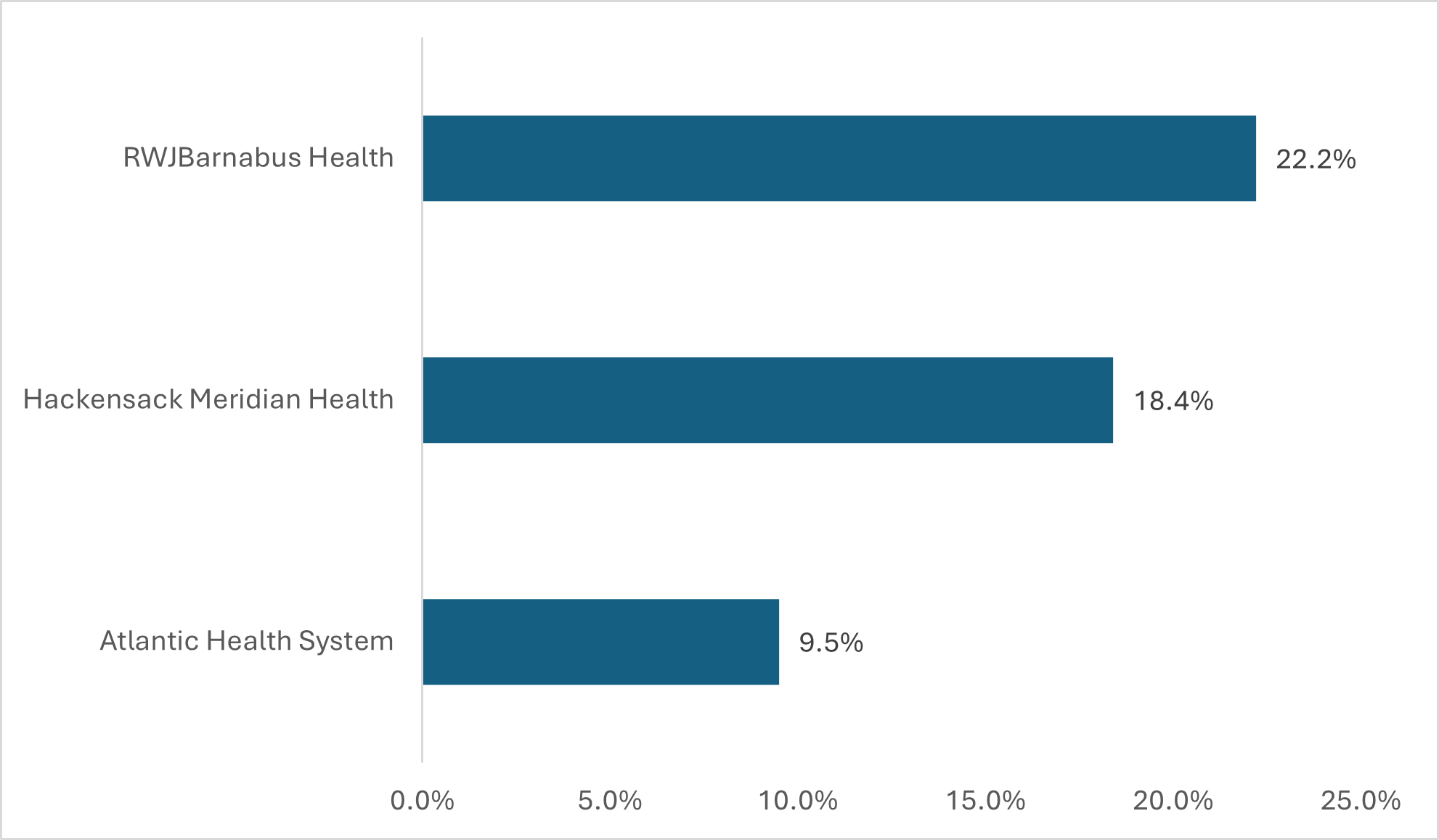
Sources: New Jersey Department of Health; American Hospital Directory; Leapfrog Hospital Survey; publicly available sources.
Hospital consolidation, its effects, and at least some of its solutions are not confined within state boundaries. As shown in Figure 1 above, NJ’s HRRs routinely cross into New York, Pennsylvania, Maryland, and Delaware. This reflects hospital utilization patterns among residents who often seek care outside of their home state. Like the quote attributed to Benjamin Franklin, New Jersey hospital markets are like “a keg tapped at both ends.”
As shown in Figure 3, the intensity of concentration varies across the state’s HRRs. The figure displays calculations of the Herfindahl-Hirschman Index (HHI), which is widely used in antitrust evaluations. The HHI varies from 0 (indicating perfect competition) to 1 (indicating pure monopoly). A market with an HHI greater than 0.18 is considered highly concentrated and raises suspicion that the dominant firms have the ability to charge exorbitantly high prices. Eight of the state’s 10 HRRs have values above this threshold, even though this measure includes hospitals available across state borders (Figure 1). Among the state’s 10 HRRs, 1 indicates monopoly (HHI=1) and 4 indicates a concentration level of a duopoly (2 hospitals) or higher (HHI>0.5). This finding is consistent with prior work by part of our blog team (Wu, Cantor), which demonstrated that NJ hospital mergers and acquisitions from 2010-2020 resulted in 71% of total admissions being in highly concentrated markets.
Figure 3: Herfindahl-Hirschman Index (HHI) Showing Hospital Concentration across NJ’s Hospital Referral Regions (HRRs)

Source: American Hospital Directory; Leapfrog Hospital Survey
Big Challenges Ahead
Despite the problems posed by hospital consolidation, it also presents potential opportunities in the current healthcare policy environment. The federal Budget Reconciliation law enacted last July, also known as the One Big Beautifull Bill Act (OBBBA) or just H.R.1, dramatically cuts a wide variety of publicly financed health insurance coverage. These cuts will be especially painful for state residents relying on the Obamacare insurance exchanges, Medicaid, and even some individuals covered by Medicare.
Highly profitable hospitals in highly concentrated markets appear better positioned to weather the H.R.1 storm. In theory, more profitable hospitals could use their financial margins to maintain access for safety net patients, including those expected to lose coverage. The ability to do this, however, will certainly vary by hospital. A recent report by Public Citizen used information about exposure to H.R.1 cuts and profit margins to identify hospitals at risk of closure, with 12 of these from NJ. As more uninsured and underinsured individuals seek care at hospitals, it will be important for policymakers to determine which hospitals require targeted state assistance to maintain services and which are financially powerful enough to cross-subsidize care for the most vulnerable patients.
The impact of HR1 on healthcare coverage, especially in the context of the state’s tight state budget environment, suggests that New Jersey charity care subsidies should be targeted to hospitals at greatest risk of financial distress. This would be done with the expectation, and perhaps monitoring, that hospitals in large, consolidated systems can meet their charity care obligations with little or no subsidies.