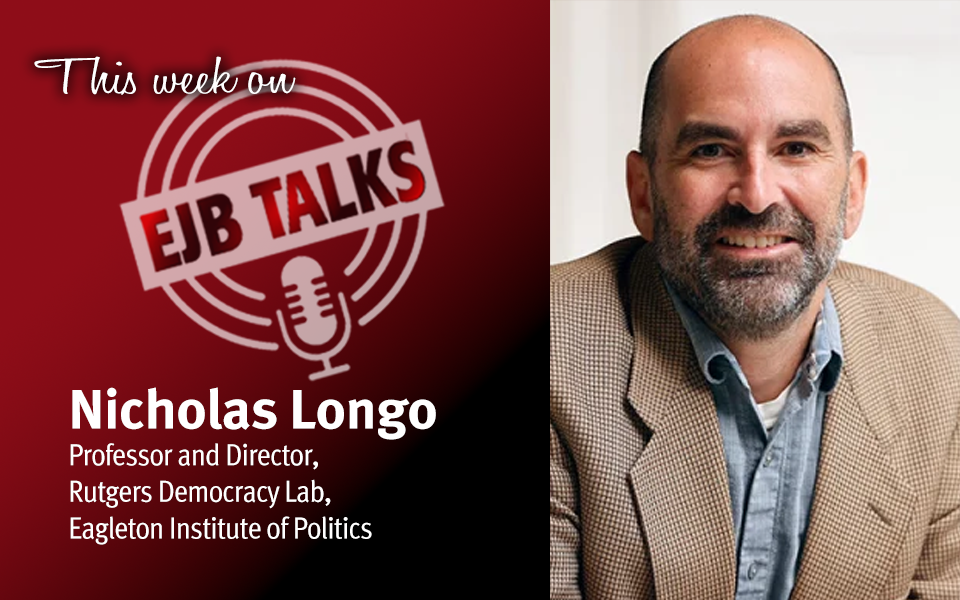
Rehearsing Democracy: Helping Rutgers Students Move from Thinking to Doing with Nicholas Longo of the Rutgers Democracy Lab
Transcript
Stuart Shapiro
Welcome to EJB Talks. I’m Stuart Shapiro, the dean of the Bloustein School, and the purpose of this podcast is to highlight the work my colleagues and our alumni in the fields of policy, planning and health are doing to make the world a better place.
Today we start our 15th season of EJB Talks, and our guest today is Bloustein Professor and leader of the Rutgers Democracy Lab, Nicholas Longo. Nicholas joined Rutgers last spring, and the lab is just over a year old now.
Welcome to the podcast, Nick.
Nicholas Longo
Oh, thanks, Stuart. It’s an honor to be here!
Stuart Shapiro
Nick has listened to a number of episodes, and so he’s very prepared for the first one.
Nicholas Longo
I’m a big fan! I’m a big fan, as you know.
Stuart Shapiro
First question is the origin question! So, tell me a little bit about what got you into the, sort of, overlapping fields of civic engagement, student engagement, student discourse, and democracy.
Nicholas Longo
Yeah. Well, thanks. Yeah, I am a big fan of this question because I think of, you know, an educator, a facilitator, a teacher. Your kind of main tool, or your default position, is to ask questions. And there’s no better question than you’re getting someone to tell their origin story.
So my origin story in this work comes out of… I was a kid growing up in Yonkers. And my dad, from really from when I was born, was a city councilman. He spent 16 years on the city council, so I spent my whole childhood doing politics, going door to door, talking with folks, and seeing how politics can make a difference in people’s lives.
But I also, especially towards the end of his terms, saw some of the dark side of politics. There was a really contentious issue in Yonkers around housing, and he was the swing vote. And got to see the way the divisiveness of a city, especially a local issue and a divisive issue, and became really polarized. I mean, growing up, we had… there were times we had 24 hour police protection on our house and death threats.
Stuart Shapiro
Wow.
Nicholas Longo
So I saw the dark side, but I still love politics. I went to college, and I was a political science major. And at that point, this is kind of the start of a really… the polarization, the government shutdown. And I kind of became disillusioned with politics, and without really knowing it, got myself into three different service learning courses that semester. And that transformed me. And the thing that it introduced me to was a different kind of politics, what I would now call a citizen politics.
Stuart Shapiro
Mmm hmm.
Nicholas Longo
And so, I was seeing the relational work I was doing in community, connecting my studies with trying to make the world a better place, with the kind of relational politics I wish I had seen. I’d seen glimpses of that in Yonkers, but I also saw how the limitations of kind of, adversarial politics, got introduced to this other method. And then the last piece of this, as I said, like how can I keep doing this?
Stuart Shapiro
((laughing))
Nicholas Longo
And I kind of looked around. Actually, this is a longer story. Almost went to Rutgers for graduate school.
Stuart Shapiro
Uh huh…
Nicholas Longo
But ended up at the University of Minnesota, and I worked at the Center for Democracy and Citizenship. And kind of got a firsthand experience and my foundation with thinking about what works to engage citizens in public life.
Stuart Shapiro
Well, the gravitational pull of Rutgers finally worked and got you back here to run the Democracy Lab. So tell us a little bit about what the Democracy Lab is and what it’s supposed to be.
Nicholas Longo
Yeah, I think of the Democracy Lab… Andy Delbanco has this great saying about, you know, how campuses can be rehearsal spaces for democracy. So I think of the Democracy Lab as a place for our students to practice democracy. Practice healthy democracy, gain skills in democracy.
Here’s the thing: I take, and I come at this work as an organizer. And I’ve been going around talking to folks, you know, about their understanding, and I haven’t had to convince anyone about the need for a Democracy Lab in this moment.
Stuart Shapiro
Right.
Nicholas Longo
And the Rutgers Democracy Lab is Rutgers University’s response to that. Where we’re trying to create space for students to practice democracy. We’re trying to mobilize the resources of Rutgers to be engaged in kind of, solving public problems. And I’m so glad to have my faculty appointment in Bloustein because I actually think Bloustein is the center of this work.
That I’ve been carrying around in my wallet, this idea and this quote for what the kind of work of Bloustein is, and this idea of a rebirth of the public service ethic, right?
Stuart Shapiro
Right!
Nicholas Longo
That’s what the Rutgers Democracy Lab wants to do. We want to collaborate with Bloustein as much as possible to make that happen. And we’re doing it. And I’ll just end really quickly, with in three different ways. We’re trying to create space on campus for innovation. So we’re a lab. We want to experiment, see what works. We want to embed civic engagement in the places where students are. So that means embedding it in the curriculum, working with faculty, making sure this is sustained and part of the core work of Rutgers University. And then we want to scale up. You know, we want this to be something that happens across all of Rutgers campuses. We’re working with Newark, we’re working with Camden, as well as in New Brunswick, doing national convenings, and we want to kind of practice, like innovate, try things out, see what works, embed it, and then scale up those lessons because we think that that’s what the moment calls for.
Stuart Shapiro
Great, I’d love to go through each of those three arms with you, but we are gonna we are time constrained here.
So, but maybe there’s…this is a way of doing it. Your work has had a lot of different arms of this, right? Talking about how students engage, talking about democracy writ large. Can you sort of talk about how they come together and brought you to the lab, and how that’s going to manifest itself in those three goals?
Nicholas Longo
Yeah. So if I continue my origin story, when I was a grad student, I actually did something that my advisors and I would, if I’m advising grad students, I tell them not to do this. But I took a leave of absence. And I took a leave of absence to run a national campaign called Raise Your Voice.
Stuart Shapiro
Mmm hmm.
Nicholas Longo
And it was a… really working in all 50 states with college students, and I got to really talk to college students about their ideas of democracy. And here’s what I learned from that: I learned that young people don’t learn about democracy from reading a book or even taking a class. They learn about it by how much they’ve experienced it in their lives.
Stuart Shapiro
Mmm!
Nicholas Longo
And they had so little positive, healthy experiences with democracy. And I think that’s why we kind of see this, the kind of challenges where young people are saying, “I’m not even sure democracy is the best form of government.”
So out of that experience, I kind of set out and said, how can I make my life’s work to create space for democracy? And I’ve done that on college campuses. Was able to go back, finish my dissertation, did it at a research foundation, the Kettering Foundation at Miami of Ohio, most recently Providence College. And really kind of what ties it together is that singular idea that, we need to create spaces for young people to be creators of a healthy democracy. And that’s kind of been the key insight that we’re trying to bring to the Rutgers Democracy Lab.
Stuart Shapiro
Great. So, is it fair to say that, sort of, success in your view, looks like students shedding that belief that democracy doesn’t work? That it’s not the right system that we should be using?
Nicholas Longo
I think that’s, yes, part of our success. I mean, I think we, you know, we see this crisis of democracy where there’s democratic backsliding across all all democracies, including in the U.S. And young people, I think, in some ways, are rightly skeptical. So we want to build into that. We want to kind of work with that skepticism. Give them space to reimagine, recreate, and see what a kind of democracy can look like.
Doesn’t mean we’re like setting up things where people are voting and majority rules. It means like, people have agency and voice to make the world a better place to solve problems.
Like one shift that I have had in my career, which… so earlier I mentioned like I worked on this Raise Your Voice campaign.
Stuart Shapiro
Right.
Nicholas Longo
And I think the work like… it was like young people, their voices weren’t being heard in politics? And now my work is a lot more around constructive dialog where it’s like, we’ve had some success at getting young people more engaged, but now they don’t necessarily have capacity to work across differences. So, I think about, you know, part of that kind of, rebuilding our democracy is helping them gain skills of talking with folks they disagree with.
Stuart Shapiro
Right
Nicholas Longo
And doing that respectfully, listening, and then be and ultimately using that as a way to solve problems.
Stuart Shapiro
So, is this inability to talk to people you disagree with, and I agree 100% that that’s a major problem. Is it a crisis? Is it the crisis that we’re facing? You said, nobody disagrees that we need a Democracy Lab, right? And I’m wondering, is that the problem? Are there more components to why that need exists? In other words, why are we in the moment where?
Nicholas Longo
So if you don’t believe in institutions, it’s hard to engage with them and respectfully, civilly. But at the same time, those same… those institutions that people are losing trust in? Have lost trust in ordinary people, right?
Yeah, yeah, we are. That’s a great question. I think one thing… This… I think we are in a moment of democratic backsliding, a crisis moment. And it’s actually… it’s about more than any one politician or political party.
Stuart Shapiro
Hmm.
Nicholas Longo
I think… Our research on this is kind of like multi…. This is a long term challenge. A big piece of it is a loss of trust in institutions.
Stuart Shapiro
Mmm hmm.
Nicholas Longo
So it’s a two way street where people who are most affected by an issue don’t necessarily have agency. They’re not at the table when decisions are being made. So that’s a piece of this kind of loss of trust as a two-way street is a crisis… is a piece of why we have this this crisis moment.
But then also, and I think this is around the talking across difference. We have this these twin challenges of like kind of pernicious polarization. Where I’ll decide what I think about an issue, based on what the person I can’t stand thinks, and I’ll think the opposite.
Stuart Shapiro
Hmm. ((laughing))
Nicholas Longo
And at the same time, we have this isolation where people are, you know, there’s this kind of a crisis of loneliness, an epidemic of loneliness. The last surgeon general talked about it. So people are both not connecting and don’t? So there’s both a loss of social capital, and then there’s also an inability to work across difference. So there’s this kind of crisis of bridging capital.
Stuart Shapiro
Right.
Nicholas Longo
So those are kind of pernicious undertones to the crisis of democracy. And then I think the last piece of it is that we have a set of challenges that can’t be solved with any technical expertise alone. Like you said, you have adaptive problems and you know environmental issues. What should we do about AI…
Stuart Shapiro
Right.
Nicholas Longo
…racism. And so we need like different ways of thinking, different ways of acting. And so, if you think about the crisis of loss of trust, isolation, polarization, adaptive challenges, kind of all mixed together, that leads to this undergird of like a crisis of democracy,
Stuart Shapiro
Right. So how are you going to pull us out of this?
Nicholas Longo
((laughing)) Oh man, that’s a well… This is the one thing. It’s like, it takes all of us. I actually have right over here the the sign from June Jordan that says, “We are the ones we’ve been waiting for.” Right?
Stuart Shapiro
Right.
Nicholas Longo
So what are we going to do? We’re gonna build, and we’re gonna build together. There’s this idea of like, you know, higher education. We’re really good at predicting problems, right? Analyzing them, problematizing them. With the Rutgers Democracy Lab, we want to build solutions.
Stuart Shapiro
Right.
Nicholas Longo
So we’re trying to do that in lots of ways. We’re trying to make civic engagement unavoidable for students on campus. So if you’re a Bloustein student, and you’re going to be in Stuart’s class, and he’s going to be talking about this stuff. Or you’re going to come into this next class, and you’re going to get a chance to talk across difference. You’re going to go to the next class, you’re going to get a chance to work with a community organization and do research for them. So we want to kind of, build these opportunities throughout all of Rutgers, and that’s what we’re doing with the Rutgers Democracy Lab.
Stuart Shapiro
So you’ve had about eight months now of interacting with Rutgers students, and this is going to be a weeding question.
Nicholas Longo
((laughing))
Stuart Shapiro
But you know, from those interactions, give me, give us all a reason to be optimistic about where those students are and the potential they have to embrace this challenge.
Nicholas Longo
Yeah, that’s… I mean, if you’re looking for… I mean, there’s a lot of kind of doom and gloom. If you’re looking for a reason to be hopeful, spend time with our students at Rutgers University. Like, that for me is why I came to Rutgers. I knew this was a diverse student body. I knew it was the land grant institution of New Jersey, and then now I’ve gotten to see it up close. I’m teaching a course in Bloustein called the Think and Do Tank, which is a fellowship course. Students, you know, they do the reading, they come prepared, they’re engaged, and what they’ve said about this class, especially, is what they like about it. Is like they’ve had lots of opportunities to think.
Stuart Shapiro
Mmm hmm.
Nicholas Longo
But they are hungry to do. Right? They actually want to make an impact on the world. And they want to gain the skills. Because they’re also saying, like, “Hey, I’m spending a lot of money on this education. I want to make sure when I graduate, I’m prepared and I have the skill set I need to get a job.”
And I think that what we’re trying to do is build some of those soft skills, be able to have folks connect, you know, their ideas with action. Rutgers students are, I think, idealistic, critical, really diverse. And they’re change agents.
Stuart Shapiro
Yep, yep. That has been my experience as as well. So if any students are listening and they are so excited by this conversation that they they want to get more involved with the Democracy Lab, what are what are the pathways for them to do so?
Yeah. So for students, we’ve got lots of different programs. We’ve got programs where….Talk Across Difference program. We’ve got the Think and Do Tank. We’ve got a Research Hub. We’ve got opportunities for them to be digital content creators.
Nicholas Longo
But this is the other thing. And for students who are listening, the one thing that I say is, if you’ve got an idea to improve our democracy and make the world a better place, you have a willing partner in the Rutgers Democracy Lab. So come reach out to us, check and go to our website, connect with us, and let’s work together.
Stuart Shapiro
I really couldn’t craft a better ending myself there, so I think I’m gonna I’m gonna wrap it there. Nick, thank you so much for coming on today.
Nicholas Longo
Oh, thanks so much, Stuart!
Stuart Shapiro
Also, a big thank you to Tamara Swedberg and Karyn Olsen who make this podcast run. And now that we are back for our 15th season, we’ll be back in another couple weeks with another episode from experts at the Bloustein School. Until then, stay safe.