
iMotions names Noland, Weiner, Nelessen article one of 2016's "10 Best" in human behavior research

January 6, 2017
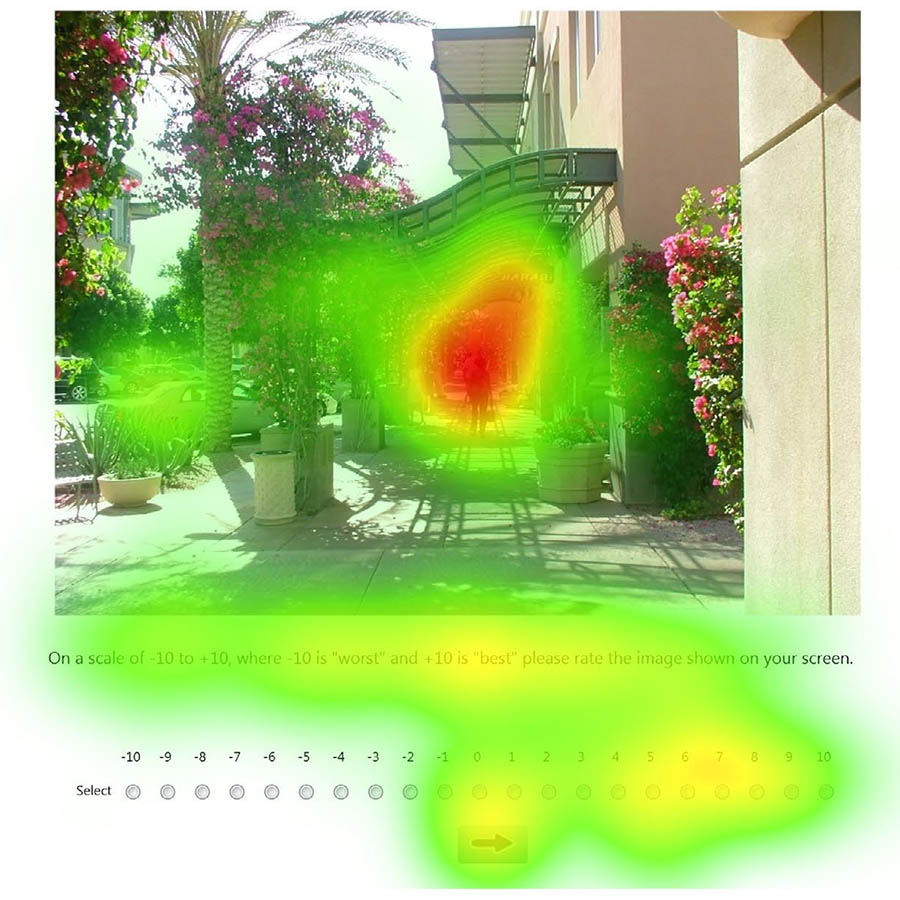
A sample image showing the the area of interest of an image, or "fixation time," represented visually in a heat map. The red areas indicate more time spent, ranging to green, where less time was spent on the image.

A sample image showing the area of interest of an image, or “fixation time,” represented visually in a heat map. The red areas indicate where more time was spent, ranging to green, where less time was spent on the image.

iMotions, one of the leading designers and manufacturers of eye-tracking equipment in the country, recently named an article by Bloustein School researchers as on of the “10 Best Articles of the Year in Human Behavior Research.”

The article, “Eye-tracking technology, visual preference surveys, and urban design: preliminary evidence of an effective methodology,” was published in the Journal of Urbanism: International Research on Placemaking and Urban Sustainability. The research was conducted by , , , and

Using eye-tracking technology, the researchers administered a visual preference survey to a convenience sample to evaluate quantitatively the ways in which individuals process and rank images used in public settings for urban planning. Combining both a subjective qualitative analysis with quantitative evaluation of the eye-tracking data, the analysis largely confirms that various new urbanist components of the images, namely people, pedestrian features, and greenery, lead to higher rankings, while images with cars and parking receive negative rankings. Buildings, which are a key component of architectural design, had mixed results. The analysis demonstrates the efficacy of visual preference surveys. Though the survey, the researchers show a way for transportation and urban planners to extract greater value from visual preference surveys, consistent with efforts to increase pedestrian activity while reducing motor vehicle traffic in cities.


Recent Posts

Risk Analysis Celebrates Distinguished Prof. Greenberg

Michael Greenberg: Master Synthesizer of Risk, Public Health, and Public Policy by Joanna Burger & Karen W. Lowrie Michael Greenberg is an extraordinary researcher, teacher, and pioneer who has combined his broad knowledge and expertise in environmental...

STEM Pathways are a Two-Way Street, Not a “Leaky Pipeline”

A new article in the Journal for STEM Education Research challenges the longstanding “leaky pipeline” narrative that has shaped U.S. education and workforce policy for decades. The article, “Reconceptualizing College STEM Pathways: Is ‘Leaving STEM’ the Problem?”, was...

NJSPL: New Jersey’s New E-Bike Laws – What Comes Next?

New Jersey’s New E-Bike Laws: Safety, Impact, and What Comes Next Leigh Ann Von Hagen & Gabrielle Cain In recent years, e-bikes have become an increasingly popular form of micromobility, which are small, lightweight transportation devices designed for short trips...

Heldrich: Aligning NJ’s AI Policy with Small Business Needs

Researchers at the Heldrich Center for Workforce Development, with funding from the New Jersey State Policy Lab, are currently engaged in a project to examine how New Jersey’s public Artificial Intelligence (AI) initiatives can better align with the evolving needs of...

EJB Talks: Planning, Policy, Politics, and the Path to Office

Planning, Policy, Politics, and the Path to Office with Assemblywoman Katie Brennan This week on EJB talks, Dean Stuart Shapiro talks to Bloustein alumnus Katie Brennan MCRP '12, now an Assemblywoman in New Jersey's 32nd District. Katie reflects on how her early...