
 by Zoe Linder-Baptie MPP/MCRP ’18
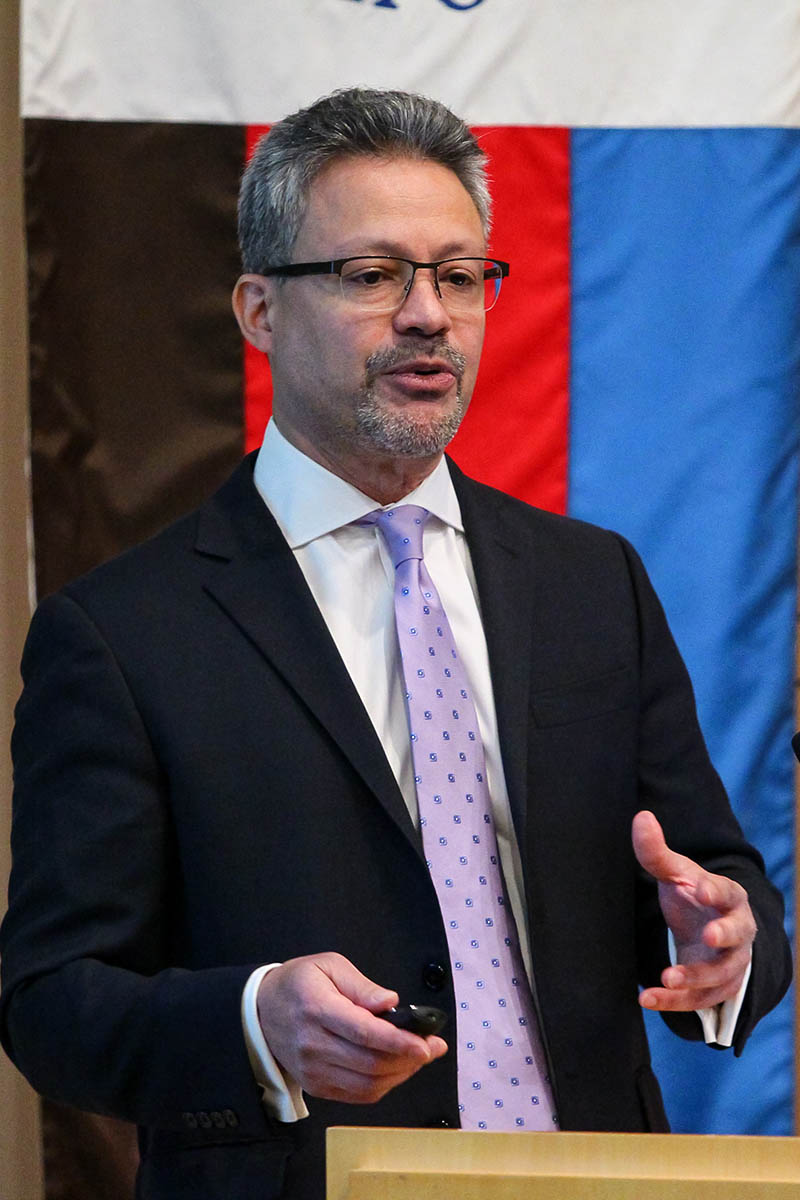
Many of the environmental and societal challenges that public policy and planning students study are being addressed through public health initiatives. In late March Brian D. Smedley, co-founder and Executive Director of the National Collaborative for Health Equity, visited the Bloustein School to present a preview of the Health Opportunity and Equity (HOPE) Measures for the 2018 Robert A. Catlin Memorial Lecture.
From 2008 to 2014, Dr. Smedley was Vice President and Director of the Health Policy Institute of the Joint Center for Political and Economic Studies in Washington, DC, a research and policy organization focused on addressing the needs of communities of color. His areas of expertise include racism and health inequities, social determinants of health, health care disparities, and diversity in health professions.
After introductions and gratitude expressed to the Catlin family for their continued support of the Bloustein School by Distinguished Professor and Interim Dean Michael Greenberg and Jeanne Herb, Associate Director of the Environmental Analysis and Communications group, Dr. Smedley shared a presentation of the work he has been overseeing with funding from the Robert Wood Johnson Foundation. The initiative looks at how patterns of residential segregation reinforce health inequities, and both place- and people-based strategies to counter the effects of segregation.
Dr. Smedley’s goal is to use these identified patterns in order to determine opportunities for improving health for people of color and undo the health consequences of racism. The HOPE indicators measure a variety of social and geographic factors that determine the status of someone’s health in order to compare across geographies and set benchmarks in order to see improvements and impacts of policy changes.
The event concluded with many questions from audience members, who were interested in data collection methos, other factors that might be considered, and how to use the indicators moving forward.
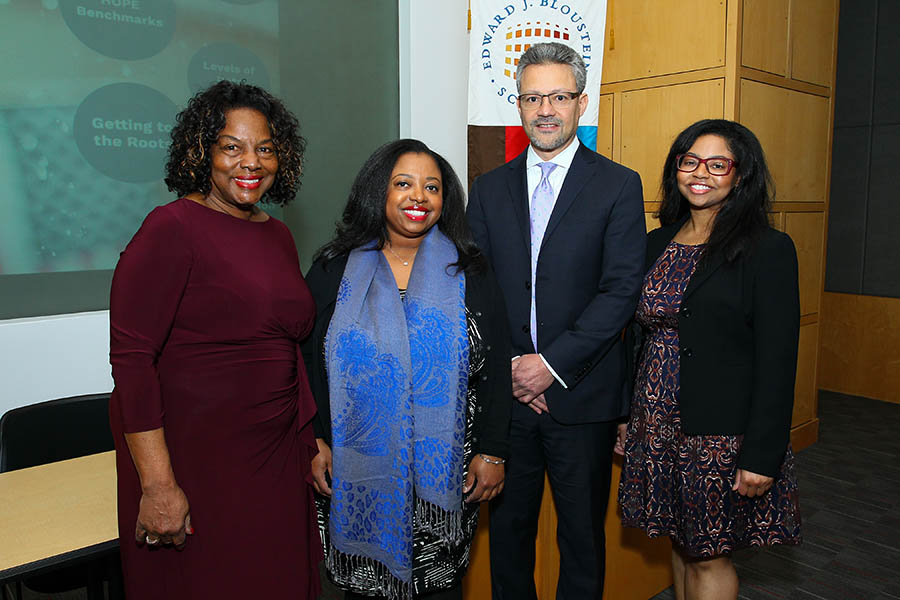
Members of the Catlin family have attended almost every lecture since its inception. From left to right: Mrs. Ethel Catlin, daughter Janell, speaker Brian Smedley, and daughter Michelle.
The lecture honors the legacy of Robert A. Catlin, Bloustein School professor, who died in July 2004. Catlin began his career as a staff planner for governmental agencies and community organizations in several cities, including Los Angeles, Washington, D.C., and New York. He also served as dean of the College of Social Science at Florida Atlantic University, dean of the Camden College of Arts and Sciences at Rutgers, and provost and vice president for academic affairs at California State University, Bakersfield. He was inducted as an AICP Fellow in 2001. At the Bloustein School, he specialized in urban revitalization and the impact of race in public policy decision-making, which is a focal point of the annual lecture.