
Rutgers Democracy Lab (RDL) is excited to announce the launch of its inaugural Democracy Summer Research Fellowship. The fellowship funds 25 projects led by doctoral students from Rutgers–New Brunswick, Camden, and Newark and 15 academic disciplines selected from a competitive applicant pool. Fellowships support dissertation or co-authored research projects on deliberative dialogue, artificial intelligence (AI) and democracy, democratic innovation, or topics aligned with the Rutgers Democracy Lab’s mission to strengthen American democracy.
Twenty one projects received a Seed Fellowship ($2,000), while four projects received a Democracy Catalyst Fellowship ($8,000), which supports ambitious, interdisciplinary, or collaborative projects. Reflecting on the selected projects, Jason Geary, Provost of Rutgers University–New Brunswick, noted, “This cohort demonstrates how Rutgers researchers are pushing conversations about democracy in new and creative directions.”
Fellows employ a wide range of methodologies, including archival research, interviews, policy analysis, computational methods, survey research, and community-engaged scholarship. Two project themes, AI infrastructure and civic education are explored by multiple projects. Several fellows examine the politics and public impacts of data centers, including questions of sustainability, regional economies, community power, and local governance in New Jersey. Others focus on democratic education through research on school-based participation, AI policy in K–12 education, public history, and political education movements.
“What makes this program especially exciting is the range of methods and scholarly approaches fellows are bringing to policy-relevant research,” said Eyal Hanfling, Director of the Technology and Democracy Research Hub at RDL. “Understanding democracy today requires perspectives that cut across disciplinary boundaries.”
RDL plans to convene the fellows and broader university community at a public research symposium in Fall 2026 to showcase the cohort’s work. RDL will also open applications soon to the Democracy in Action Fund and Democracy Associates programs, which fund Rutgers Faculty and Staff to implement public programs and research projects in line with the lab’s mission.
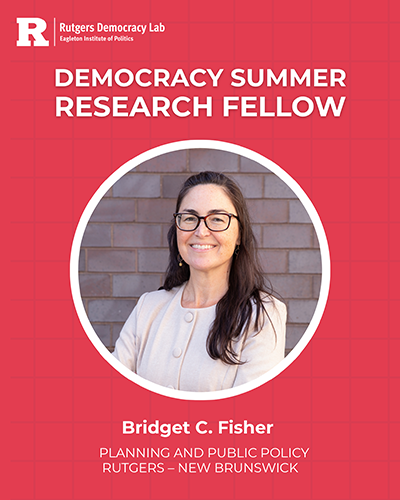 Bridget Fisher is a PhD student in the Bloustein School of Planning & Public Policy at Rutgers–New Brunswick. Her research focuses on the relationships between municipal finance, land, and equity. Fisher previously served as Associate Director of The New School’s Schwartz Center for Economic Policy Analysis, where she remains a senior fellow working on urban redevelopment projects and land-based financing tools, and worked in the New York City Council, NYS Working Families Party, and the U.S. Congress. She has a master’s in public administration from CUNY’s Baruch College and a BA in public communication and women’s studies from American University.
Fiscal Enclaves, Public Finance, and Democratic Visibility
This research investigates the public finance mechanisms used in public/private urban land development projects and their role in the governance of public resources. This preliminary research will utilize a mixed-methods case study approach of the political and fiscal relationships underlying New York City’s Hudson Yards development. This case study explores how modern debt instruments affect relationships between democratic governance and public officials, taxpayers and investors, and public and private finance. This project supports RDL’s mission by promoting transparency in public finance to enable the civic engagement necessary to ensure public resources build an inclusive future.

Lina Moe is a PhD Candidate in Urban Planning and Public Policy at the Edward J. Bloustein School of Planning and Public Policy at Rutgers–New Brunswick. Her research focuses on the governance of emerging technologies and infrastructure siting, with particular attention to how communities exercise democratic power over large-scale energy and data center development. She has produced policy analysis for the New Jersey Board of Public Utilities on community benefits frameworks and has studied the spatial distribution of data centers relative to overburdened communities as part of her research at the Center for Urban Policy Research. Her work has been published in Energy Policy and Environmental Research: Energy.
Who Decides Where AI Lives? Community Power and the Democratic Politics of Data Center Siting in New Jersey
AI is a white-hot topic of growing confusion, concern, and resistance. The large data centers undergirding generative AI are among the fastest-growing categories of infrastructure being sited in American communities. Like much large-scale infrastructure, they concentrate costs locally while benefits flow to distant shareholders and global users. AI may live in the cloud, but AI infrastructure consumes land, electricity, and water, produces noise and raises utility prices. I will be studying a hyperscale facility in Vineland, NJ designed to reach 300 MW, which is nearly double the entire municipality’s total electricity consumption. This project focuses on AI’s physical footprint. I will investigate: how does the proliferation of the physical infrastructure of AI affect democratic governance in the communities where AI physically lives?
Below is the complete list of Democracy Summer Research Fellows. More information about each of the projects and recipients is available here.
- Rachel M Acosta, Communication, Rutgers – New Brunswick
- Morenike Alugo, Prevention Science, Rutgers – Camden
- Muhammad Ammar & Chia-lin Kao, Political Science, Rutgers – New Brunswick
- Zachary Baum, Political Science, Rutgers – New Brunswick
- Anderson de Andrade, Sociology, Rutgers – New Brunswick
- Samantha G. Deane, Industrial Relations and Human Resources, Rutgers – New Brunswick
- Bridget C. Fisher, Planning and Public Policy, Rutgers – New Brunswick
- William Foley , Industrial Relations and Human Resources, Rutgers – New Brunswick
- Erica Fugger, American Studies, Rutgers – Newark*
- Sudhamshu Hosamane, Communication, Rutgers – New Brunswick*
- Duhui Lee, Sociology, Rutgers – New Brunswick
- Ashley Y. Lipscomb , Education, Rutgers – New Brunswick*
- Kristine Maassen, Anthropology, Rutgers – New Brunswick
- Hyacinth Miller, Global Urban Studies, Rutgers – Newark
- Lina Moe, Planning and Public Policy, Rutgers – New Brunswick
- Sarah Mughal, Psychology, Rutgers – New Brunswick
- Mahsun Oti, Anthropology, Rutgers – New Brunswick
- Oğuz Kaan Özalp, Public Affairs and Community Development, Rutgers – Camden
- George Quinn, Political Science, Rutgers – New Brunswick
- Stephanie A. Rodríguez, Bilingualism and Second Language Acquisition, Rutgers – New Brunswick
- Michellepreet Sanghera, Political Science, Rutgers – New Brunswick
- Safiyeh Tayebi, Geography, Rutgers – New Brunswick
- Sara M. Thomas, Social Work, Rutgers – New Brunswick
- Wenzhe Xu, Communication, Rutgers – New Brunswick
- Yi Zhao & S. M. Mehedi Zaman, Communication, Rutgers – New Brunswick*
*PhD Students working on these projects were selected to receive Democracy Catalyst Fellowships.