
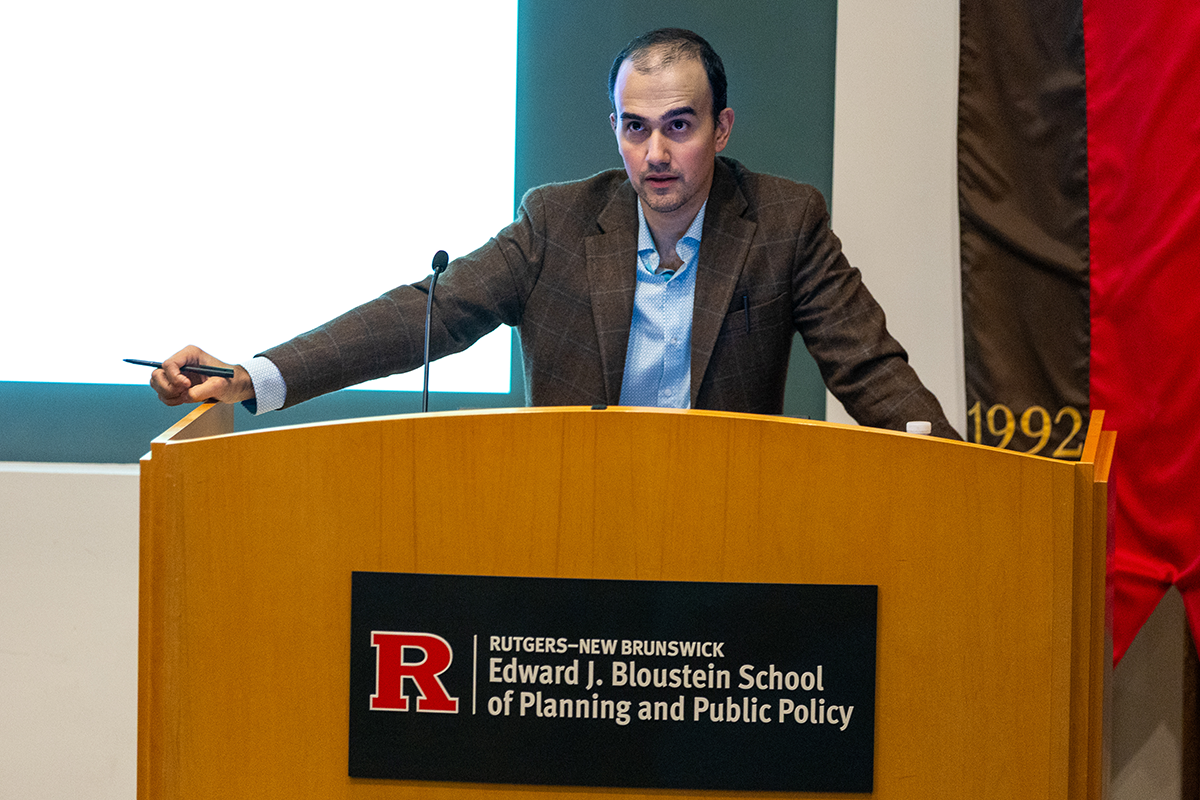
Bloustein alumnus Dan Dominguez PP, AICP, MCRP ’14 answers audience question at the podium in the Bloustein School’s Civic Square Building presenting the 2026 Meck Memorial Lecture, “New Brunswick: The Last Seven Years and the Next Seven Years.”
In early October Bloustein alumnus Dan Dominguez, PP, AICP, MCRP ’14, the City of New Brunswick Director of Policy and Development, delivered the school’s annual Stuart Meck Memorial Lecture in Land Use Law and Affordable Housing. Dan discussed the evolution of urban planning and development in the city, focusing on recent zoning changes and future housing strategies.
Dan opened his discussion by remembering Stuart Meck as an excellent professor and was grateful to have learned from him. He recalled taking Meck’s History and Theory of Planning course at Bloustein, describing it as a foundational class for aspiring planners and said Meck made a potentially dry subject more engaging through his energy and enthusiasm.
“If any of you are looking to get into—when you graduate—the field of land use planning, that is the class that you will benefit the most for taking your AICP test,” he said. “A lot of the stuff that gets covered in that class…is going to be very helpful in getting your certification.”
After graduating from Bloustein, Dan spent about three years doing housing and tenant-support work at a local nonprofit before taking a job with the city to administer federal community-development and housing grants. At the end of 2018, longtime New Brunswick planning director Glenn Patterson, MCRP ’86, retired, and another staff planner left around the same time. The city asked Dan, then its remaining staff member with planning knowledge, to take on planning responsibilities temporarily. After about 15 months, Dan was offered the role full time.
“They said, you’re going to get some experience here and you’re going to get your certifications in the next year or so and then you can work for the next director when we hire them,” he said. “Turns out that took a long time, and eventually they asked me to just stay on.”
Dan now oversees a wide range of city responsibilities including planning and zoning, redevelopment, federal housing grants, rent control, cannabis licensing, engineering, and home-repair assistance for lower-income residents. He highlighted recent and ongoing projects he has worked on such as Robert Wood Johnson Cancer Institute, the Sears redevelopment, the three phases of the Helix, and Hildebrand Commons and the Sterlingside Residences, which together are planned to provide 118 affordable homes for the city.
New Brunswick has about 2,800 housing units in its development pipeline, at various stages, including roughly 320 to 400 affordable units. A priority is encouraging more student housing near Rutgers’ College Avenue campus, where students can walk and use the Rutgers bus system.
“We should leverage that to create dense housing for students where they don’t need to own a car,” he said. He said adding homes near campus could also help ease competition for housing elsewhere in the city.
Dan said New Brunswick needs to keep building housing while attracting businesses and creating local jobs.
“People need roofs over their head,” he said, “and they need to be able to pay for that roof and they need to be able to put food on the table.”
He described downtown as another focus for housing growth, with an emphasis on taking advantage of transit access while limiting disruption to existing neighborhoods.
Audience questions touched on street safety, including safer crossings near the train station and more walkable streets, storm water improvements, and public benefits such as street trees. Dan said plans for George Street were still under discussion, while a Complete Streets plan was underway to improve walking and biking connections around the transit-village area.
Asked about the relationship between his office and DEVCO, Dan said developers generally propose and build projects, while the city reviews proposals for consistency with municipal rules and goals. He also noted that federal “Buy American, Build America” requirements could complicate some affordable-housing projects.
In closing, Dan reflected on the personal stakes of his work. Approving completed projects is rewarding, he said, but turning down residents who want to improve their homes can be difficult. “Whenever you say no to an apartment,” he noted, “you’re killing somebody’s dream.”
His advice to students entering planning was to pursue opportunities and take risks early in their careers: “Saying yes to opportunities is probably the best thing you could do to go places.”