
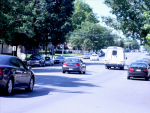
 A new research study from the Bloustein School’s Alan M. Voorhees Transportation Center, “Costs and Benefits of a Road Diet for Livingston Avenue in New Brunswick, New Jersey,” found that by including turning lanes and bike lanes will not only create safer streets for bicyclists and pedestrians, but is likely to reduce crashes by 19 percent. The report was produced in collaboration with the Department of Civil and Environmental Engineering at the University of Massachusetts Amherst and the City of New Brunswick.
The feasibility report was produced for the City of New Brunswick as part of theCommunity-University Research Partnership Grant program developed by the Rutgers University Office of Community Affairs. The $25,000 grant to theVoorhees Transportation Center allowed the staff, led by Professor Robert Noland, to collect data about how the street operates now and to run computer models as to how a road diet would change how traffic flows on the street. A “road diet” is a design that can improve roadway safety for all users with no or minimal loss of service on the road by creating a vehicle travel lane in each direction, a center turn lane to accommodate turning traffic without backing up through traffic, and adding bicycle lanes and pedestrian improvements to increase safety for all users.
The study found that:
- A road diet on an urban street like Livingston Avenue is likely to reduce crashes by 19%;
- The travel time on the street will be increased slightly, but this is a good thing as the vast majority of cars on the street are speeding now;
- The travel delay times are not significant and will not reduce the level of service on the street to unacceptable levels;
- The cost/benefit of doing the road diet is heavily weighted towards the benefits as the added travel time cost is minimal and the cost savings from less loss of life and injury is substantial
In order to begin implementing the road diet plan, the City of New Brunswick worked with the Middlesex County Engineers Office—Livingston Avenue is a county road—to develop a concept plan, project budget and design plans. The city began work on the project on May 13, 2014.
For more information about this report or to speak with the report’s authors, please contact Karyn Olsen at (848) 932-2814 or karyno@rutgers.edu.