
Graduate U.S. urban planning program
Planetizen, 2023
Public health undergraduate program in New Jersey
College Factual, 2025
Master of Health Administration, nationwide
U.S. News & World Report, 2026
%
Employed or pursuing higher education after graduation
2024 data
Join our mailing list!
Graduate Program Virtual Information Sessions
Undergrad Pre-Major Advising Sessions

Undergraduate Programs

Urban Planning Graduate Program

Public Policy Graduate Program

Health Administration Graduate Program

Public Informatics Graduate Program

Doctoral Programs: Ph.D./DHA
Recent News

What Do People Think of E-bikes? A Closer Look by Younes and Xie
Sixty-four percent (64%) of respondents from a recent survey on e-bike use and perception agreed that the government should do more to support e-bike use. Researchers conducted this survey (N=998) in Fall 2025 to adult, non-users of e-bikes in the U.S. Over 70% of the respondents were from NJ, with a smaller percentage from surrounding states, and 443 were non-owners.

New NJSDS Report: Noncredit Education in New Jersey
As more adults pursue nondegree pathways for skill development and career advancement, and with the enactment of Workforce Pell in July 2025, which authorizes Pell Grants for training programs as short as 150 hours or eight weeks, the need for clear definitions and reliable data on noncredit education has become increasingly important. Establishing a standardized system will be key to turning these data into actionable information that helps New Jersey maximize the benefits of Workforce Pell.
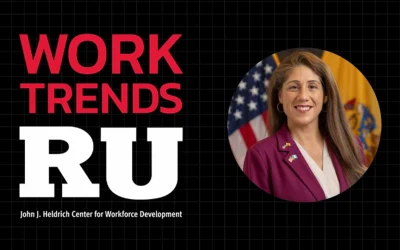
“Work Trends RU” Podcast with Margo Chaly
Listen to the latest episode of the Heldrich Center’s Work Trends RU podcast, featuring featuring Margo Chaly, Acting Secretary of the New Jersey Office of the Secretary of Higher Education, about the future of higher education in New Jersey. They discuss key challenges and opportunities facing colleges and universities, including enrollment trends, financial sustainability, workforce alignment, and student success.

NJSPL Report: Reducing Opioid Overdose Risk in New Jersey
Researchers found that incidents of NJ Medicaid beneficiaries who received buprenorphine immediately and/or shortly after an opioid-related emergency department visit increased from 4.0% in 2018 to 14.4% in 2022. The team also conducted a series of interviews with medical professionals and discussed the challenges to buprenorphine provision, including patient resistance, insurance and pharmacy obstacles, and limited training and stigmatization.

Bloustein, MGSA to Host Exhibit on Memorial Homes New Brunswick
We invite you to join us for “We Mean Something to Each Other: Life in Memorial Homes,” a public exhibition celebrating the history and legacy of Memorial Homes, a New Brunswick public housing development that was the heart of a vibrant, close-knit community.

Kathe Newman elected as Chair of Board, Urban Affairs Association
Her research explores urban change, what it is, why it happens, and what it means and has explored gentrification, foreclosure, urban redevelopment, food security, community economic development and community participation.
Community and Belonging Initiatives
The school is home to individuals from many cultures, races, nationalities, genders, identities, and life experiences and with different beliefs and values. The Edward J. Bloustein School of Planning and Public Policy values community and belonging and aims to improve and grow these efforts strategically by managing and assessing performance.
Undergraduate Pre-Major Advising Sessions
These sessions are open to current Rutgers University students who are interested in declaring a Bloustein School major. Attendance at a session will be used to confirm your engagement with our Office of Student and Academic Services, which is required to declare a Bloustein School major. Join one of our two remaining sessions this fall! Thursday, November 19 at 4pm or Friday, December 11 at 11am. RSVP HERE.
Student Spotlight: Ariyan Henry, MPI/MCRP ’27
“When deciding to apply to graduate school, it was important that I started with the end in mind. I knew what my goal was, so I had to figure out what path would get me there. I chose the urban planning/public informatics track at Rutgers’ Bloustein School because it bridges the ideas and plans for what can be done with the technical skills needed to put them into action. With every class that I take, I immediately see the practical application and feel more equipped to step out into the workforce.”