
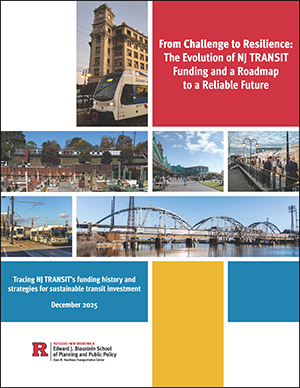
Click for report
The Alan M. Voorhees Transportation Center (VTC) has released a new report examining the history of public transit funding in New Jersey and its lasting implications for system performance today. This work was sponsored by NJ TRANSIT to document how past funding decisions have shaped the agency’s current operations and future opportunities
Authored by Matt Bond and Stephanie DiPetrillo, From Challenge to Resilience: The Evolution of NJ TRANSIT Funding and a Roadmap to a Reliable Future traces NJ TRANSIT’s financial development from its establishment in 1979 through the present day. Since its creation under the New Jersey Public Transportation Act of 1979, NJ TRANSIT has grown into the largest statewide public transit system in the United States, serving more than 5,000 square miles and millions of riders each year.
Over more than four decades, the agency’s funding and financing structure has shifted in response to changing state and federal priorities. These decisions shaped major service expansions, capital investments, and long-term debt obligations—effects that continue to influence system reliability and performance today.
 Drawing on historical documents, academic literature, and longitudinal data on ridership, debt service, and mechanical reliability, the report identifies key fiscal periods in NJ TRANSIT’s history. These include fleet renewal efforts in the 1980s, rising debt and operating deficits in the 2000s, and capital asset deterioration during the 2010s. The analysis demonstrates how funding choices made decades ago created both opportunities and constraints for the system that New Jersey relies on today.
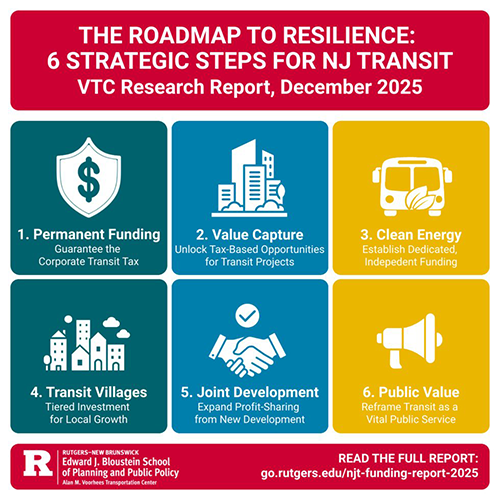
The report concludes with a set of policy and administrative strategies aimed at strengthening the long-term financial foundation of public transit in the state. Recommendations include reinforcing dedicated revenue sources, leveraging transit-oriented development initiatives, and exploring value capture mechanisms to support ongoing investment. By placing current challenges in historical context, the study offers a framework to inform future decision-making and promote a more stable and resilient funding model for NJ TRANSIT.
Read the full report:
From Challenge to Resilience: The Evolution of NJ TRANSIT Funding and a Roadmap to a Reliable Future
Bond, M., & DiPetrillo, S. (2025). Alan M. Voorhees Transportation Center, Rutgers University.
Learn more about this project and related research:
https://vtc.rutgers.edu/projects/