
Convened by the Transportation Research Board (TRB), the 2026 TRB Annual Meeting was held January 11–15, 2026, in Washington, D.C., at the Walter E. Washington Convention Center and the Marriott Marquis. The Alan M. Voorhees Transportation Center participated in the meeting, presenting research on pedestrian safety, travel behavior, and access to public transportation.
Expanding Transit Access for People with Disabilities
Lectern Session – Outcomes of an Individualized Travel Instruction Program to Improve Access to Public Transit Among People Living with Disabilities
Lauren Murphy (Kessler Foundation), Amanda Botticello (Kessler Foundation), and Andrea Lubin (Rutgers University)
Presented on January 14, this paper evaluated outcomes from New Jersey’s individualized travel instruction program. A follow-up analysis of 56 participants found that 60 percent reported using public transit one year after completing the program, supporting employment, social, and daily living activities. Results indicate that individualized travel instruction, combined with supportive community conditions, can lead to sustained, independent transit use among people with disabilities.
New Tools for Understanding Pedestrian Safety
Poster A157 – Seeing What Matters: A New Metric for Understanding Pedestrian Visual Attention in Urban Crossings
Shiyu Ma and Wenwen Zhang, Rutgers University
This poster introduced Size-Weighted Fixation Duration (SWFD), a new eye-tracking metric that improves how researchers measure pedestrian visual attention in real-world crossing environments. Based on a naturalistic study of 30 participants navigating 15 intersections, the research shows that SWFD better captures attention to safety-critical elements such as vehicles and other pedestrians, compared to traditional metrics that overemphasize large background features. The findings support more precise, evidence-based approaches to pedestrian safety analysis and urban design.
Clarifying the Debate on Induced Travel
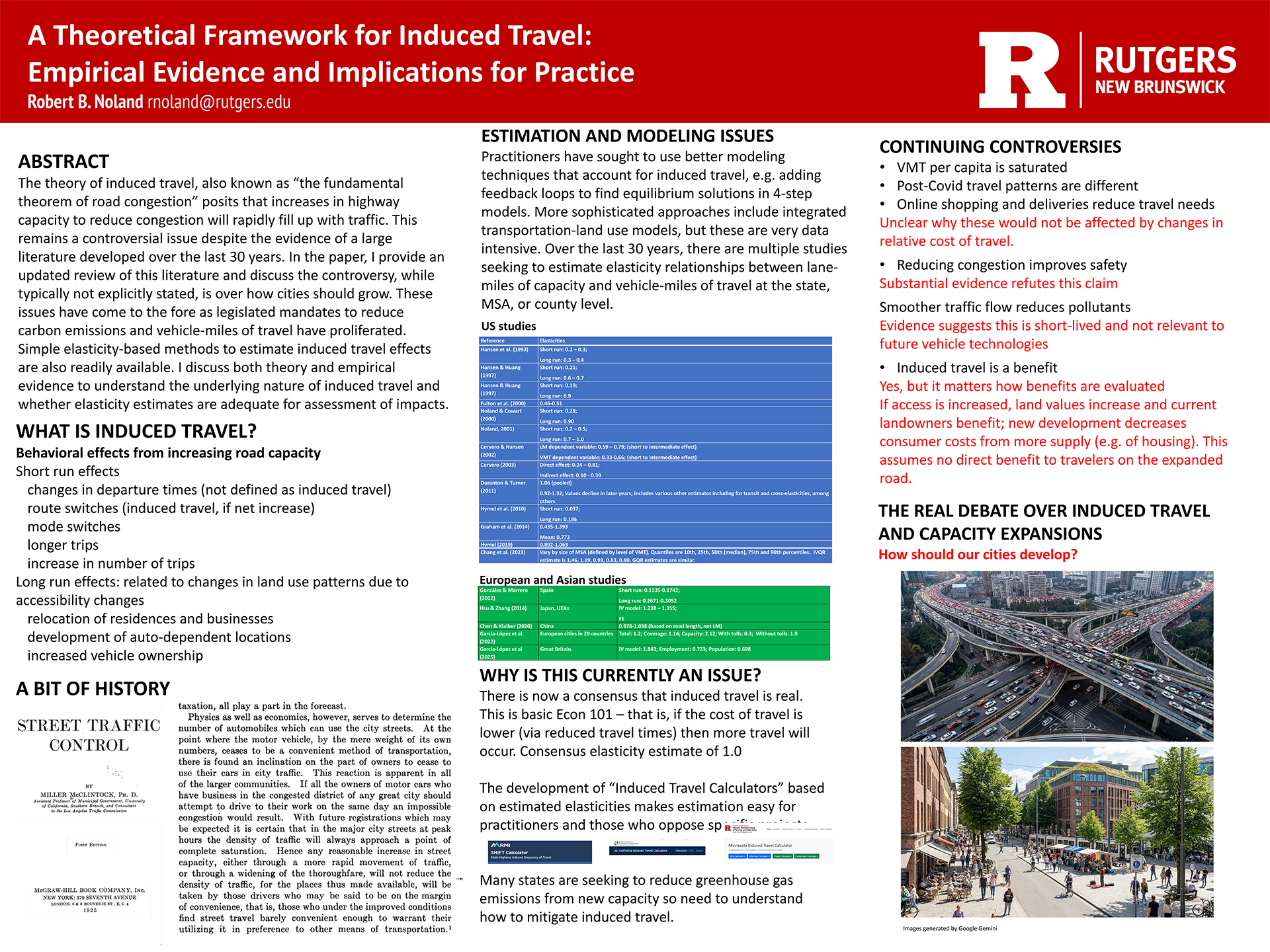
Poster A244 – A Theoretical Framework for Induced Travel: Empirical Evidence and Implications for Practice
Robert B. Noland, Rutgers University
This research examined the long-standing debate over induced travel—the idea that increasing highway capacity leads to additional vehicle travel. Drawing on recent literature and empirical evidence, the paper explored how differing views on urban growth and mobility shape interpretations of induced travel and questioned whether elasticity estimates alone are sufficient for evaluating impacts. The framework offers guidance for planners and policymakers considering roadway expansion and congestion management strategies.
Through these poster and lectern presentations, VTC researchers shared applied, policy-relevant research that supports safer streets, strengthens access to public transportation, and informs transportation decisions that affect communities across New Jersey and beyond.