
New Jersey State Policy Lab Celebrates Four Years in Service to the State
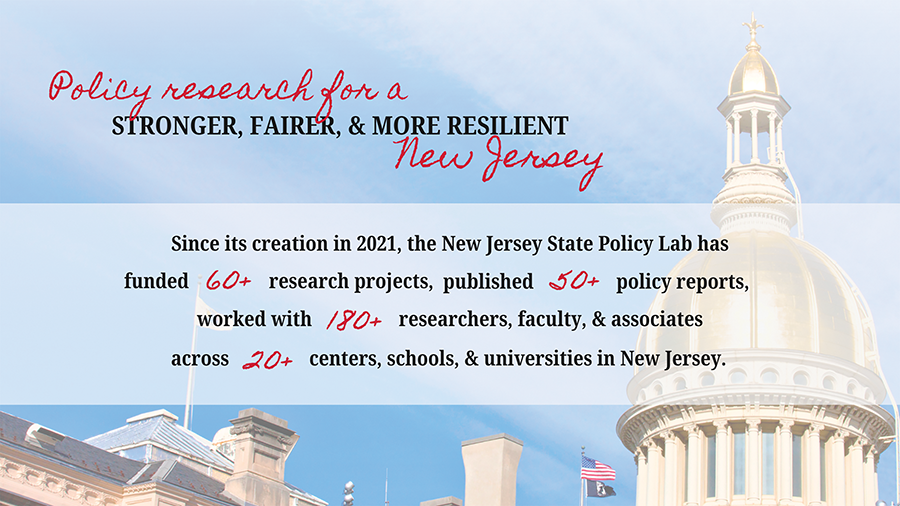
Working with more than 180 faculty members and staff, 100 students, and experts from more than 20 centers, schools, and universities across New Jersey, the New Jersey State Policy Lab has launched more than 60 research projects and published over 350 research blogs and 50 reports since 2021.
“Since our inception, the New Jersey State Policy Lab has advanced understanding on a wide range of policy domains impacting the state—from education to economics and the environment—always relying upon an equity framework,” said Dr. Elizabeth Cooner, Executive Director of the New Jersey State Policy Lab (NJSPL).
“Our overarching goal is to improve understanding of policy issues impacting the state and to amplify policy recommendations—for policymakers, the public, and other key stakeholders.”
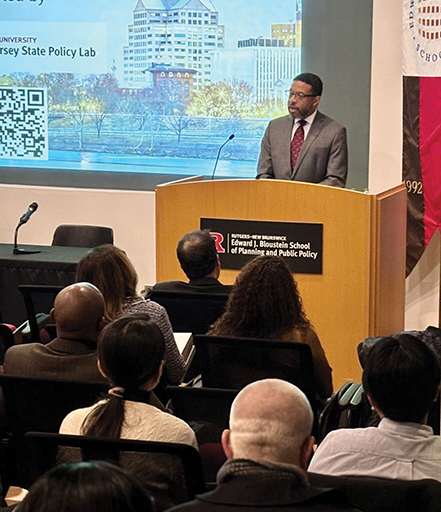
Dr. Brian Bridges, Secretary of Higher Education for the state of New Jersey, held a talk and Q&A at the Bloustein School to discuss trends in higher education’s affordability, accessibility, and attainment in New Jersey, as well as challenges confronting assorted stakeholders.
One of its key objectives has been to establish a network of scholars and research centers within New Jersey institutions of higher education to coordinate state policy research and facilitate collaboration. The NJSPL has forged connections with dozens of universities, schools, and centers within the Garden State and beyond. Its guiding mission is to identify and respond to state government and community needs for effective policy solutions through firsthand research and coordination with relevant experts across the state.
Chosen through an application process of the state’s higher education institutions, the Rutgers-based research center was launched with a $1 million grant from the Office of the Secretary of Higher Education and began its work in the spring of 2021. It is housed at the Bloustein School and managed in conjunction with the Rutgers-Newark School of Public Affairs and Administration.
“High-quality research and analysis are crucial to ensure New Jersey remains at the center of innovation,” said Brian Bridges, secretary of the Office of the Secretary of Higher Education at the time of the announcement. “This will be even more critical as our economy recovers from the pandemic, as the State Policy Lab will examine how to address long-term issues facing the state and improve the lives of New Jerseyans. I look forward to Rutgers’ leadership in this research endeavor.”
Research Insights
The NJSPL regularly solicits proposals for policy analysis from scholars throughout the Garden State, evaluating and selecting proposals for funding. The staff then works with project leaders to publish blogs throughout the research process, along with a final report of the findings. The NJSPL team then endeavors to ensure the research gets in front of policymakers at the local, municipal, and state levels to whom it might be most relevant.
In the four years since its formation, the NJSPL has published over 50 reports in a variety of important policy areas, some of which have had impacts on policy in New Jersey including:
- The Wealth Disparity Task Force, which bolstered understanding of issues surrounding criminal justice, the economy, education, health, and housing, and helped inform Governor Murphy’s FY2024 investments to increase access to homeownership, reduce medical debt, and increase access to capital.
- The Impact of Cannabis-Related Businesses on Home Sale Prices report, which has been cited in the development of municipal cannabis ordinances.
- The City of Newark launched the Newark Women Forward Initiative, citing the NJSPL and Center for Women and Work report on The Impact of Inflation on Women in New Jersey.
- Research on Youth Mental Health in New Jersey documents the challenges New Jersey youths face, and supported increased funding for the NJ Statewide Student Support Services network.
- A report on Higher Education in New Jersey: A Policy Review assesses New Jersey’s progress toward the goals laid out in the state’s higher education plan.
The New Jersey Promising Practices Project
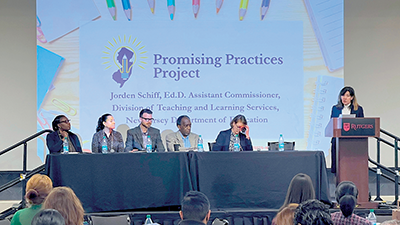
The 2025 Promising Practices Summit featured opening remarks delivered by NJDOE Assistant Commissioner Jorden Schiff and a keynote presentation from Stefanie Lachenauer, 2024-2025 New Jersey State Teacher of the Year.
The COVID-19 pandemic drastically disrupted K-12 education as school staff were faced with the unprecedented task of delivering high-quality instruction amidst a global health crisis. In New Jersey, approximately 15% of K-12 public schools managed to improve proficiency rates in math and/or English language arts (ELA) on the New Jersey Student Learning Assessment from 2018-19 (pre-pandemic) to 2021-22 (post-pandemic).
Motivated by the evident resilience of these schools, the New Jersey Department of Education commissioned the New Jersey State Policy Lab, in partnership with the Joseph C. Cornwall Center for Metropolitan Studies, to conduct the Promising Practices study, which analyzed the practices and activities that bolstered student learning and their positive effect on student performance in ELA and mathematics on the New Jersey State Learning Assessments (NJSLA). It explored how individual schools successfully served all students’ needs, with special attention paid to practices that lead to growth in historically underserved students’ academic performance.
The research team identified positive outlier schools based on the Department’s School Performance Reports, student demographic/testing data, and NCES socioeconomic files. Using statistical models that compared predicted and actual performance, the research team selected a sample of schools blindly (i.e., without school names identified) that exceeded expected student learning outcomes for all students and/or for some disaggregated groups of students (i.e., multilingual learners, students with disabilities, economically disadvantaged students, etc.).
After the quantitative analysis, the Rutgers research team focused on 52 New Jersey schools from 47 local educational agencies (LEAs ) statewide with identified positive learning outcomes when comparing pre- to post-pandemic performance in ELA and mathematics.
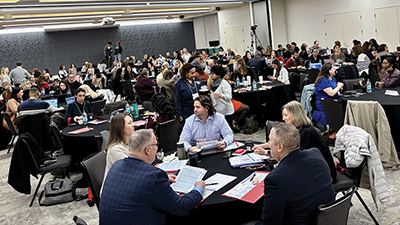
More than 200 teachers, administrators, and NJDOE staff attended this event, which was held in April 2025 at Rutgers-New Brunswick.
The Rutgers research team worked with the identified LEAs to uncover innovative, promising practices that significantly impacted students’ academic performance. The details of the research project, a full set of reports, and additional information can be found at Rutgers University’s Promising Practices Project webpage.
A one-day summit for NJ educators was held in April 2025 at Rutgers-New Brunswick. More than 200 teachers, administrators, and NJDOE staff attended this event, which featured opening remarks delivered by NJDOE Assistant Commissioner Jorden Schiff and a keynote presentation from Stefanie Lachenauer, 2024-2025 New Jersey State Teacher of the Year.
Thirteen breakout sessions, led by and for NJ educators, included insights on a range of innovative and promising educational practices. The sessions centered on peer-to-peer discussions of practical approaches to topics such as social-emotional learning, supporting historically underserved student populations, tiered instructional interventions, and utilizing data to improve educational outcomes.
Fostering Student Engagement
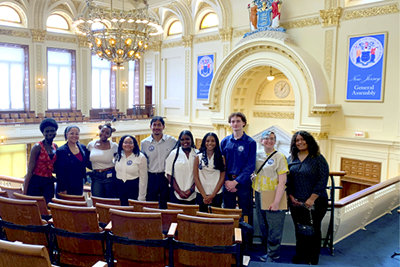
NJSPL interns are given a guided tour of the New Jersey state house in Trenton, New Jersey each summer.
The NJSPL creates opportunities for students to get involved in policy research and analysis through student work opportunities, summer internships, and more. During the academic year, the NJSPL provides opportunities for students interested in policy making and implementation to work with faculty throughout Rutgers, as well as outside the university. Students participate in ongoing research projects and coauthor blog posts and briefs on their areas of interest to begin building a professional portfolio of their work.
The summer internship program was initiated in 2022, enabling cohorts of graduate and undergraduate students to develop research skills and knowledge about the policy development process. Over the course of each ten-week program, interns research specific policy issues, meet with state and municipal legislators, and design presentations to highlight their findings.
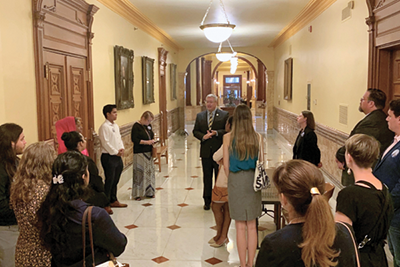
Bloustein alumnus Dan Benson MPP ‘99, Mercer County Executive and former member of the New Jersey General Assembly (14th District) is one of several state legislators who serves as host and tour guide for the prospective policymakers.
“Each week [of the internship], faculty and staff make presentations on quantitative and qualitative research methods, library research, and more, or share insights about their research interests and career transitions, normalizing assorted challenges and nonlinear career paths,” said Dr. Cooner. “Interns are paired with mentors who broaden their thinking and reinforce a growth mindset.”
The interns complete literature reviews and research blogs, ultimately presenting their research findings to an audience of policymakers, faculty, and staff. Summer research projects have included ways to bridge the technological gap among teachers in K-12 settings, how interventions based on person-centered care principles impact Black maternal well-being, strategies the state can adopt to promote equitable aging in place, and how socio-political, economic, and legal factors have influenced the evolution of the U.S. immigration system since the late 20th century.
Ciera Gaither studied food insecurity issues during her own NJSPL internship in the summer of 2023, after which she stepped into a teaching assistant role in 2024.

2024 NJSPL interns participated in a “day of service” at the Five Loaves Food Pantry in New Brunswick after collecting food donations.
Following her internship, Gaither and fellow teaching assistant Sophia Fox-Dichter initiated a “day of service” for the interns. In 2024, they set up food collection boxes at the Bloustein School. The donations were brought to the Five Loaves Food Pantry in New Brunswick, where they then spent the day volunteering, cleaning, organizing, and stocking shelves.
“The interns and the teaching assistants are terrific ambassadors for the New Jersey State Policy Lab and the university,” shared Dr. Cooner. “Whether it’s a day of service, a visit to the State House in Trenton, or during meetings with faculty, the interns are polished and well-prepared.”
One summer intern described having “a renewed sense of confidence” and feeling capable of “conquer[ing] even more academic pursuits than I had ever imagined for myself” at the end of the internship.
Another intern concluded, “The environment was much more welcoming and receptive than I expected. This is truly a perfect place to learn and grow.”
In March 2024, the NJSPL worked with the Princeton School of Public and International Affairs to launch a policy research collaboration. Graduate students from Rutgers and Princeton worked in cross-university teams to brainstorm potential managed retreat solutions to strategically address sea level rise impacting the state.
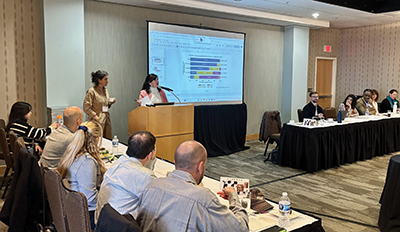
The 2025 Policy Collaboratory welcomed over four dozen graduate students from Princeton and Rutgers universities who worked together to brainstorm various solutions to address affordable housing challenges in the Garden State. Academic experts from a variety of disciplines as well as advocates, policymakers, elected officials, and others with lived experience worked with students in mixed teams to develop creative and original solutions to address these challenges.
“All of the students who participated in the Policy Hackathon crafted excellent presentations to address processes to implement managed retreat in the face of ongoing climate change,” said Bloustein School Dean and Professor of Public Policy Stuart Shapiro, who is also the principal investigator for the NJSPL.
“It provided students with an opportunity to collaborate with other policy-focused students and to contemplate potential solutions to real-world challenges.”
In spring 2025 the renamed Policy Collaboratory hosted a panel of experts discussing affordable housing issues in the Garden State. Afterward, they worked with more than 40 Rutgers and Princeton graduate students to identify opportunities to address housing needs and challenges.
Strategic Partnerships and Participation
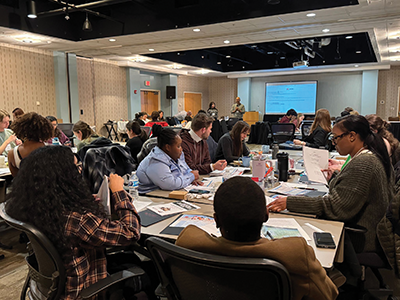
Some of the participants included Katie Brennan (Baro Strategies), Rev. Eric Dobson (Fair Share Housing), Tim Evans (New Jersey Future), Margaret Fiori, Esq (Make the Road New Jersey), Christiana Foglio (Community Investment Strategies, Inc.), Katharine Nelson (Rutgers, Center on Law, Inequality and Metropolitan Equity), Kathe Newman (Rutgers, Ralph W. Voorhees Center for Civic Engagement), Sebastián Ramirez (Princeton, Pace Center for Civic Engagement), and Eric Seymour (Rutgers Bloustein School).
A key objective in the establishment of the New Jersey State Policy Lab was to build a network of scholars and research centers within New Jersey institutions of higher education to coordinate state policy research and facilitate collaboration.
In the four years since its creation, the NJSPL has forged connections between Rutgers’ three campuses in New Brunswick, Newark, and Camden, Princeton University, New Jersey Institute of Technology, and Montclair University, as well as coordination with New Jersey state and local government including the Office of the Governor, Office of the Secretary of Higher Education, Department of Education, Department of Environmental Protection, Department of Human Services, Governor’s Office of Equity, and the Wealth Disparity Task Force.
Dr. Cooner and NJSPL researchers have annually attended the New Jersey League of Municipalities conference to meet with attendees from all across the state and discuss the important work being produced by the Policy Lab. The center also sponsors events on the New Brunswick and Newark campuses designed to assist policymakers, researchers, and students in topics such as public finance and budgeting, partnerships with practitioners, the future of public service, and strategies for securing grants for policy work.
The New Jersey State Policy Lab continues to respond to the needs of state government and communities by providing timely research and policy solutions. While the State of New Jersey continues to fund the work and research at NJSPL, support from other sources is critical. To make a gift toward the future operations and support the many graduate and undergraduate students that assist throughout the year by providing valuable public policy research, visit go.rutgers.edu/policylab.