
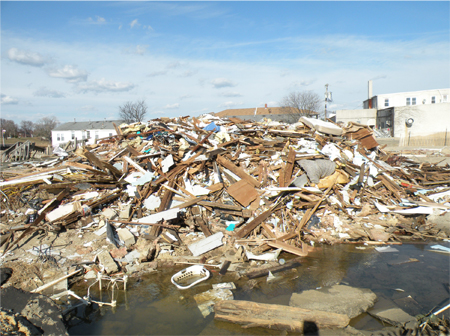
Sea Bright, NJ — January 2013. Image courtesy Carlos Rodrigues.
The small community of Sea Bright, NJ — along with many other communities throughout the Northeast United States — was devastated by Sandy. This spring Bloustein lecturers Carlos Rodrigues and Michael Yaffe will lead a graduate planning studio centered around Sea Bright, tackling the difficult questions around “rebuild,” “retreat,” and “selective retreat.”
Sea Bright happens to be one of three case studies examined by the Bloustein School’s Spring 2012 studio “Adapting to Climate Change in Coastal Monmouth County,” taught by professor Clint Andrews. The work of that studio, documented the history of catastrophic storm events affecting the study area over a period of 150 years, and described some of the more significant decisions affecting land use and infrastructure taken over the years in response to these events.
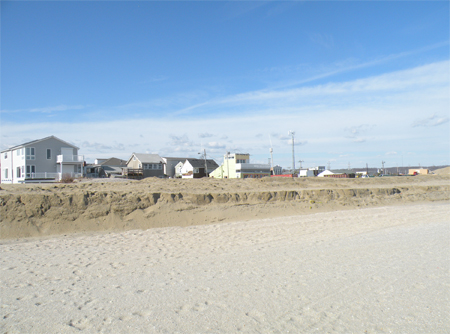 The Spring 2013 studio seeks to build on the information gathered and knowledge gained by the earlier studio and leverages it, in a post-Sandy environment, to offer Sea Bright planning advice that is sound, creative and pragmatic. That analysis will be updated using the most recent GIS data, FEMA’s recently released ABFE maps, data on actual post-Sandy damage assessments and any other relevant data sources available. The studio will seek to provide both short-term, recovery advice as well as a vision for sustainable and resilient longer term transformations.
The Atlanticville newspaper recently talked with Sea Bright mayor Dina Long about her initial meetings with the students as well as her hopes for the project.
Carlos Rodrigues, PP, AICP is a Princeton, NJ based urban designer, planner, and educator. He works with public, private, and non-profit clients on a wide range of planning, sustainability, design, research, and educational initiatives. He has worked in senior management positions in the private, public, and non-profit sectors. He is a charter member of the Congress for the New Urbanism, Past President of APA-NJ, and a board member of the Society for American City and Regional Planning History. His work has been recognized with numerous awards, including the Charter Award from the Congress for the New Urbanism. Carlos received a Masters of City and Regional Planning from the Bloustein School.
Michael P. Yaffe, GISP is a licensed Geographic Information Systems Professional. His academic background is rooted in the principles of geographic information systems (GIS), urban planning, and environmental planning and policy. He has a B.S. in Environmental Planning and Design, a Masters in City and Regional Planning from the Bloustein School, and is currently a Planner at LRK Inc. While at Rutgers, Michael has been the recipient of numerous academic, leadership, and service honors from the New Jersey Department of Environmental Protection and Rutgers University.
Related to the studio course, Professor Andrews is working with NJIT to develop an alternate Spring Break service project. Graduates and undergraduates will have the opportunity to assist with clean-up activities and determine community needs in Jersey shore communities hit hardest by Sandy.
For more information about the studio course, please contact Carlos Rodriguez or Michael Yaffe.