
by Angie Nga Le
The Annie E. Casey Foundation has released its 36th Kids Count Data Book, providing updated insights into the well-being of children in New Jersey and across the nation[1]. The report assesses child well-being in all 50 states using 16 key indicators organized into four categories: Economic Well-being, Education, Health, and Family and Community.
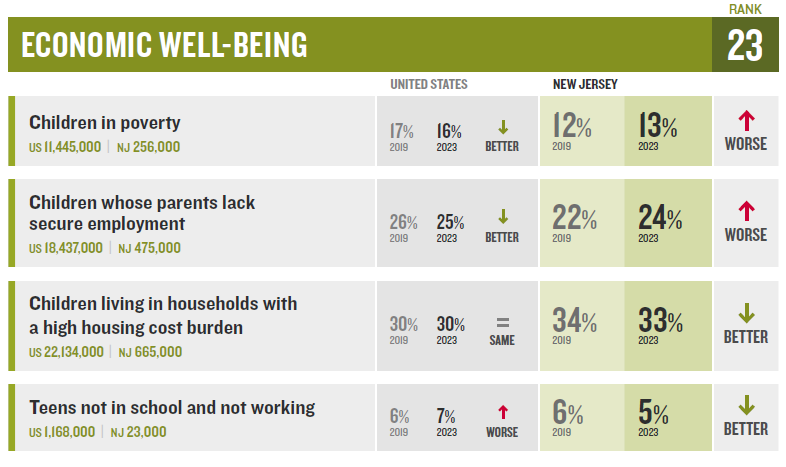
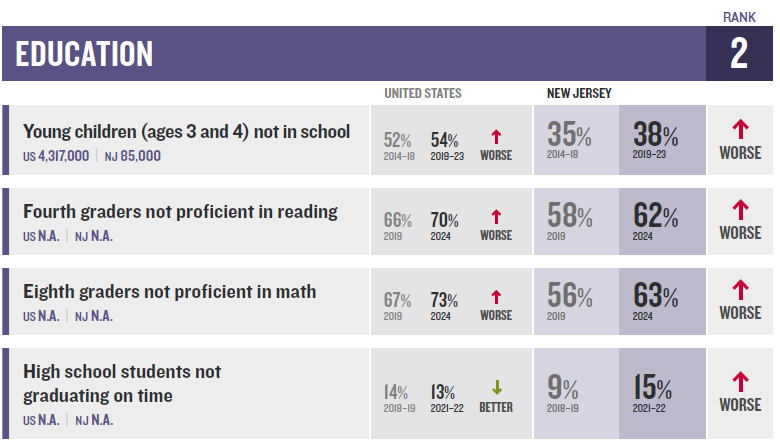
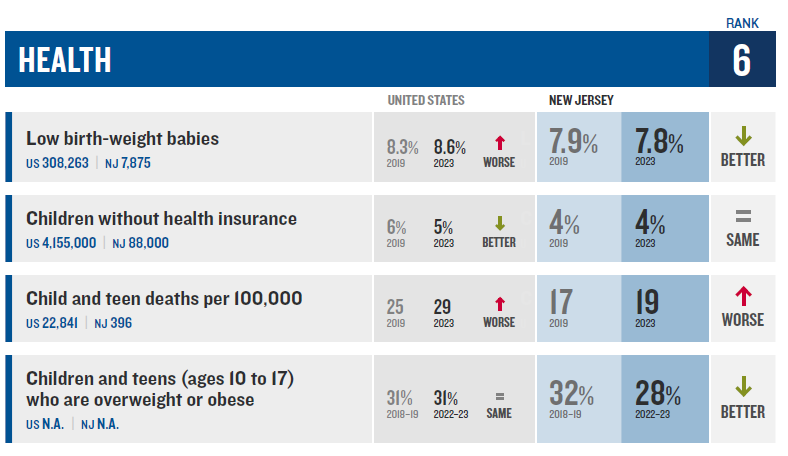
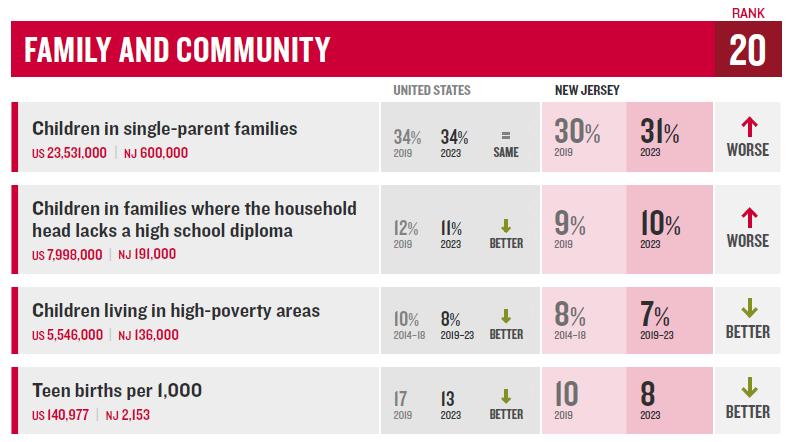
New Jersey is among the top performers in overall child well-being, placing 7th nationally. The six leading states are New Hampshire, Vermont, Massachusetts, Utah, Minnesota, and North Dakota, holding the first through sixth positions, respectively. Figure 1 presents the most recent data on child well-being in New Jersey and the nation, primarily in 2023, compared to their status before the pandemic.
New Jersey ranks near the top nationwide in Education (2nd) and Health (6th). Nearly all the state’s indicators in these areas were better than the corresponding national level. The only exception was the proportion of high school students not graduating on time, where the state performed slightly worse than the national level (15% compared to 13%, respectively).
Among the four Education indicators, preschool participation showed the most pronounced difference between the state and national figures. In 2019-2023, 38% of young children in the state were not in school, meaning that around 85,000 children aged 3 or 4 in New Jersey were not enrolled. This rate was significantly lower than the national level of 54%.
In the Health domain, the state’s child and teen death rate was substantially lower than that of the nation. In 2023, New Jersey reported 19 deaths in every 100,000 young people ages 1 to 19, compared to 29 deaths per 100,000 nationwide.
Regarding Economic Well-being and Family and Community development, the state ranked in the mid-range group, placing 23rd and 20th, respectively. New Jersey’s results were generally similar to or slightly better than the national figures, except for the percentage of children living in households with a high housing cost burden, which was somewhat worse (33% in the state versus 30% nationally).
Compared to the pre-pandemic period, child well-being in New Jersey showed improvement in six of the 16 evaluated indicators. However, these gains were modest. The most significant progress was made in the rate of children and teens who were overweight or obese, which dropped from 32% in 2018-2019 to 28% in 2022-2023.
Meanwhile, the percentage of children without health insurance remained unchanged at 4% in 2019 and 2023. For the remaining nine indicators, outcomes were less favorable than before the pandemic. Despite the high national ranking, Education was the area with the least progress in New Jersey. All four observed educational indicators showed poorer results, with the largest gap seen in math proficiency. The percentage of eighth graders not proficient in math rose from 56% in 2019 to 63% in 2024, a seven-percentage point increase.
Figure 1. Child Well-Being in New Jersey and the US
Source: The Annie E. Casey Foundation (2025). 2025 Kids Count Data Book – New Jersey’s Data Profile https://www.aecf.org/resources/2025-kids-count-data-book
References:
[1] The Annie E. Casey Foundation (2025). 2025 Kids Count Data Book. https://www.aecf.org/resources/2025-kids-count-data-book